
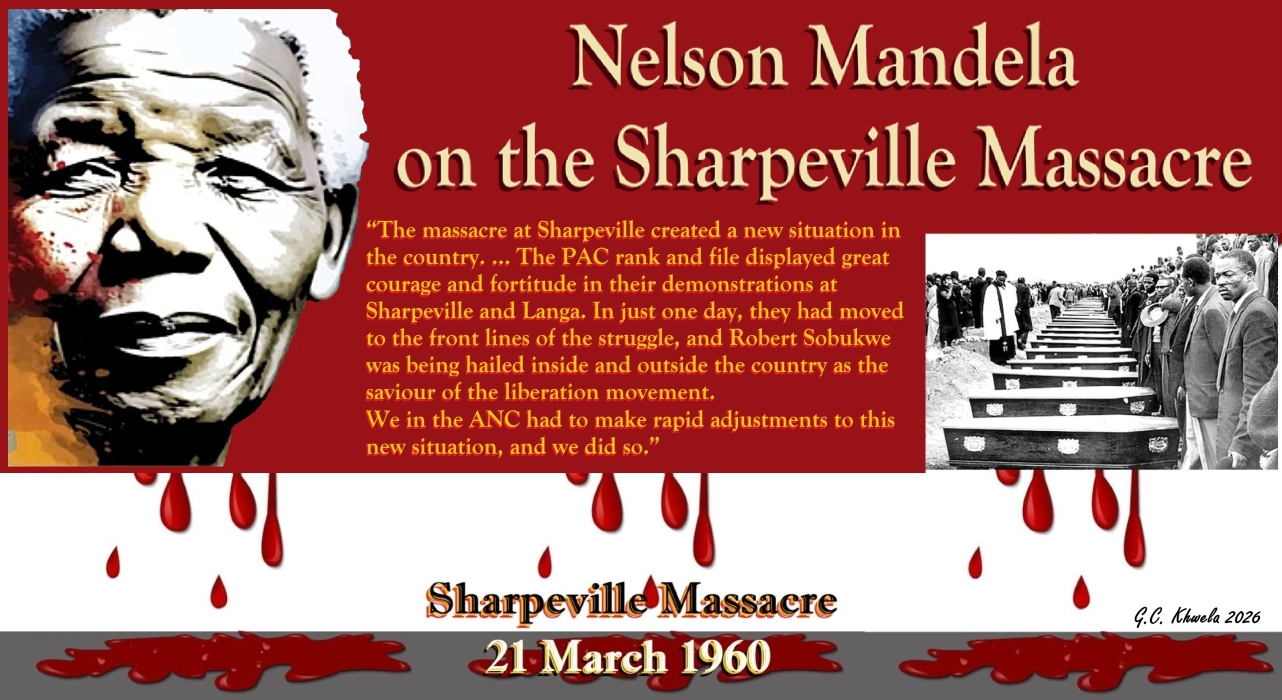
Nelson Mandela on the Sharpeville Massacre
The Sharpeville Massacre occurred 66 years ago, on 21 March 1960, outside the police station in the Vaal township of Sharpeville, in the then Transvaal. After a day of demonstrations against the pass laws, a crowd of about 7,000 protesters went to the police station. The apartheid police opened fire on the crowd, killing 69 people and injuring 180 others, including 19 children. Various sources maintain that the shooting started when the crowd started advancing toward the fence around the police station. Many were shot in the back as they fled the scene.
Nelson Mandela provided an appropriate version of the events following the Sharpeville Massacre in his autobiography, “Long Walk to Freedom”. According to Mandela, “The shooting at Sharpeville provoked national turmoil and a government crisis. Outraged protests came in from across the globe, including one of the American State Department. For the first time, the UN (United Nations) Security Council intervened in South African affairs, blaming the government for the shootings and urging it to initiate measures to bring about racial equality. The Johannesburg stock exchange plunged, and capital started to flow out of the country. South African whites began making plans to emigrate. Liberals urged Verwoerd to offer concessions to Africans. The government insisted that Sharpeville was the result of a communist conspiracy.”
“The massacre at Sharpeville”, Mandela continued “created a new situation in the country. In spite of the amateurishness and opportunism of their leaders, the PAC rank and file displayed great courage and fortitude in their demonstrations at Sharpeville and Langa. In just one day, they had moved to the front lines of the struggle, and Robert Sobukwe was being hailed inside and outside the country as the saviour of the liberation movement. We in the ANC had to make rapid adjustments to this new situation, and we did so.”
The police brutality on display during Sharpeville, as well as other innumerable acts of violence under Apartheid, are what inspired South Africa’s famously progressive Bill of Rights, in which the right to life, regardless of race, gender or age is entrenched. 21 March was also proclaimed by the United Nations as the International Day for the Elimination of Racial Discrimination in 1966, inspired by events that took place six years earlier in Sharpeville, South Africa. The day marked a turning point for the future of South Africa and the struggle for liberation, which intensified in its wake, following the banning of the liberation movements.
Sources:
Wikipedia.
South African History Online (SAHO).
Nelson Mandela, “Long Walk to Freedom”, Abacus, 1994.
Castro Khwela
Good morning fellow Compatriots!🙏🏾✊🏾👊🏾
Discover more from CASTRO KHWELA
Subscribe to get the latest posts sent to your email.


