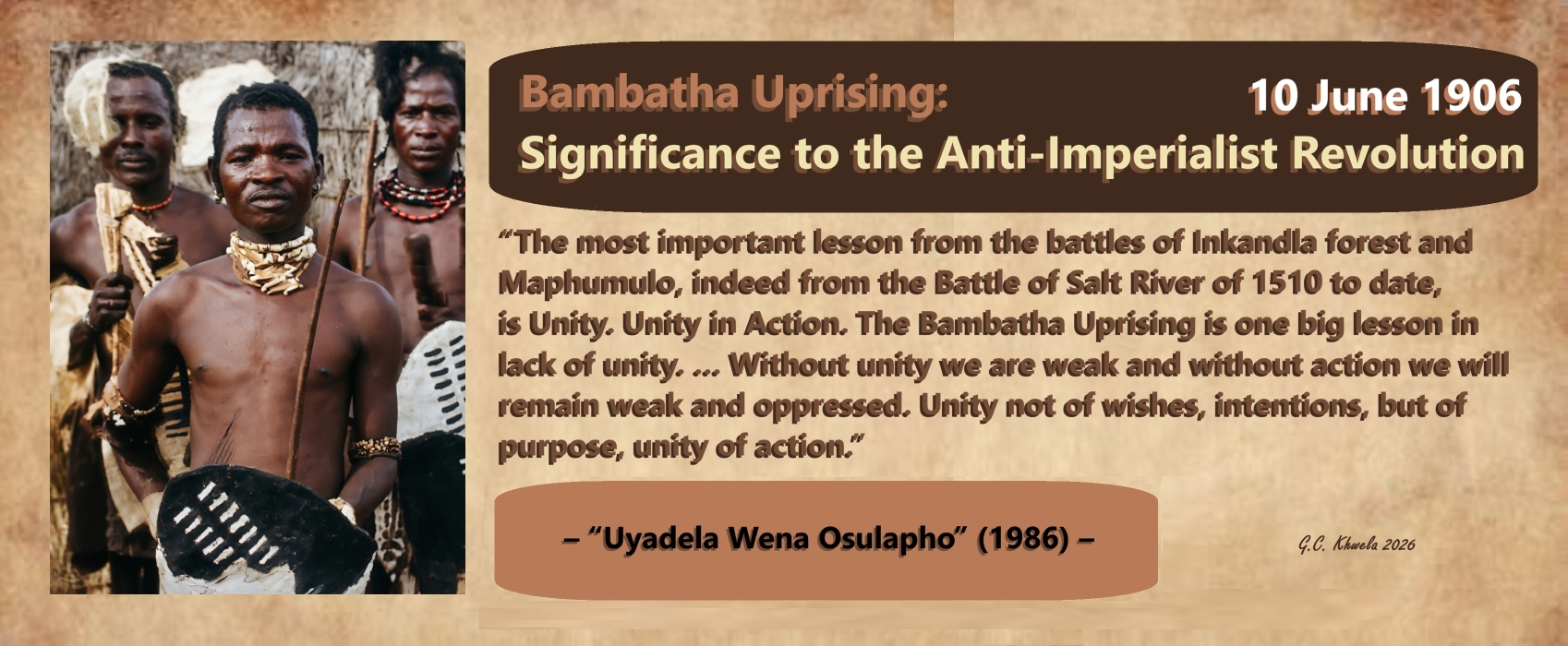
Bambatha Uprising: Significance to the Anti-Imperialist Revolution
Exactly 120 years ago, on 10 June 1906, British colonial troops under the command of Colonel Duncan Mckenzie, which consisted of a large militia that was raised from Natal, Johannesburg and the Cape, encountered the warrior forces led by Bambatha ka Mancinza Zondi along the Mome Gorge, near the Nkandla forest. In a half-hour’s engagement, Bambatha’s followers were massacred, and nearly 600 lives were shed. A body that was presumed to be Bambatha’s, was decapitated. However, other historical accounts dispute that the body actually belonged to Bambatha, since he had escaped before the battle was terminated.
Several influential chiefs, such as Ndlovu ka Thimuni, Gobizembe, Meseni, Swayimana, Mashwili and Tshingumuzi, continued resistance in the Lower Thukela River area until July 1906. For example, warrior forces under Ndlovu ka Thimuni attacked a colonial army outpost at Thring’s Post, kwaMaphumulo, killing the soldiers manning it and a Norwegian running a store there. They also ambushed a convoy of Natal’s Mounted Rifles trying to cross the Otimati River. Over the next six months, the uprising was effectively crushed, 5 000 members of the warrior forces were arrested, tried and some eventually served life sentences.
The Bambatha Uprising of 1906 was primarily caused by the imposition of a one pound (£1) poll tax (“Ukhandampondo”) on all adult males. Unlike the household “hut tax” that existed at that time, this new tax targeted individual males over the age of 18 by the colonial administration of Natal, introduced under the government of Charles Smythe. The tax was designed to force African men into the colonial labour market by creating a financial obligation that could only be paid in cash. Actually, the British colonial government needed cheap, compliant labour for agriculture, sugar plantations and the maintenance of the Durban port. However, African workers preferred the better-paying gold mines of the Witwatersrand.
The tax was an economic mechanism intended to compel local Zulu men to work for white farmers and the Durban seaport. Instead, this deeply angered the Zulu people, as it disproportionately affected young, low-earning men and strained household finances during an economic depression. The uprising was the culmination of long-term economic, social and political grievances experienced by the Zulu population. The early 1900s brought severe economic hardship to the region. A series of natural disasters – including an epidemic of East Coast fever that decimated cattle populations in 1903, locust swarms and a devastating hailstorm in 1905 – had already impoverished African families before the tax was introduced.
Following the annexation of Zululand by the Natal colony in 1887, white settler farmers continuously expanded their territory. This gradually stripped the Zulu population of their arable land and restricted their traditional, independent farming practices. The colonial administration systematically undermined the powers of traditional Zulu chiefs, replacing local governance with British colonial laws and a system of forced labour known as “isibalo”.
Tensions reached a tipping point in February 1906 when Chief Bambatha kaMancinza of the Zondi clan refused to pay the poll tax. When the colonial government deposed him and sent forces to arrest him, Bambatha and his supporters launched an armed resistance utilising the Nkandla Forest as a tactical base. Following the initial outbreak of tax resistance in early 1906, the Natal government declared martial law and appointed Colonel Duncan McKenzie to command the colonial militia.
McKenzie, a veteran of the Anglo-Boer War, implemented aggressive scorched-earth tactics specifically designed to terrorise the Natal Midlands clans, crush their economic independence and force compliance. His forces moved methodically through the Mngeni and Richmond areas, setting fire to hundreds of traditional Zulu homesteads. By deliberately destroying shelter, clothing and stored grain reserves, the colonial militia left entire families, including women and children, completely destitute in the approaching winter. This was used as a collective punishment against communities suspected of harbouring or sympathising with tax refusers.
Cattle were the central pillar of Zulu wealth, food security, and social structure. McKenzie ordered the wholesale confiscation of thousands of head of cattle and goats belonging to the Midlands clans. This massive economic asset stripping served two purposes: it instantly bankrupted the local population to prevent them from funding any prolonged resistance; and the seized livestock was often sold off to enrich white settler farmers or feed the colonial troops. To ensure that hiding warriors could not sustain themselves, McKenzie’s columns actively destroyed standing crops in the fields and looted communal granaries. Depriving the clans of their agricultural output effectively used starvation as a weapon of war, forcing starving community members to either surrender or betray the leaders of the tax refusal.
To maximise psychological terror, martial law courts were established directly in the field. Following the death of two police officers at the Trewirgie clash, McKenzie oversaw the rapid court-martial and public execution by firing squad of 12 Zulu men in Richmond, forcing local chiefs to watch. This was accompanied by thousands of public floggings with sjamboks, which was intended to humiliate traditional leaders and break the community’s morale. Clans that refused to pay the poll tax saw their legal autonomy stripped.
McKenzie’s administration deposed non-compliant chiefs, replacing them with compliant, puppet leaders appointed by the British colonial state. Anyone caught obeying a deposed chief faced immediate arrest, imprisonment or hard labour. While McKenzie’s scorched-earth campaign successfully suppressed the immediate protests in the Natal Midlands, it failed to stop the uprising. Instead of forcing complete submission, the sheer brutality of his tactics drove desperate leaders like Chief Bambatha to cross the Tugela River and launch a full-scale guerrilla war from the Nkandla Forest.
Before the climactic Battle of Mome Gorge, the early phases of the 1906 uprising saw several intense skirmishes and ambushes in the Natal Midlands, primarily around the Richmond, Greytown and Mpanza Valley regions. The fate of these initial midland clashes was marked by brief tactical successes for the warrior forces, which ultimately provoked an overwhelmingly brutal and punitive military retaliation by the colonial state.
During the Trewirgie Clash, February 1906, near Richmond, a small group of Zulu farmers actively protesting the poll tax resisted a squad of colonial court officials and police. During the scuffle, two white police officers (Sub-Inspector Hunt and Trooper Armstrong) were killed. The surviving colonial police panicked and fled back to Pietermaritzburg. However, this sparked the immediate deployment of the Natal Militia under Colonel McKenzie and the declaration of martial law. Colonial forces swept the Mngeni area, burning down local homesteads and seizing thousands of head of cattle. Twelve of the suspected protesters were quickly captured, court-martialled, and executed by firing squad in Richmond, despite strong protests from the British government in London.
The Mpanza Valley Ambush, in the Greytown Area, on 4 April 1906, occurred after Chief Bambatha refused the tax and was officially deposed. He fled briefly to the Zulu Kingdom before returning to kidnap his colonial-appointed replacement. When a contingent of the Natal Police rode into the Mpanza Valley near Greytown to apprehend him, Bambatha’s warriors, under the command of Chakijana kaGezindaba, launched a surprise night ambush at what became known as Ambush Rock. The ambush was a temporary victory for Bambatha. Four colonial policemen were killed and several others wounded. Bambatha’s forces successfully drove the police back, securing an early morale boost. This clash officially transformed local, scattered tax resistance into an organised, armed guerrilla revolt.
Knowing that the full might of the colonial military would descend on the Natal Midlands after the Mpanza ambush, Bambatha realised his forces could not hold the open terrain against modern artillery and Maxim machine guns. He and his followers abandoned the Natal Midlands entirely, crossing the Tugela River into Zululand to seek sanctuary in the rugged, dense terrain of the Nkandla Forest. This tactical retreat effectively ended the Midlands phase of the war and shifted the conflict toward the Nkandla operations, setting the stage for the disastrous encirclement at Mome Gorge.
At Mome Gorge, Inkosi Sigananda kaZokufa Shezi, the elderly leader of the amaChube clan, the Veteran Military Strategist, provided critical military refuge, veteran leadership, and tactical advantage to the revolt. Sigananda’s territory encompassed the dense, mountainous Nkandla Forest. When Bambatha’s forces fled colonial pursuit, Sigananda defied the British administration by welcoming Bambatha and providing a highly defensible base of operations. In May 1906, Inkosi Mehlokazulu and his Qungebe clan also joined the warrior forces.
Sigananda was nearly 100 years old and had served as a warrior under King Shaka, King Dingane, and King Cetshwayo. His endorsement of Bambatha bridged generations of Zulu resistance and inspired hundreds of young warriors to join the fight. Sigananda formally combined his clan’s forces with Bambatha’s warriors, making the Nkandla Forest the epicentre of the guerrilla campaign against the heavily armed colonial troops. Following the decisive and brutal British ambush at the Mome Gorge in June 1906, Sigananda’s forces were scattered. He surrendered to colonial forces shortly after the battle and died in captivity in July 1906 while awaiting court-martial.
What is also important to note is the role of King Dinuzulu kaCetshwayo in the uprising. King Dinuzulu held immense symbolic authority but maintained a cautious, ambiguous public position during the uprising to protect the Zulu monarchy from complete destruction. Chief Bambatha secretly visited Dinuzulu at his Osuthu homestead before the engagement with the colonial forces. Dinuzulu allegedly offered Bambatha a safe haven for his wife and children and gave him a modern rifle and a ritual doctor.
Bambatha used King Dinuzulu’s name to rally and unite fractured Zulu clans. He claimed he was fighting on direct orders from the King, which gave the uprising a powerful sense of royal legitimacy. Externally, Dinuzulu publicly distanced himself from the armed revolt. He paid his own taxes and offered colonial authorities a small contingent of loyal levies to prove his allegiance and protect his people from immediate colonial retribution. Despite his public neutrality, British colonial authorities distrusted him deeply. Subsequently, in 1907, Dinuzulu was arrested and charged with high treason for harbouring rebels. He was convicted in 1909 and exiled to the Transvaal, where he died in 1913.
The Bambatha Uprising of 1906 is widely recognised by historians as a critical turning point in Southern African history. It marked the end of traditional, armed resistance led by tribal chiefs and catalysed the birth of modern, unified national liberation movements against colonial and imperial rule. Its significance to the broader anti-colonial and anti-imperialist revolution can be broken down into several profound shifts.
For centuries, African resistance to European imperialism was fought along fragmented tribal and clan lines (such as individual Zulu, Xhosa, Sotho, Pedi, Swazi, Venda or Tsonga wars). The overwhelming brutality of the colonial response to Bambatha – where modern Maxim machine guns and artillery slaughtered warriors carrying traditional spears and outdated rifles – proved that isolated, tribal-based military resistance was no longer viable against industrialised imperial powers. The defeat of the uprising directly accelerated the understanding that Africans needed a unified, non-tribal political front to fight British imperialism.
Early black intellectuals and leaders like Pixley ka Isaka Seme, John Langalibalele Dube (who founded the Ilanga lase Natal newspaper during the uprising), and Sol Plaatje witnessed the devastating consequences of the uprising. They realised that if the British and Boer settlers could unite to form the Union of South Africa in 1910, African people had to look past tribal divisions. This directly led to the formation of the South African Native National Congress (SANNC) in 1912 – which was later renamed the African National Congress (ANC).
The uprising forced a massive tactical evolution in the anti-colonial struggle. Armed warfare was temporarily abandoned in favour of political organising, labour strikes, constitutional petitions and international lobbying. The struggle shifted from the battlefield to the courts, the press, and political forums, laying the groundwork for the 20th-century liberation struggle. The uprising resonated far beyond the borders of Natal, capturing the attention of the global African diaspora and early Pan-African thinkers.
During the uprising, Mahatma Gandhi volunteered as a stretcher-bearer for the Indian Stretcher Bearer Corps on the colonial side. Witnessing the horrific, unprovoked violence inflicted by British forces on the Zulu population deeply traumatised Gandhi. It heavily influenced his political awakening, hardening his resolve against British imperialism and solidifying his philosophy of “Satyagraha” (non-violent resistance). The uprising was reported in international black-owned newspapers in the United States and the Caribbean, framing the Zulu struggle as part of a global, interconnected fight against white supremacy and European imperialism.
Decades later, when the liberation movement eventually returned to armed struggle in the 1960s (with the formation of the ANC’s Umkhonto we Sizwe and the Pan Africanist Congress’s Azanian People’s Liberation Army (APLA), the Bambatha Uprising was invoked as a powerful symbol of revolutionary courage. Bambatha was elevated from a local Zulu chief to a national hero of anti-imperialism, symbolising unbroken African defiance against colonial subjugation.
This year marks the 120th anniversary of the four months starting with April 1906, which have come to be known as the Bambatha Uprising. Accordingly, this anniversary is an appropriate tribute to the fighters, those courageous warriors of 1906, and at the same time a reminder that that anti-imperialist struggle is continuing. Judging by the magnitude and ferocity of the liberation struggle, it is clear that the main lesson of the battles of INkandla forest and Maphumulo were learned well by the revolutionary forces. We must be honouring the Bambathas, Chakijanas, Mtheles, Mehlokazulus, Siganandas, Gobizembes and other heroes of 1906 and before then, indeed up till today.
The second most significant lesson to learn from the warriors is bravery. The sheer size of the might they were taking on with their spears and a few rifles is something to be proud of. It’s not just an inspiration; it’s a warning too to our enemies. They took it from Makhanda, Shaka, Sekhukhune, Hintsa, and Mzilikazi. We need to take this standard of bravery to an even higher level. We must part ways with excuses, however profound and refined they are, and expel fear from our hearts.
The most important lesson from the battles of Nkandla forest and Maphumulo, indeed from the Battle of Salt River of 1510 to date, is Unity. Unity in Action. The Bambatha Uprising is one big lesson in lack of unity. It is obvious that had all the battles in Inkandla been planned from the same place consciously, the colonial forces would not have had it as easy as they did. That is why we no must protect the unity of the African people, and all the democratic forces like the apple of our eyes. Without unity we are weak and without action we will remain weak and oppressed. Unity not of wishes, intentions, but of purpose, unity of action.
THE WARRIOR CRY: “UYADELA WENA OSULAPHO!”
Sources:
Wikipedia.
South African History Online (SAHO).
Sello Moeti, “Uyadela Wena Osulapho”, Sechaba, April 1986.
K.G. Gillings, “The Bambata Rebellion of 1906: Nkandla Operations and the Battle of Mome Gorge, 10 June 1906”, Military History Journal, Vol. 8, No. 1, June 1989.
Hamish Paterson, “The Natal Rebellion: 1906 Some Military Perspectives”, Military History Journal, Vol. 13, No. 5, June 2006.
P.S. Thompson, “Dinizulu and Bhambatha, 1906: An Invasion of Natal and An Uprising in Zululand That Almost Took Place”, Historia, Vol. 58, No. 2, January 2013.
M. Nkomonde, “The Bambatha Rebellion”, Dawn – Journal of Umkhonto we Sizwe, Vol. 10, No. 4, April 1986.
Castro Khwela
Good evening fellow Compatriots!🙏🏾✊🏾👊🏾
Discover more from CASTRO KHWELA
Subscribe to get the latest posts sent to your email.