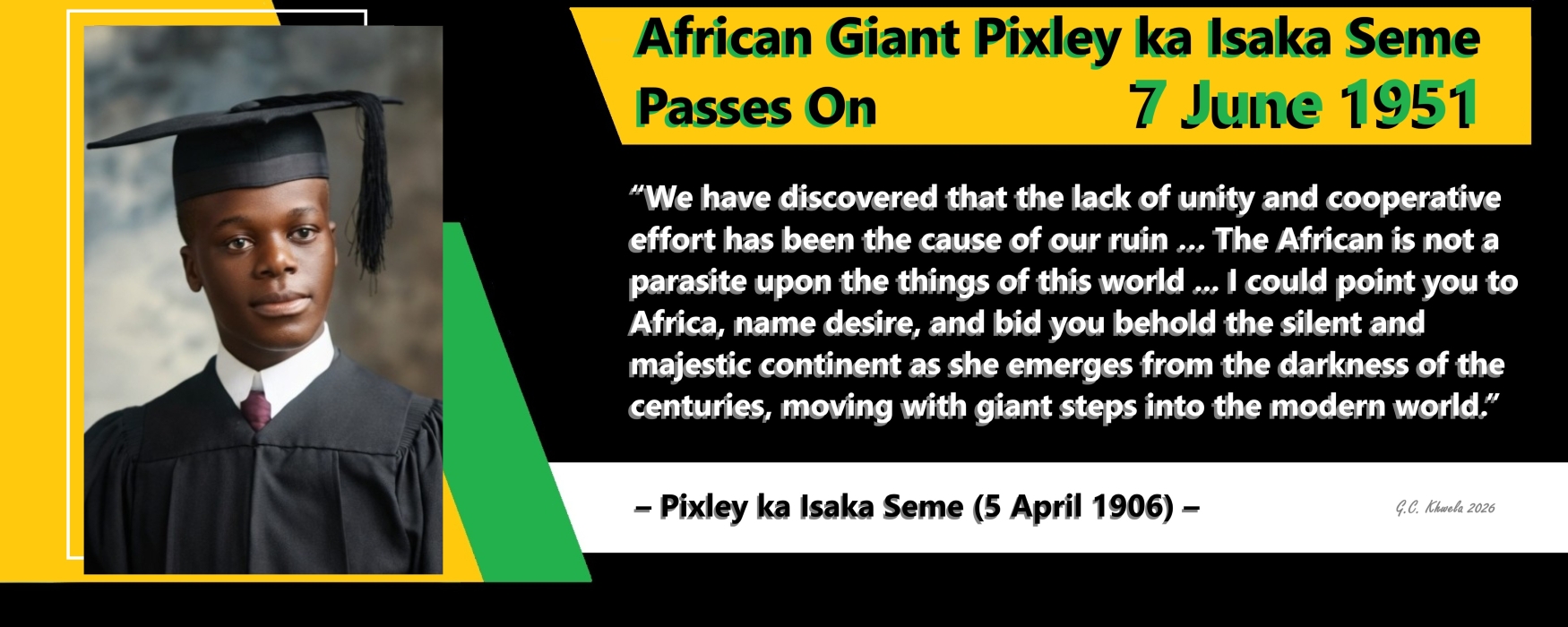
African Giant Pixley ka Isaka Seme Passes On
Seventy-five years ago, on 7 June 1951, a colossal figure in the anti-colonial struggle and founder of the African National Congress (ANC), died of natural, age-related causes in Johannesburg, at the age of 69. His later years were marked by significant personal hardships, including severe financial difficulties and the curtailment of his legal career. Contemporary historical accounts point to a quiet death amid these ongoing struggles rather than a specific documented illness.
Pixley ka Isaka Seme was born on 1 October 1881 at the Inanda Mission Station near Durban, in what was then the British Colony of Natal (now KwaZulu-Natal). He was born just two years after the British defeated the Zulu Kingdom in the Anglo-Zulu War of 1879. His family lived in a fractured, post-defeat society under British colonial rule. His parents, Isaka Seme and Sarah Mseleku, were prominent, devout members of the American Board Zulu Mission. This meant he grew up in a Christian household strongly influenced by Western education, literacy and religious discipline.
His birthplace was a hub for the American Board of Commissioners for Foreign Missions. An American Congregationalist missionary, Reverend S.C. Pixley, took a personal interest in him and provided the financial and moral backing that shaped his primary education and later sponsored his travel to the United States for university studies. Seme was likely named “Pixley” after Reverend Pixley. Although his immediate household was under missionary influence, Seme maintained deep traditional roots, as he later claimed a lineage connected to Zulu royalty, asserting he was a nephew of the prominent Chief Mqhawe of the amaQadi.
Seme began his schooling at the local Congregationalist mission school in his birthplace of Inanda, just north of Durban. At the age of 14, he moved to the Adams Training School for Boys (later known as Adams College) located in Amanzimtoti, south of Durban. This was an advanced institution also run by the American Zulu Mission. In 1898, at the age of 16 or 17, Seme travelled to Massachusetts, in the United States, under the sponsorship of missionaries. He attended high school at Mount Hermon School (now Northfield Mount Hermon School), where he received a rigorous classical education and graduated in 1902.
Seme’s time in America was a deeply transformative period where he evolved from a rural mission schoolboy into a highly articulate, globally minded intellectual. His stellar academic performance, intense work ethic, and mastery of a classical high school education caught the attention of his benefactors. Expressing a desire to be in the centre of things, Seme chose to move to New York City, viewing it as the focal point of modern American life. This ambition, coupled with financial networking from American clergymen, allowed him to secure admission into Columbia University in the autumn of 1902.
Upon enrolling, he changed his name from “Pixley Seme” to “Pixley ka Isaka Seme” (meaning “son of Isaka”) to explicitly assert his African identity. His transition from secondary school to Colombia University laid the foundational ideology for what would eventually become the African National Congress (ANC). Since Columbia did not have dormitories at the time, Seme lived in Harlem on West 134th and West 135th Streets. This placed him directly in the epicentre of an emerging African-American cultural and political consciousness. Seme enrolled in a Bachelor of Arts (BA) programme, focusing heavily on history, political science and anthropology. He explicitly chose these subjects to find scientific, rigorous counterarguments against the colonial and racial prejudices dominating South Africa and Western society.
During this time, he became fascinated by African-American strategies for advancement. He deeply admired Booker T. Washington’s vocational programmes, eventually visiting the Tuskegee Institute in Alabama and corresponding directly with Washington. He was highly active in the university’s debating society, where he honed the sharp oratorical skills that would later define his political career. On 5 April 1906, during his senior year, Seme achieved international historical prominence. He entered Columbia University’s annual public speaking contest and delivered a sweeping, poetic speech titled “The Regeneration of Africa”.
In the speech, Seme fiercely rejected European colonial narratives that painted Africa as a “dark continent” devoid of history. Instead, he famously declared: “The African is not a parasite upon the things of this world… I could point you to Africa, name desire, and bid you behold the silent and majestic continent as she emerges from the darkness of the centuries, moving with giant steps into the modern world.”
The address was a masterpiece of early Pan-African thought and won him the George William Curtis Medal – Columbia’s highest honor for oratory – and was widely publicised, even receiving coverage in the New York Times newspaper. He graduated with his BA degree later that month as the first Black South African to graduate from Columbia University, using this monumental American success as a springboard to read law at the University of Oxford.
His legal training in the United Kingdom was a demanding and highly strategic period of his life. Spanning from 1906 to 1910, it solidified his academic credentials, equipped him with a profound mastery of British law, and introduced him to the critical political networks that would help him shape South Africa’s history.
Seme enrolled to read for the Bachelor of Civil Law (BCL). This postgraduate qualification focused heavily on Roman-Dutch law, English common law, and international legal principles. This specific training was essential because Roman-Dutch law formed the bedrock of the legal system in South Africa. Despite the immense pressure of being one of the very few Black students in an environment historically dominated by European scholars, he persevered. In June 1909, he successfully obtained his degree. In doing so, he became the first Black South African individual to graduate from Oxford University, joining other Africans such as Christian Frederick Cole and Joseph Renner Maxwell, both from Sierra Leone.
While still studying at Oxford, Seme knew that an academic degree alone would not allow him to practice in court. He needed professional qualification as a barrister. On 12 February 1907, he was formally admitted to the Middle Temple, one of London’s prestigious Inns of Court. He split his time between his Oxford studies and preparing for the rigorous English bar examinations, passing his initial bar exams in June 1909. On 8 June 1910, Seme reached the apex of his legal training when he was officially Called to the Bar at the Middle Temple. This qualification officially made him an English barrister, legally permitted to argue cases in higher courts.
Seme’s time in the United Kingdom was not spent solely in libraries. London was the political heart of the British Empire, and his stay coincided with a massive turning point for South Africa. While Seme was finishing his studies, white political leaders from South Africa travelled to London to shepherd the South Africa Act through the British Parliament. This act, which officially came to force on 31 May 1910, sought to unify the British colonies and Boer republics into the Union of South Africa – while completely disenfranchising and excluding the Black majority. Seme deeply engaged with members of the African delegation from the South African Native Convention who had also travelled to London to protest this unjust legislation.
During these meetings, he connected with other foreign-educated Black South African lawyers and intellectuals, such as Alfred Mangena, D.D.T. Jabavu and Richard Msimang, among others. Seeing the British government ignore Black interests and pass the Act convinced Seme that fragmented, regional resistance was useless. He realised that Africans needed a singular, unified, national political body to fight back. Armed with an Ivy League BA, an Oxford law degree, and a British barrister qualification, Seme returned to South Africa later in 1910. He was uniquely equipped with the exact legal tools used by the colonisers, which he intended to turn against them.
Upon returning to South Africa in late 1910, Pixley ka Isaka Seme immediately set out to weaponise his elite education. He chose Johannesburg as his base, which was the rapidly growing economic heart of the country and a hotspot for racial exploitation. In 1911, Seme established a partnership with Alfred Mangena, another brilliant, foreign-educated pioneer who had become the very first Black barrister admitted to the Supreme Court of South Africa. Together, they opened the firm Seme & Mangena office. They set up their offices in the central business district of Johannesburg, operating out of Corner House and later Fox Street.
Operating a Black-owned law firm in early 20th-century Johannesburg was an act of political defiance. The firm faced immense hurdles as white magistrates, judges and colonial officials routinely tried to humiliate and undermine them in court, viewing educated Black lawyers as a threat to white supremacy. The firm’s offices were constantly busy helping clients navigate the restrictive pass laws, urban segregation and unfair labour practices used to exploit Black workers on the gold mines. Seme utilised his deep understanding of Roman-Dutch and British property law to help African syndicates, communities, and chiefs purchase and secure land titles before the catastrophic Natives Land Act of 1913 banned such purchases entirely.
The law firm was more than just a business; it was a sanctuary and a political laboratory for the brewing African nationalism and unity. Because Seme and Mangena were among the few people who understood the inner workings of the British legal system, African chiefs, workers and activists from all over southern Africa flocked to their Johannesburg office for advice. It was precisely during these consultations at the firm that Seme realised how fragmented African resistance was. This realisation prompted him to use his office networks to draft the historic “Call-To-Action” that brought together chiefs, royals, and intellectuals to launch the South African Native National Congress (later renamed the ANC) in January 1912.
Seme was the primary architect, convener, and driving force behind the historic founding meeting on 8 January 1912 in Bloemfontein, where the South African Native National Congress (SANNC – later renamed the ANC) was launched. In late 1911, Seme used his Johannesburg law office to write and distribute a powerful manifesto to African leaders, traditional chiefs and intellectuals across southern Africa. He famously declared that the greatest demon facing Africans was division, stating: “We have discovered that the lack of unity and cooperative effort has been the cause of our ruin”. He called for a national convention to bury tribal differences and form a unified front against colonial oppression.
“The African already recognizes his anomalous position and desires a change. The brighter day is rising upon Africa. Already I seem to see her chains dissolved, her desert plains red with harvest, her Abyssinia and her Zululand the seats of science and of religion, reflecting the glory of the rising sun from the spires of their churches and universities. Her Congo and her Gambia whitened with commerce, her crowded cities sending forth the hum of business, and all her sons employed in advancing the victories of peace – greater and more abiding than the spoils of war.”
When delegates gathered at the Wesleyan Church schoolroom in Waaihoek, Bloemfontein, Seme delivered the opening keynote address. He stood before a diverse crowd of traditional kings, chiefs, church ministers, and educated professionals, using his elite oratorical skills to unite them. He urged the delegates to forget past tribal conflicts and to view themselves as one collective African nation. Seme did not just provide inspiration; he designed the actual framework of the new organisation. He deliberately structured the Congress with a two-house parliament to respect both modern intellectuals and traditional leaders:
The Upper House: Consisted of traditional chiefs and royalty (including representatives from modern-day South Africa, Lesotho, Botswana, and Eswatini), ensuring they held a prestigious place in the movement.
The Lower House: Consisted of elected representatives, professionals and commoners who managed day-to-day political tasks.
Despite being the mastermind behind the conference, Seme showed immense political maturity by refusing to run for the presidency himself. At just 30 years old, he knew that traditional chiefs and older delegates might not rally behind a young, Westernised lawyer. Instead, Seme nominated John Langalibalele Dube, an older, widely respected educator and minister, to be the first President. Seme accepted the role of Treasurer-General, ensuring he could manage the finances and organisational growth from behind the scenes.
From the launch of the movement in 1912 until his death in 1951, Pixley ka Isaka Seme’s role in the political development of the ANC transformed from him from a revolutionary architect to a controversial President, and finally to a revered, elder statesman. While his early vision built the foundation of the movement, his later leadership nearly destroyed it. His political involvement across these four decades unfolded through distinct phases.
Immediately following the founding meeting, Seme recognised that the infant organisation required communication and economic independence to survive. In 1912, Seme secured funding from the Queen Regent Labotsibeni Mdluli of Swaziland, also widely revered by her praise name Gwamile (meaning “the indomitable one”) to launch Abantu-Batho, as the ANC’s official multilingual newspaper. It became the most influential Black newspaper in South Africa, printing in English, Zulu, Xhosa, Sotho and Tswana to continuously unite the regions. In 1911, he established the South African Native Farmers Association, which he used to buy up farms from white owners and distribute them to Black families to secure land tenure before the devastating 1913 Natives Land Act banned Black property ownership.
In April 1930, Seme was elected President-General of the ANC, ousting Josiah Gumede. His presidency was viewed by historians as the most contentious period of his life. He took power specifically to purge left-wing, communist influences introduced by his predecessor. He wanted to steer the ANC back to its moderate, middle-class roots. Facing internal regional factions, Seme attempted to centralise absolute power by rewriting the constitution to allow him to dismiss executive members. His leadership style was criticised as highly authoritarian yet politically inactive – a period contemporary critics labelled as one of “culpable inertia”.
By focusing heavily on economic self-help rather than actively mobilising protests against segregation laws, the ANC’s national structures practically collapsed. His beloved Abantu-Batho newspaper folded due to declining popularity, and Seme was voted out of the presidency in 1937, replaced by Reverend Z.R. Mahabane. Despite the bitter ending to his presidency, Seme did not abandon the movement. In the 1940s, a new president, Dr A.B. Xuma, began rebuilding the ANC and brought the older generation back into the fold to stabilise the party. Seme served in Xuma’s National Executive Committee as the “Secretary for Chiefs”, utilising his deep, lifelong personal relationships with the Zulu and Swazi royal houses to keep traditional leaders aligned with the ANC.
In 1943, Seme helped co-author the landmark African Claims in South Africa document. This text mapped out a Bill of Rights demanding full political franchise and equal rights, serving as a critical precursor to the ANC’s later Freedom Charter. In his final active years, Seme acted as a bridge to the radical new generation. When young radicals like Anton Lembede, A.P. Mda, Nelson Mandela, Oliver Tambo and Walter Sisulu formed the ANC Youth League (ANCYL) in 1944, Lembede sought out Seme as a mentor to the emerging youth formation. Seme’s early 1906 philosophy of “The Regeneration of Africa” heavily inspired Lembede’s formulation of “African Nationalism”, which directly drove the Youth League. By the time Seme passed away in Johannesburg on 7 June 1951, he was personally broke, but his status as the foundational “Father of the ANC” had been firmly restored.
“We have discovered that the lack of unity and cooperative effort has been the cause of our ruin” – Pixley ka Isaka Seme.
Sources:
Wikipedia.
South African History Online (SAHO).
David Saetang, “Pixley Ka Isaka Seme”, Pitzer College, 11 January 2016.
Bongani Ngqulunga, “The Man Who Founded the ANC: A Biography of Pixley ka Isaka Seme”, Penguin, 2017.
Maru Attwood, “King Mswati Should Take Note of His Great-Grandmother’s Support of a Free Press”, Daily Maverick, 21 July 2022.
Castro Khwela
Good day fellow Compatriots!🙏🏾✊🏾👊🏾
Discover more from CASTRO KHWELA
Subscribe to get the latest posts sent to your email.