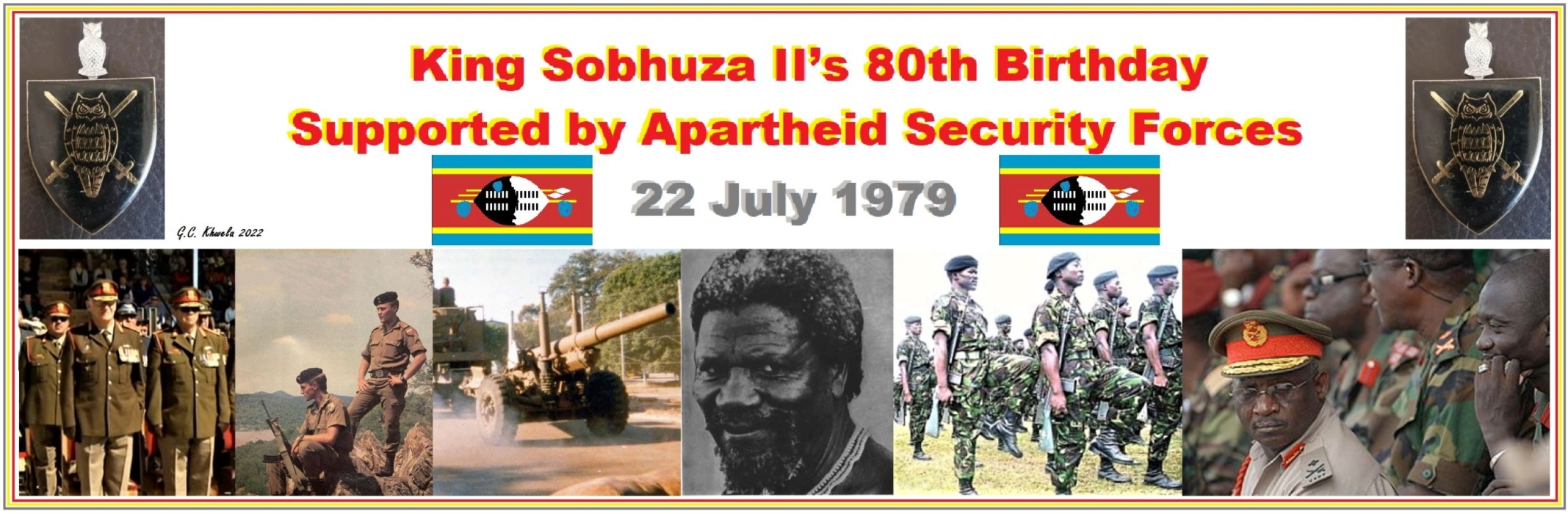
King Sobhuza II’s 80th Birthday Supported by Apartheid Security Forces
On 22 July 1979, Prime Minister Maphevu Dlamini thanked the apartheid South African Military Training Team for the success of the twenty-one-gun salute following King Sobhuza’s 80th birthday celebrations on that day. This was a cualmination of a secret meeting held on 8 June 1979, between Dlamini and several apartheid South African Military Intelligence officers, wherein the concept of a “common enemy” was discussed. The “common enemy”, in this instance, referred to anti-apartheid liberation movements – primarily the African National Congress (ANC) and its armed wing, Umkhonto we Sizwe (MK)
Lieutenant Colonel Dube, who was the second in command in the Royal Swazi Defence Force (RSDF), jokingly asked Major T.J. Vermaak, the leader of the Military Training Team to transfer to the Swazi Army to ensure that unity between the two forces was strengthened. Meanwhile a Swazi civilian official who was present at the celebrations expressed his concerns that cooperation between Swaziland and South Africa was going well within the military sphere, whereas it was not emulated in other domains.
The involvement of the apartheid South African Military Training Team in Sobhuza’s birthday celebrations followed a meeting between Prime Minister Maphevu Dlamini, who was also a Major in the RSDF, and Brigadier P.J. Schalkwyk, Commandant C.J. van Niekerk and Major Ian R. Gleeson of the apartheid South African Defence Force (SADF) in Swaziland on 5 July 1979.
During the 5 July meeting, Dlamini repeated his request about cooperation regarding the Swazi Army’s problems in acquiring weapons, equipment and training, as well as the need for standardisation in the spheres of logistics and transport. He emphasised that the challenges faced by the RSDF would be eliminated by joint procedures with the apartheid SADF.
It was at this meeting that the request for cannons and ammunition for firing a twenty-one-gun salute on King Sobhuza’s eightieth birthday celebrations was made, since the request for help from Britain was not anticipated to arrive in time. Major Gleeson then agreed to offer an 88-mm field cannon, as well as an instructor to train RSDF personnel beforehand, so that they could make the shots themselves.
The July 5 meeting was actually a successor to a secret meeting held on 8 June 1979, between Dlamini and several apartheid South African Military Intelligence officers, wherein the concept of a “common enemy” was discussed. According to Dlamini, this enemy posed a genuine threat that needed to be countered with urgency, and the only effective solution lay on close cooperation between the two countries. As far as he was concerned, he would not allow Swaziland to be locked in the same stranglehold as Kenneth Kaunda of Zambia.
He welcomed the prospect of an exchange of information and continuous co-operation between the apartheid SADF and the RSDF in order to analyse and confront the “common” threat. In his view, he subscribed to the notion that in order to cooperate effectively, the two militaries had to standardise equipment and procedures, as well as undergo a degree of joint training. The areas of co-operation that Swaziland was interested in included leadership, mine laying and agent handling. Dlamini also raised the possibility of the Kingdom of Swaziland purchasing arms from South Africa, since it was experiencing problems sourcing supplies from Britain.
In the secret meeting on 8 June 1979, Prime Minister Dlamini and apartheid South African Military Intelligence officers focused on establishing a formal, covert security alliance to eliminate liberation movements operating within and across Swaziland’s borders. The defining terms and details of this discussion included the two regimes explicitly agreeing that the “common enemy” referred to anti-apartheid liberation movements, particularly the ANC and its armed wing, Umkhonto we Sizwe (MK). The definition was extended to target internal progressive activists within Swaziland who opposed the Swazi absolute monarchy or sympathised with the South African liberation struggle.
The meeting provided a “clear mandate” for both security forces to work together to hunt down and assassinate these individuals. They established framework agreements for South African intelligence operatives to receive local police cooperation, track political exiles, and conduct cross-border surveillance. The discussions laid the groundwork for deploying undercover agents and turned operatives to spy on, kidnap, and disrupt underground resistance networks.
According to documented historical records of Apartheid Covert Collaboration, “…let the two political allies, Swazi regime and Pretoria regime work together to get rid of the common enemy (the liberation movements and the internal progressive activist) This gives a clear mandate to both security forces to work together to hunt down members of the liberation movements and kill them.”
The quote highlighted a dark turning point where the Swazi monarchy and the apartheid government formalised a secret pact to use state-sanctioned violence against political dissidents. It meant that Swaziland’s official policy of neutrality was a front, and behind closed doors, they had greenlit cross-border assassinations. The quote breaks down into several critical meanings. The phrase “clear mandate… to hunt down… and kill them” meant that South African death squads (like the notorious Vlakplaas unit) were given explicit, top-level permission to operate inside Swaziland. The Swazi regime agreed to look the other way – or actively assist – when South African agents kidnapped, bombed, or assassinated ANC members on Swazi soil.
By including “internal progressive activists” alongside liberation movements, the Swazi regime used South Africa’s military might to protect its own absolute monarchy. Anyone in Swaziland advocating for democracy or labour rights was lumped into the same lethal category as armed liberation fighters, making them targets for both Swazi police and South African operatives. The directive for “both security forces to work together” meant the Swaziland Police and the apartheid SADF merged their intelligence networks.
Swazi police routinely arrested ANC cadres, interrogated them, and then handed their intelligence – or the prisoners themselves – directly over to apartheid security branches. The term “political allies” solidified a transactional relationship. The Pretoria regime needed to seal its borders against guerrilla incursions, while the Swazi regime needed South African economic backing and military security to suppress internal uprising.
These meetings and the subsequent interaction between the apartheid SADF and RSDF actually coincided with ANC’s President Oliver Tambo’s concerns when he was addressing the National Executive Committee (NEC) meeting in Tanzania on 28 May 1979, on the need to intensify the armed struggle inside the country. It was at this meeting wherein he raised a concern about the effectiveness of the armed struggle, saying, “We must admit among ourselves that our roar is indeed very thunderous while our claws are virtually absent”.
It was obvious in his analysis that for the armed struggle to be effectively implemented, the ANC needed Swaziland. According to Tambo, “What we are therefore confronted with Comrades is a difficult, an uphill and complex struggle for the allegiance of Swaziland to the struggle for the liberation of Southern Africa against her seduction into the ranks of the forces of counter-revolution.”
The ANC leadership was not aware of the specific discussions or the exact contents of the secret meeting on 8 June 1979 when it occurred. Because it was highly classified espionage coordination. The ANC only felt the immediate, deadly consequences on the ground rather than having advanced intelligence of the meeting itself. The meeting between Prime Minister Dlamini and South African Military Intelligence was kept strictly covert to protect Swaziland’s public image. Officially, King Sobhuza II maintained a policy of balancing relations and providing limited, quiet protection to ANC political exiles. While the ANC had a robust intelligence wing, South Africa’s State Security Council was actively using an extensive network of highly placed agents within the Swazi establishment to blindside the liberation movement.
The ANC did not need to see the minutes of the meeting to realise something had fundamentally changed on the “Eastern Front”. Immediately following June 1979, Umkhonto we Sizwe (MK) cadres waiting for contacts or traveling through Swaziland faced an unprecedented surge in sudden ambushes, state betrayals and targeted police arrests. By 1981, the ANC’s Department of Intelligence and Security (NAT) launched internal investigations – such as those later compiled in the “Shishita Report” – which eventually exposed how deeply apartheid operatives had penetrated their networks via Swazi channels.
The true confirmation of these backroom 1979 deals became undeniable to the ANC leadership in 1982. In that year, Swaziland and South Africa signed a formal, public Secret Security Agreement, which led to the immediate expulsion of the ANC’s Chief Representative in Swaziland, Stanley Mabizela, and the mass detention of over 100 ANC freedom fighters.
“We must admit among ourselves that our roar is indeed very thunderous while our claws are virtually absent”, said President Oliver Tambo.
Sources:
Wikipedia.
South African History Online (SAHO).
Sapa, “NP Govt Planned to Assassinate ANC Leaders: Report”, South African Press Association, 29 May 1997.
Thula Simpson, “‘The Bay and the Ocean’: A History of the ANC in Swaziland, 1960-1979”, African Historical Review, Vol. 41, Issue 1, 2009.
Thula Simpson, “Umkhonto we Sizwe: The ANC’s Armed Struggle”, Penguin, 2016.
Muhammad Nooh Osman, “Father of Independence – and of 210 Children: Swazi King Sobhuza II’s 124th Birthday”, Sputnik Africa, 22 July 2023.
Castro Khwela
Good morning fellow Compatriots!🙏🏾✊🏾👊🏾
Discover more from CASTRO KHWELA
Subscribe to get the latest posts sent to your email.