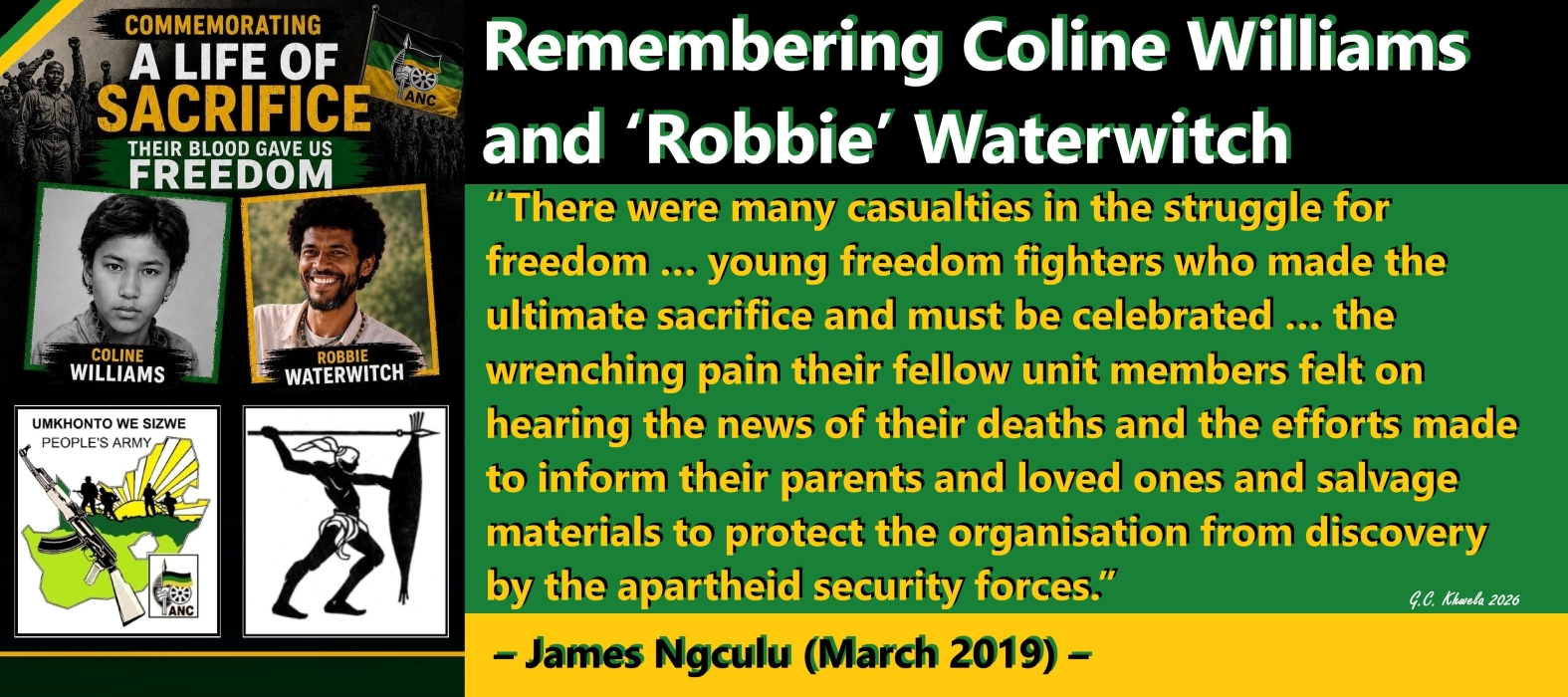
Remembering Coline Williams and ‘Robbie’ Waterwitch
On 23 July 1989, 22-year-old Coline Williams and 20-year-old Robert Anthony Basil “Robbie” Waterwitch died when a time-delayed explosive device detonated prematurely in a public toilet opposite the Athlone Magistrate’s Court on Klipfontein Road. Williams and Waterwitch were two young, anti-apartheid freedom fighters and operatives of Umkhonto we Sizwe (MK), the armed wing of the African National Congress (ANC). They were part of the Ashley Kriel Detachment, an underground cell named in honour of a prominent Western Cape youth leader and Commander of MK, who was assassinated by the apartheid security police.
The Ashley Kriel Detachment was unit was highly active in the Cape Peninsula, carrying out multiple coordinated sabotage and urban guerrilla operations targeting state symbols like police complexes and magistrates’ courts to disrupt the Tricameral Parliamentary elections. Operating primarily in the Western Cape between late 1987 and early 1990, the unit effectively fought an urban guerrilla war against the apartheid state. The unit was named in honour of Ashley Kriel, a charismatic 20-year-old MK soldier and youth leader from Bonteheuwel. Dubbed the “Che Guevara of the Cape Flats”, Kriel was brutally assassinated by apartheid security police officer Jeffrey Benzien in an Athlone safe house on 9 July 1987 and his murder ignited many people to continue the fight against the unjust system.
In 1987, the apartheid Minister of Law and Order, Adriaan Vlok, boasted that the regime had completely crushed MK in the Western Cape. Following the mass arrest of the previous Western Cape MK command network, surviving operatives reorganised under the leadership of Shirley Gunn and Aneez Salie to build a vast, resilient underground network. The Ashley Kriel Detachment was structured into roughly 12 to 15 highly secretive, compartmentalised cells, comprising between 45 and 60 total combatants.
While centred in the Cape Peninsula, its operations extended into rural and peri-rural regions of the Western Cape. The detachment was supplied primarily via a clandestine supply line running from Botswana and Lesotho. Its members were highly trained across various international locations, including Angola, Cuba, Tanzania and Botswana.
The Unit conducted over 30 coordinated “armed propaganda” operations, meaning their strikes targeted infrastructure and political institutions rather than human lives. Their high-profile targets included the Cape Town Castle, a stunning infiltration and bombing of a major, heavily fortified military base; the Bonteheuwel Rent Office, the bombing of a key state symbol of economic exploitation on 28 September 1988; the Sea Point Conservative Party Venue, which was a tactical bombing targeting right-wing political infrastructure; and Magistrates’ Courts and Police Complexes, which were coordinated blasts intended to disrupt apartheid elections and symbols of judicial oppression.
The detachment paid an incredibly heavy price for its resistance, losing prominent members to state-sponsored violence and sabotage. Beyond the deaths of Coline Williams and Robbie Waterwitch, other iconic figures like Anton Fransch were killed in multi-hour standoffs with police forces. The collective history of the unit was formally preserved in 2019 through the publication of “Voices from the Underground: Eighteen Life Stories from Umkhonto we Sizwe’s Ashley Kriel Detachment”, keeping their frontline contribution to South Africa’s democracy alive.
As a member of the Ashley Kriel Detachment, Coline Denise Williams was born on 30 May 1967 and grew up in the Cape Flats township of Bonteheuwel. Radicalised during the 1985 school boycotts, she endured 11 months of detention without trial at Pollsmoor Prison before fleeing underground to join MK in 1988. Coline was born at Peninsula Hospital in District Six, Cape Town. At age 5, her family was forcibly evicted from District Six due to the apartheid government’s Group Areas Act and relocated to the township of Bonteheuwel.
Coline Williams was integrated and recruited into the underground structures of the Ashley Kriel Detachment through a deliberate transition from student activism into the armed struggle. Her entry into the unit was defined by highly selective underground recruitment, extreme compartmentalisation and rapid promotion to operational command. Williams began her political journey as a student organiser during the turbulent 1985–1986 school boycotts in the township of Bonteheuwel. Through these networks, she worked closely with other youth leaders, including Ashley Kriel himself and members of the Bonteheuwel Military Wing (BMW).
In 1986, at just 19 years old, she was arrested by the Security Branch and held without trial for 11 months at Pollsmoor Prison. “She was interrogated until she emerged quieter, withdrawn, altered,” according to historical testimonies on her life. This brutal state torture hardened her resolve, steering her away from open, public protests and driving her toward the clandestine armed struggle. Upon her release, she went completely underground to evade ongoing police surveillance, formally joining Umkhonto we Sizwe (MK) in 1988. Following the assassination of Ashley Kriel in 1987, MK leadership formed the detachment to consolidate the scattered Western Cape youth units. Williams was evaluated and brought into the Detachment structures by its regional command, which was headed by Shirley Gunn and Aneez Salie.
To protect operatives from the regime’s vast informant network, her recruitment was kept strictly confidential, “Except for Aneez and Shirley, no one outside the unit knew that Coline was part of MK,” recalled her fellow cell commander Melvin Bruintjies. Even her closest family members were unaware of her involvement until after her death. Williams was placed into a highly active combat cell alongside operatives Sidney Hendricks and Vanessa November. On 28 September 1988, she proved her operational readiness by helping to execute the high-profile tactical bombing of the Bonteheuwel Rent Office.
Due to her discipline, deep knowledge of local terrain, and bravery, the Ashley Kriel Detachment leadership promoted Williams to Commander of the Athlone Zone. In this role, she directly oversaw and executed operations in the Cape Peninsula, leading up to her final mission with Robbie Waterwitch at the Athlone Magistrate’s Court.
Robert Anthony Basil “Robbie” Waterwitch was a young anti-apartheid student leader, devout Catholic, and internally trained guerrilla combatant of the Umkhonto we Sizwe (MK) Ashley Kriel Detachment. Born on 15 July 1969 in Athlone, Cape Town, he was just 20 years old when he was assassinated alongside his unit commander, Coline Williams, during a coordinated anti-election sabotage mission. His political perspective was deeply shaped by Steve Biko’s Black Consciousness, the moral bravery of Imam Abdullah Haron, and the liberation theology of Reverend Allan Boesak.
As a student at St. Columba’s High School, he successfully mobilised his peers to establish a Student Representative Council (SRC) during the mid-1980s school boycotts. While pursuing a Bachelor of Arts degree at the University of the Western Cape (UWC), he became a prominent organiser within the United Democratic Front (UDF) Youth of Belgravia. Frustrated by the brutal apartheid state repression of open public protests, Waterwitch moved into the underground armed machinery of MK. He was formally integrated into the Ashley Kriel Detachment’s Athlone unit, operating within the critical resistance sector commanded by the legendary operative Anton Fransch.
Because of the regime’s intense surveillance, Waterwitch was trained internally within South Africa rather than being sent into exile. He specialised in handling explosives and urban sabotage tactics. His recruitment was masked in absolute secrecy to protect his family and the unit from the regime’s extensive spy apparatus. His own mother, Hettie Waterwitch, only deduced his ANC alignment from the green, black, and yellow beads on his necklace. In July 1989, Waterwitch’s cell was tasked with executing four coordinated limpet mine operations across the Cape Peninsula to disrupt the apartheid regime’s segregated Tricameral Parliament elections.
Unknown to Waterwitch and Williams, the Truth and Reconciliation Commission (TRC) later confirmed that the Ashley Kriel Detachment had been deeply infiltrated by apartheid Military Intelligence (MI). A double agent named Shane Oliver, handled by the Directorate of Covert Collections (DCC), had direct access to the unit’s weapon stockpiles. It is strongly believed that through this infiltration, the time-delay fuse on Waterwitch’s limpet mine was intentionally booby-trapped, resulting in the premature blast on 23 July 1989.
In the hours and days leading up to the fatal explosion on 23 July 1989, a highly structured, region-wide anti-election sabotage campaign was being synchronised by the Umkhonto we Sizwe (MK) underground network. The timeline of events immediately preceding the blast reveals strict military protocols, parallel operations and signs of state surveillance. Days before the mission, the Ashley Kriel Detachment’s chief of intelligence, Melvin Bruintjies, procured the explosive devices. He handed over two or three limpet mines directly to Robbie Waterwitch for safe storage and preparation. The unit’s zone commander, Anton Fransch, then conducted final underground military briefings with the operatives to outline target locations and coordinates.
On the afternoon of Sunday, 23 July, Coline Williams spent her final hours acting completely normal to avoid breaking cover. “The hours leading up to her death on 23 July 1989 is remembered fondly by her sister, as they sat together outside the family home in Bonteheuwel talking,” according to South African History Online. Later that afternoon, she left the house under the pretext of regular activities to meet up with Waterwitch and other cell members. As Williams moved through the Cape Peninsula to rendezvous with her unit, she noticed unusual security presence.
Evidence later brought before the Truth and Reconciliation Commission (TRC) noted that “Williams stated on the day of her death that she believed she was being followed.” as recorded in TRC documentation. Despite her suspicions, the operational directive to strike ahead of the regime’s segregated elections pushed the mission forward. The operation at the Athlone Magistrate’s Court was not an isolated event; it was part of a meticulously timed, four-pronged coordinated strike across the Peninsula targeting state infrastructure before election nominations opened the following morning.
These targets included Mitchell’s Plain, as other cell members successfully detonated a limpet mine at a temporary satellite police station; Somerset West, another MK cell successfully breached and bombed the local magistrate’s court; in Bellville, security forces intercepted operatives and intervened to defuse the bomb at the Bellville Magistrate’s Court before it could detonate; and Heideveld, where operatives Venessa Rhoda November and Shamiel Isaacs – who had met with Williams right before departing on their respective tasks – attempted to plant a mine at the Heideveld rent office. However, they noticed their device appeared highly unstable and faulty, forcing them to abandon the attempt.
With the other regional operations underway, Williams and Waterwitch slipped behind the public toilet structure directly across the street from the Athlone Magistrate’s Court and police complex. Because a double agent within the MK logistics line had allegedly allowed the apartheid Security Branch to booby-trap the timing mechanisms of the unit’s stockpiled limpet mines, the device triggered prematurely the moment they attempted to prime it, killing them instantly.
While initial apartheid-era reports claimed the detonation was an operational accident caused by the operatives, the Truth and Reconciliation Commission (TRC) and the families of the victims had long contested this narrative. Evidentiary inconsistencies – such as the lack of blast injuries on the operatives’ hands and the fact that the bomb’s timer appeared to have been tampered with or booby-trapped – strongly indicated that the apartheid Security Branch intercepted the device and assassinated the duo using a modified timer.
THEIR DEATH WAS NOT IN VAIN!
THEIR BLOOD GAVE US FREEDOM!
Sources:
South African History Online (SAHO).
Truth and Reconciliation Commission, “Truth and Reconciliation Commission of South Africa Report”, Vol. 3, 29 October 1998.
Marianne Thamm, “The Heroes ANC Forgot to Remember: Robbie Waterwitch and Coline Williams, 25 Years Later”, Daily Maverick, 28 July 2014.
Alet Janse van Rensburg, “Going Underground with the Ashley Kriel MK Detachment”, News24, 29 September 2019.
Oscar van Heerden, “The Spear of the Nation – MK on the Cape Flats”, The Thinker, Vol. 80, 2019.
Shirley Gunn and Shanil Haricharan (Eds.), “Voices from the Underground: Eighteen Life Stories from Umkhonto we Sizwe’s Ashley Kriel Detachment”, Penguin, 2019.
Christopher, “Voices from the Underground”, From The Thornveld, 17 March 2020.
Nadine Cloete, “‘Voices from the Underground’: In Service for Our Liberation”, Mail & Guardian, 21 April 2020.
Shakirah Thebus, “Anti-Apartheid Activists Coline Williams and Robert Waterwitch Awarded Order of Mendi for Bravery”, Cape Argus, 25 April 2024.
Ras Hein Scheepers, “Celebrating Ashley Kriel: A Legacy of Resistance and Conscientisation, Weekend Argus, 15 October 2025.
Castro Khwela
Good morning fellow Compatriots!🙏🏾✊🏾👊🏾
Discover more from CASTRO KHWELA
Subscribe to get the latest posts sent to your email.