Khotso House is Bombed by Apartheid Security Forces
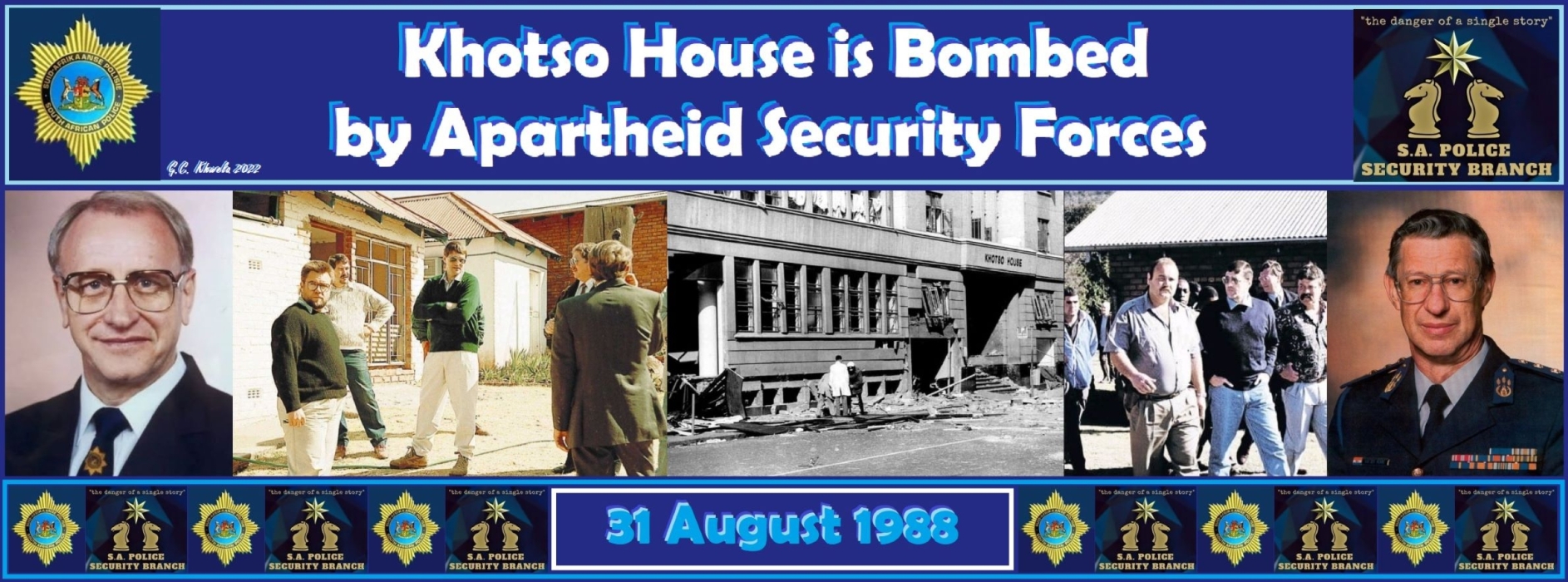
On 31 August 1988, at approximately 01:20 in the morning, the rucksacks that were containing explosives, which had been left by the apartheid Vlakplaas Team at the dividing wall between two lift shafts in the basement of Khotso House, were activated by electronic time switches. At a block of flats next to Khotso House, called Chiltern House, residents were awoken by a powerful explosion which ripped doors from hinges, shattered mirrors and hurled people from their beds.
The explosion at about 1:20 a.m. blew out part of the facade of the downtown Khotso (Peace) House and ignited gas leaking from damaged mains at the headquarters of the South African Council of Churches (SACC) and other social and community groups opposed to the white-led minority government. The foyer floor collapsed into the basement, and a large section of the front façade was blasted open, tossing rubble into the street. The explosion also blew out display windows of stores opposite Khotso House and tore doors off their hinges in nearby apartments.
Two female passers-by were in shock after their clothing was torn from their bodies by the force of the detonation. According to reports, twenty-three people were injured, including a security guard who fell into the gaping hole created by the foyer’s collapse. Nevertheless, there were no fatalities reported. When dawn arrived, it could be seen that what was Khotso House was now a pile of rubble flooded by water from burst pipes. The building was no longer usable.
That morning, the apartheid Minister of Law and Order, Andriaan Vlok, issued a statement of condolence to the injured and mentioned that the police were conducting an intensive investigation to find the culprits. This was actually a lie, as Vlok knew who was responsible. His Head of the apartheid Police, General Johan van der Merwe, had briefed his Head of the Security Police’s Covert Operations Section, Willem Schoon, earlier in August 1988 that the State President, P.W. Botha, wanted Khotso House to be rendered unusable.
Towards the end of August 1988, Schoon met with the Commander of Vlakplaas, Colonel Eugene de Kock to contact members of the apartheid Security Branch in Johannesburg, in particular Brigadier Erasmus, who was going to make the necessary arrangements. On the evening of 30 August, less than a week after De Kock met with Schoon, Brigadier Gerrit Erasmus drove a short distance from his house to a property in Honeydew, Johannesburg, where he found a group of white Vlakplaas operatives, led by Eugene de Kock. They were equipped with daggers, leather batons and coats, as well as eight rucksacks packed with heavy explosives.
Before then, De Kock had met with Captain Charles Zeelie, who was attached to John Vorster Square, the apartheid South African Police Headquarters in downtown Johannesburg. It was believed that African National Congress (ANC) operatives were using the building as a safe house where they could plan terrorist attacks against state targets. Zeelie informed de Kock that he had been assigned the task to render Khotso House unusable but admitted that he had failed.
Briefing the Vlakplaas Unit, Brigadier Gerrit Erasmus told them that the operation was directed against members of the terrorist movements who were using Khotso House against the government. Actually, the building housed the headquarters of the South African Council of Churches (SACC). Khotso House was also considered to be the national headquarters of the United Democratic Front (UDF). Vlok alleged that incidents of violence had followed meetings held by the UDF and its affiliates in the building and that individuals in Khotso House were using it to further “terrorist” activities.
When De Kock asked Erasmus what he should do if challenged by ordinary members of the police not involved in the plan, since Khotso House was located near a block of flats in a part of the city which experienced the “permanent flow of human traffic”, Erasmus replied, “Shoot them.” He then wished them luck and left. Erasmus later testified at the testified to the Truth and Reconciliation Commission (TRC) amnesty committee hearings that he could not remember giving that order, but said if he had, he had not meant it.
The Vlakplaas operatives got into three vehicles and headed in the direction of De Villiers Street in central Johannesburg. When they arrived at about midnight, a VW Kombi carried the ‘penetration’ team, a Nissan Laurel and a Ford Sierra carried the ‘stop-gap’ teams who were to keep watch while the penetration team did its work. The two stop-gap vehicles parked between Khotso House and the railway station. Their job was to prevent any interference by the SAP or anyone else for that matter.
The penetration team gained access to the basement and de Kock, who had reduced the quantity of explosives to be used to between sixty and eighty kilograms, placed the explosives next to a pillar near the lifts and set the detonators. The three cars then left the scene and drove into Hillbrow to await the explosion. Later, on 31 July 1998, George Francois Hammond told the Truth and Reconciliation Commission (TRC) amnesty committee that he helped to prepare and place the charges that wrecked the offices of the headquarters of the SA Council of Churches in August 1988 and was awarded the Gold Cross for Bravery for disarming a massive car bomb in the Hallmark Building in central Pretoria on 28 July 1990.
At the Truth and Reconciliation Commission (TRC) hearings on 31 July 1998, evidence was provided that the explosives used in the bombing of Cosatu House and Khotso House were prepared by a bomb disposal expert, George Francois Hammond, who later received widespread acclaim for his heroic disarming of a massive car bomb in central Pretoria in 1990. The involvement of bomb disposal experts in state terror campaigns emerged at the TRC’s amnesty hearing in Pretoria where former Law and Order Minister, Adriaan Vlok, and more than 30 policemen were applying for amnesty for the bombings.
The former head of the police explosives unit which dealt with bomb disposal, Captain Charles Zeelie, said in the Khotso House blast he and other policemen carried the explosives into the building in canvas bags as some policemen from the Vlakplaas security police base outside Pretoria became nervous at carrying high-powered explosives. Zeelie said the charges were initially intended to be placed in a car, but it was later decided to place them at lifts in the basement of the building. He also described how after the bombs had exploded, he returned to the scene in his capacity as an officer of the police explosives unit. “I investigated it as any other bomb blast”, he told the TRC, adding that he prevented people, including SACC officials, such as Reverends Frank Chikane and Peter Storey, from entering the building.
General Jaap Joubert was assigned to the investigation into the blast and a disinformation campaign by the STRATCOM (Strategic Communications) section of the Security Branch swung into action. Joubert later informed Vlok that a few days after the bombing, a Sandton warrant officer, named in the affidavits, gave Pretoria headquarters a fictitious declaration obtained from a black taxi driver who said he had seen a white man, a white woman and a “coloured” male with a suitcase in the vicinity of Khotso House.
He testified to the fact that he had given a lift to a white male, a white female and a “coloured” male and had, at their request, dropped them close to Khotso House on the day of the explosion. After dropping them, he had seen them make contact with a black male in a red car. Fictitious identikits were composed of the white man and woman, and the woman was later identified as Ms Shirley Gunn, who was suspected of involvement in underground Umkhonto (MK) military activities in the Western Cape. Shirley Gunn who was sought as an alleged trained “ANC terrorist”, and two unknown men had entered the building shortly before the explosion. He said they had carried a heavy case, the lid of which was later found in the rubble after the blast.
Having been assured by Joubert that Gunn was in any event being sought by the Security Branch, Vlok regarded this information as a “godsend”, and it was decided that her name would be publicly released as a prime suspect. Gunn who was pregnant at the time with their son Haroon heard on radio on 10 January 1989 a Major Jaap Joubert read a statement issued by Vlok accusing her of the bombing. After the birth of her son, Haroon Gunn-Salie, Shirley Gunn was arrested in June 1990 and detained with her son. She was later taken to the Caledon Women’s Prison where she was detained for 68 days and was released afterwards and charged with the illegal possession of a Makarov pistol.
The idea to blow up Khotso House was the brainchild of an apartheid police intelligence Major, who was named in an affidavit, who felt he had to stifle the kind of work done at the building. The mission, according to the affidavits, was discussed at a briefing session at a house in Honeydew called by Intelligence Unit members and attended by six high-ranking apartheid South African Police officials. Those present were told their mission was to blow up Khotso House. Explosives which consisted of TM57 landmines and Russian TNT pellets were prepared for the mission. The specialists stressed to the crew the importance of placing the explosives against the pillars in the basement of the building, so as to secure maximum damage.
General Johan van der Merwe said in his submission to the TRC that Adriaan Vlok had ordered him to blow up Khotso House. “According to Mr Vlok, this instruction had come from President PW Botha personally”. Vlok admitted his complicity in the bomb attack when he said in his amnesty application that PW Botha ordered the destruction of the building because it had become “a house of evil”. According to Vlok, Botha said to him, “I have done everything possible to persuade them – the South African Council of Churches – to come to their senses, but nothing helps. We cannot act against the people. You must render that building unusable.”
Former apartheid President FW de Klerk admitted that he knew the 1988 bombing of the SA Council of Churches’ Johannesburg headquarters had been authorised by the apartheid government. The admission was contained in the final two volumes of the final report of the Truth and Reconciliation Commission, released on 14 March 2003. In a testimony to the TRC in 1996 and 1997, De Klerk stated that neither he nor his colleagues in the cabinet, the State Security Council, or cabinet committees had authorised any gross violations of human rights. However, he conceded to a finding by the TRC that his then police commissioner General Johann van der Merwe told him he had been ordered to bomb Khotso House, which housed the headquarters of the SA Council of Churches.
In its report, the TRC said, “Mr de Klerk did not report the matter to the prosecuting authorities or the Goldstone Commission because he knew that General van der Merwe would be applying for amnesty in respect of the relevant bombing. The Commission finds that when Mr de Klerk testified before the Commission … he knew that General van der Merwe had been authorised to bomb Khotso House, and accordingly, his statement that none of his colleagues in Cabinet, the State Security Council or Cabinet Committees had authorised assassination, murder or other gross violations of human rights was indefensible.”
The TRC therefore found that the former president had failed to make a full disclosure of the involvement of senior members of the apartheid government and the then SA Police in the bombing of Khotso House.
Shortly before the first five volumes of the TRC’s final report were released in 1998, De Klerk filed an urgent application to the Cape High Court for an order interdicting the commission from publishing any of its intended findings against him. To prevent a delay of the handing over of the report to former President Nelson Mandela, the commission blacked out the findings on De Klerk. Afterwards, Mandela’s office sought to facilitate a settlement between the TRC and De Klerk. As a result of discussions between De Klerk and the TRC’s amnesty committee, the former president has conceded to the new finding released on Friday.
Interestingly, when Eugene de Kock gave his testimony to the TRC, he said carrying high powered explosives in built up areas put many innocent people’s lives at risk. He also knew that if the missions failed and the bombers were apprehended, it would have caused great embarrassment to the apartheid government. “It would then be revealed that the security forces had turned to state-sanctioned terrorism”, De Kock told the TRC amnesty committee.
This proves beyond reasonable doubt that the apartheid regime, committing criminal acts of sabotage by blowing up such public facilities as the diplomatic mission of the ANC in London, the offices of the South African Council of Churches (SACC – Khotso House), the South African Catholic Bishops’ Conference (Khanya House) and the Congress of South African Trade Unions (COSATU) was “STATE-SANCTIONED TERRORISM”. The involvement of the highest political authority in the Khotso House bombing is an eloquent example of the extent to which breaking the law was seen to be both legitimate and authorised.
Sources:
Wikipedia.
South African History Online (SAHO).
SAHO, “Khotso House is Bombed”, South African History Online (SAHO), 16 March 2011.
African National Congress, “Statement to the Truth and Reconciliation Commission”, August 1996.
Truth and Reconciliation Commission, “Truth and Reconciliation Commission of South Africa Report, Vol. 2”, Truth and Reconciliation Commission, 29 October 1998.
Truth and Reconciliation Commission, “Truth and Reconciliation Commission of South Africa Report, Vol. 3”, Truth and Reconciliation Commission, 29 October 1998.
Truth and Reconciliation Commission, “Truth and Reconciliation Commission of South Africa Report, Vol. 5”, Truth and Reconciliation Commission, 29 October 1998.
Truth and Reconciliation Commission, “Truth and Reconciliation Commission of South Africa Report, Vol. 6”, Truth and Reconciliation Commission, 21 March 2003.UPI Archives, “Anti-Apartheid Headquarters Bombed”, United Press International, 31 August 1988.
SAPA, “Bomb Disposal Hero Set COSATU And Khotso Bomb Blasts: TRC Hears”, South African Press Association, 31 July 1998.
Themba Molefe and Tebogo Monama, “The Bombing of Khotso House was Decided at the Highest Level of Apartheid-Era Structures”, The Sowetan, 24 July 2007.
Padraig O’Malley, “Chapter 3: The State Inside South Africa between 1960 and 1990”, The Heart of Hope: South Africa’s Transition from Apartheid to Democracy, University of the Western Cape – Robben Island Museum Mayibuye Archive – University of Massachusetts Boston, Nelson Mandela Foundation, 2009.
SAPA, “De Kock Tells TRC How He Blew Up Khotso and COSATU Houses”, South African Press Association, 29 July 1998.
Mduduzi ka Harvey, “How Khotso House was Bombed”, Mail & Guardian, 15 December 1994.
Staff Reporter, “FW Admits Apartheid Govt Bombed Khotso House”, Mail & Guardian, 21 March 2003.
Jacques Pauw, “Into the Heart of Darkness: Confessions of Apartheid’s Assassins”, Jonathan Ball, 1997.
Thula Simpson, “Umkhonto we Sizwe: The ANC’s Armed Struggle”, Penguin, 2016.
Robin Binckes, “Vlakplaas: Apartheid Death Squads, 1979–1994”, Pen and Sword, 2018.
Castro Khwela
Good evening fellow Compatriots!
Discover more from CASTRO KHWELA
Subscribe to get the latest posts sent to your email.