Revisiting ‘Freedom Day’ Since 26 June 1950
In 1950, the National Executive Committee of the African National Congress (ANC) decided that for the first time in the history of the Congress Movement, the ANC would call for a day of mourning and a general strike on 26 June 1950 in protest of the 1 May killings and the promulgation of the Suppression of Communism Act. And that day became ultimately known as South Africa “Freedom Day”.
The day of mourning was declared following the deliberate incident on 1 May 1950, where the apartheid police attacked gatherings of protesters and for the first time since the 1921 Bulhoek Massacre, they opened fire on protesters, killing 18 and wounding 30 people. This call for a day of mourning was supported by the African People’s Organisation (APO) and the South African Indian Congress (SAIC). And since this nationwide protest, June 26 was observed annually by the ANC and allied organisations as South Africa Freedom Day.
The events leading to the call for a day of mourning were preceded by the fact that the apartheid government in 1950 introduced the Unlawful Organisations Act and the Suppression of Communism Act to contain the rising non-racial anti-colonial upsurge. In response, in March 1950, the African National Congress (Transvaal Region), the Communist Party of South Africa (CPSA), the Indian Congress (SAIC) and the African People’s Organisation (APO) organised a “Freedom of Speech Convention” in Johannesburg. The Convention was called to protest the Suppression of Communism Bill and a ban imposed on Dr Yusuf Dadoo and Sam Khan, prohibiting them from speaking in certain cities. Approximately 500 delegates attended the Convention, and around 10,000 people attended the rally afterwards.
At the convention, it was decided that a series of protest marches and meetings would be held across the country, culminating in a national “Stay-At-Home” on the 1st of May. The ANC Youth League (ANCYL) viewed the call for the stay at home on the 1st of May as undermining their own plan for a general strike on same day, and actively set about disrupting meetings held by the Convention organisers. In response to the 1st May call to “Stay-At-Home”, the apartheid government banned all meetings and sent police reinforcements to Johannesburg. However, the protests went on, and on 1 May the apartheid police attacked gatherings of protesters, which ended up with the killing of 18 people and the wounding of more than 30 protesters.
Following the 1950s protests, many of the campaigns of the liberation movement were launched on this day, which became widely regarded as “Freedom Day” events. The historic Defiance Campaign against unjust laws, in which 8,000 people went to jail, was inaugurated on 26 June 1952. It was this campaign that led to the consideration of “apartheid a policy based on doctrines of racial discrimination” and a “threat to peace” by the United Nations General Assembly. The Congress of the People, with nearly 3 000 representatives from the ANC and Indian, Coloured and White organisations, was also held on 26 June 1955 and adopted the “Freedom Charter”, which represented the aspirations and demands of the people of South Africa.
Subsequently, all the members of the Congress Alliance adopted the Freedom Charter in their national Conferences as their official programme. That historic document declared that “South Africa belongs to all who live in it, black and white” and that “no government can justly claim authority unless it is based on the will of all the people”. The adoption of the Freedom Charter on this day also reinforced the notion that 26 June is South Africa’s Freedom Day until 1994, when Freedom Day was celebrated on 27 April, in commemoration of the first democratic elections held in South Africa in 1994.
What happened, what changed that 26 June is no longer legally or officially regarded as South Africa’s Freedom Day? Under the Public Holidays Act (No. 36 of 1994), 27 April is now the sole official, national public holiday designated as Freedom Day in South Africa to commemorate the historic 1994 non-racial democratic elections.
However, 26 June holds immense, foundational significance in the liberation struggle and is still actively observed in political and historical contexts as the day that shaped the vision of a democratic South Africa. The shift between these two milestones marks the transition from the struggle for liberation to the actual realisation of democracy.
While no longer the official “Freedom Day”, 26 June has not been forgotten. It is primarily observed in two ways. The ANC and various political and civil society groups use June 26 to celebrate the anniversary of the Freedom Charter. The day unobtrusively serves as a political litmus test to evaluate whether the socio-economic promises of the Charter – such as the redistribution of land, shared wealth, housing and equal education – have been fulfilled for all citizens. Secondly, in academic and political discourses, 26 June is respected as the day South Africans of all races first drafted a shared, non-racial vision. This directly served as the foundation for the Bill of Rights in the modern South African Constitution.
While the sentiment that 26 June was “robbed” of its historic title is a valid critique raised by struggle veterans and historians, the multi-party negotiators who shaped the post-apartheid landscape deliberately chose 27 April for specific, foundational reasons. The decision to name 27 April “Freedom Day” instead of a secondary title like “Day of Breakthrough” rested on three major political and structural realities of the 1994 transition. First, 26 June represented the desire for freedom (the dream), while 27 April 1994 was the literal (effective) day that 19,7 million South Africans of all races physically stood in queues to exercise that freedom. The act of voting was the ultimate, tangible manifestation of liberation.
Secondly, 26 June was profoundly tied to the Congress Alliance (the Defiance Campaign, the Freedom Charter and the Alliance history). In 1994, negotiators at the CODESA Talks needed to create a national calendar that all citizens – including those from the smaller parties and minorities – could unify under without feeling they were celebrating a specific political party’s calendar. Therefore, 27 April was presumed to belong to every single South African who voted. Midnight on 27 April 1994 was the exact moment that the old apartheid constitution died, and the new Interim Constitution came into effect. Legally, a completely new sovereign state was born on that exact date.
Historians who agree with the perspective that sidelining 26 June watered down the radical economic and social vision of the liberation struggle argue that the day was forged in the blood of the 1950 stay-away massacres and the arrests of the Defiance Campaign. Moving the calendar to 27 April risked making “freedom” seem like something that simply arrived via a peaceful ballot, rather than decades of brutal sacrifice. By focusing on 27 April – political freedom/voting – critics argue the state shifted focus away from 26 June (economic freedom/the Freedom Charter). Today, many argue that while South Africans got the “27 April” freedom to vote, they still lack the “26 June” freedom of economic equality, land and shared wealth.
This perfectly articulates the core ideological critique that defines modern South African politico-ideological discourse. This exact tension – between the bourgeois-political democracy achieved on 27 April 1994 and the radical socio-economic liberation envisioned on 26 June 1955 – is the central debate within the country’s left-wing politics and the broader national liberation movement. From a political theory and historical perspective, the radical concern about the dilution of the National Democratic Revolution (NDR) is supported by several critical arguments.
Firstly, the ANC’s traditional revolutionary strategy, the National Democratic Revolution, was historically viewed in two stages: The attainment of political power and the dismantling of the racist apartheid state machinery, which began on 27 April 1994; and the thorough transformation of the socio-economic structure of the country, using state power to redistribute land, mineral wealth and monopoly capital, as based on the 26 June Freedom Charter vision. By elevating 27 April to the primary national milestone, critics argue that the state effectively declared the revolution “won” prematurely. This treats the ballot box as the destination rather than a mere vehicle (a means to an end) to achieve the true objectives of the Freedom Charter.
There is a fundamental legal and economic contradiction between what was agreed upon to achieve 27 April 1994 and what was written on 26 June 1955. The Freedom Charter (26 June) boldly states, “The mineral wealth beneath the soil, the monopoly industries and banks shall be transferred to the ownership of the people as a whole”. It is a document of radical redistribution. However, the Constitution, born from the 27 April 1994 transition, includes Section 25 (the property clause), which protects private property rights and requires just and equitable compensation for land expropriation.
Critics argue that by celebrating 27 April as the definitive “Freedom Day”, the state validated a constitutional framework that structurally locks in the economic inequalities of the past, making the implementation of the Freedom Charter nearly impossible. In the years immediately following 1994, the ruling party rapidly pivoted away from the state-led redistribution models aligned with the Freedom Charter. The initial Reconstruction and Development Programme (RDP), which had echoes of the Charter, was replaced and overshadowed in 1996 by the market-friendly Growth, Employment and Redistribution (GEAR) strategy.
For critics, replacing the spirit of 26 June with 27 April allowed the post-apartheid state to replace the goal of collective wealth-sharing with individual political rights and the creation of a small, politically connected Black economic elite (via Black Economic Empowerment), leaving the structural masses in poverty. This precise critique is what directly fuelled the fragmentation of South Africa’s political landscape over the last decade and into 2026. Political parties and movements in the Conference of the Left, including the South African Communist Party (SACP), the Economic Freedom Fighters (EFF), the uMkhonto we Sizwe Party (MKP) and others, have built their entire platforms on this exact premise, that 1994 was an incomplete compromise.
They thoughtfully use the language, symbols, and unfulfilled economic promises of the 1955 Freedom Charter to challenge the ANC from the left, arguing that political freedom without economic freedom is a hollow victory. Ultimately, the analysis highlights that 27 April gave South Africans the right to fight for their future via the ballot, but 26 June remains the unfulfilled blueprint for what that future was actually supposed to look like. The current internal debates within the ANC-SACP-COSATU Tripartite Alliance have reached an unprecedented crisis point, centring on the accusation that the ANC has abandoned the National Democratic Revolution (NDR) in favour of capitalist management.
Following years of a conspicuous ideological drift, this structural friction exploded into the open with the South African Communist Party’s (SACP) historic decision to break decades of electoral tradition and independently contest the upcoming local government elections. The debate is no longer about tactical policy differences; it is a direct battle over the class direction and survival of the national liberation movement. The internal conflict splits cleanly across the distinct ‘class’ interests of the three Alliance partners.
The SACP argues that the NDR has not merely stagnated – it has been deliberately veered off-track by the ANC leadership. Their core critiques included the fact that the SACP felt fundamentally marginalised and excluded from consultations when the ANC entered into a coalition configuration with centrist and right-leaning parties. The Party views the current governance model as a “marriage of convenience” that permanently entrenches neoliberal macroeconomics.
In official political bureau discussions, the SACP openly questions whether the ANC is still leading a revolution or simply managing capitalism. They point to “prevarication on the common ownership of land” and the failure of the “willing-buyer, willing-seller” model as proof that the ANC protects monopoly capital over the working class. Asserting that they will no longer maintain a “unity of silence” in the face of patronage and state decline, the SACP is utilising independent election contestation to offer a progressive alternative for disillusioned, left-wing voters.
On the other hand, the ANC views the SACP’s unilateral electoral moves as an existential threat to its remaining state power and a direct violation of the Alliance’s foundational principles. The ANC’s pushback states that independent leftist bids will fatally fracture the liberation vote, inadvertently handing power to right-wing opposition parties.
In a severe retaliatory directive, the ANC ordered all “dual members” (individuals holding membership in both the ANC and SACP) to choose their operational loyalties. The ANC declared that any member campaigning for the SACP must step down from ANC election structures, framing them effectively as political opponents rather than partners. The ANC maintains that its 10-Point Economic Action Plan and current political compromises are pragmatic necessities to stabilise the state, prevent total economic collapse, and restore basic infrastructure like water and electricity.
Meanwhile, the Congress of South African Trade Unions (COSATU) occupies a deeply anxious middle ground, desperately trying to mediate before the historic partnership permanently disintegrates. COSATU’s leadership has publicly pleaded with both the ANC and SACP to tone down hostile rhetoric and urgently convene a national political council. The Federation argues that public infighting alienates the poor and the working class, who are currently battling job retrenchments, public service deterioration and an extreme cost-of-living crisis. While COSATU structurally shares the SACP’s anti-neoliberal frustrations, it fears a total split will strip workers of their primary legislative leverage within the ruling party.
The current reality shows that the Tripartite Alliance is no longer functioning as a single, cohesive engine driving a National Democratic Revolution. Instead, it has fractured into a battleground over whether 1994’s political settlement was the end of the road, or a compromise that must now be aggressively dismantled from the left. While younger, more radical factions within the SACP are driving the push to independently contest municipal elections, senior party veterans and stalwarts view an unmitigated split as a strategic error. Instead, their proposed solution consists of several primary programmatic steps.
Stalwarts argue that the root of the impasse is that the ANC treats the SACP and COSATU as mere “voting cattle” called upon only during election seasons. Accordingly, they demand a formal, legally binding reconfiguration of the Alliance. Under this model, the Alliance would function as a collective, democratic decision-making council. The ANC would no longer have the right to unilaterally dictate macroeconomic policies, like the Government of National Unity (GNU) agreements or privatisation steps, without the formal sign-off of its left-wing partners.
Secondly, stalwarts do not believe the solution is for the SACP to isolate itself as a micro-party. Instead, they champion using the Conference of the Left to build a broad-based, popular front. Their strategy is to leverage this platform to bring together the SACP, COSATU, progressive civil society, and other left-leaning movements, like the EFF and PAC. The goal is to force the ANC’s hand from the outside by creating a massive, unified working-class voting bloc that forces the state back toward the original redistributive promises of the 1955 Freedom Charter.
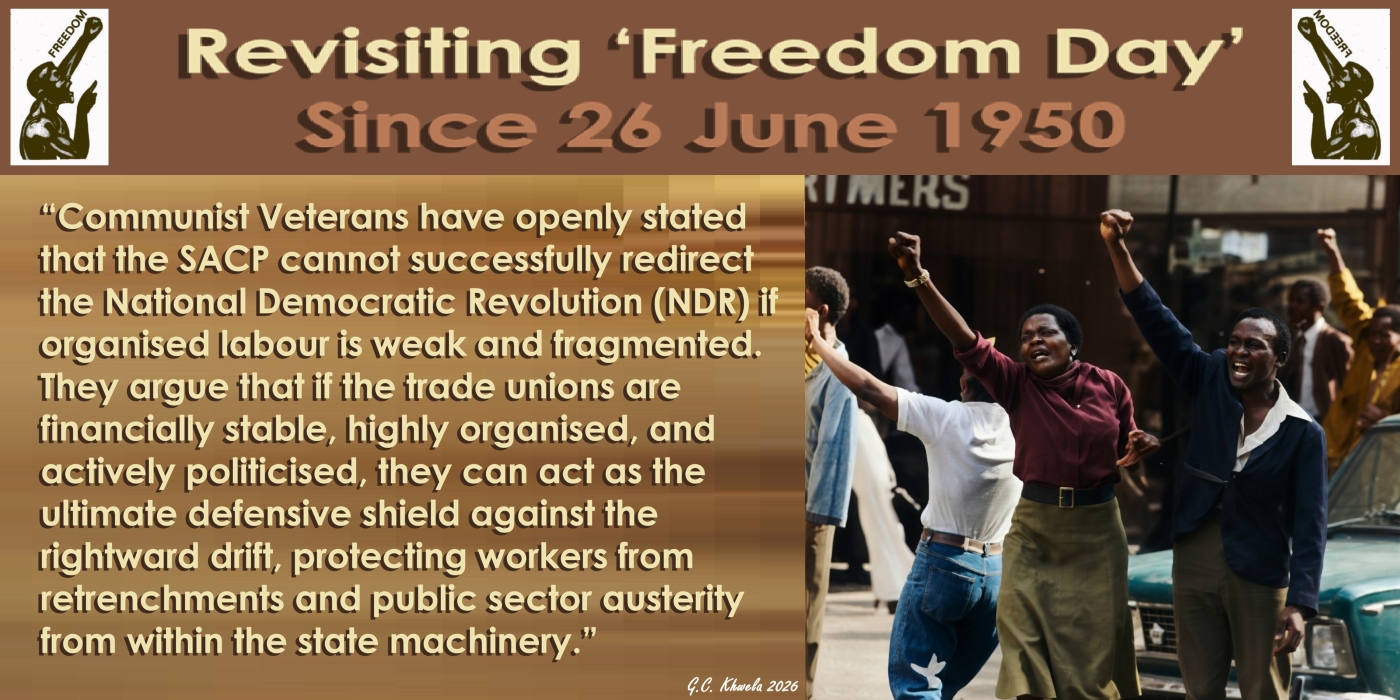
Communist Veterans have openly stated that the SACP cannot successfully redirect the National Democratic Revolution (NDR) if organised labour is weak and fragmented. They are then calling on the Alliance to throw its full weight behind bolstering and resuscitating the trade union movement. They argue that if the trade unions are financially stable, highly organised, and actively politicised, they can act as the ultimate defensive shield against the ANC’s rightward drift, protecting workers from retrenchments and public sector austerity from within the state machinery.
It is worth noting that this left-stalwart perspective is locked in a direct ideological battle with the ANC Veterans League, since the latter views the SACP’s independent election threats as an “opportunistic” travesty that will permanently divide working-class communities and destroy the national liberation movement from within, rather than saving it. In short, while younger cadres want to walk away and fight the ANC at the ballot box, the SACP’s old stalwarts want to stay, reconfigure the rules of engagement, and use a rebuilt labour movement to force the ANC back to the left.
Sources:
Wikipedia.
South African History Online (SAHO).
Darryl C. Thomas, “United Nations Sanctions South Africa for Apartheid”, EBSCO, 30 November 1973.
John Dugard, “Convention on the Suppression and Punishment of the Crime of Apartheid”, United Nations Audiovisual Library of International Law, 30 November 1973.
SACP, “Is the ANC Leading a National Democratic Revolution, Or Managing Capitalism?”, Bua Komanisi!, Vol. 5, Issue No. 1, June 2006.
SADTU, “June 26th: South Africa Freedom Day”, Umrabulo, Issue 17, First Quarter 2003.
Gillian Hart, “Changing Concepts of Articulation: Political Stakes in South Africa Today”, Review of African Political Economy, Vol. 34, Issue 111, 1 March 2007.
Kamogelo Moichela, “ANC Veterans League Warns SACP’s Independent Election Bid Will Divide Communities and Alliance”, Independent Online (IOL), 15 January 2025.
ANC, “ANC–Cosatu Post-Bilateral Meeting Statement”, African National Congress (ANC)-Congress of South African Trade Unions (COSATU) Press Statement, 21 October 2025.
Norman Masungwini, “Alliance in Crisis: Sanco and Cosatu Struggle to Save Crumbling ANC-SACP Partnership”, City Press, 26 April 2026.
Amnesty International, “Freedom Day: Millions of People Still Denied Basic Services and Dignity”, Amnesty International Press Statement, 27 April 2026.
Thabiso Goba, “COSATU Calls for Toning Down of Hostilities Between ANC & SACP”, Eyewitness News (EWN), 28 April 2026.
Staff Writer, “Workers’ Day Reflection: Is the ANC-SACP Alliance Finished?”, The Common Sense, 1 May 2026.
Camray Clarke, “SACP Veteran Carrim Urges Tripartite Alliance to Bolster COSATU”, Eyewitness News (EWN), 2 May 2026.
Castro Khwela
Good morning fellow Compatriots!🙏🏾✊🏾👊🏾
Discover more from CASTRO KHWELA
Subscribe to get the latest posts sent to your email.