Apartheid Minister Kruger Amends the Internal Security Act
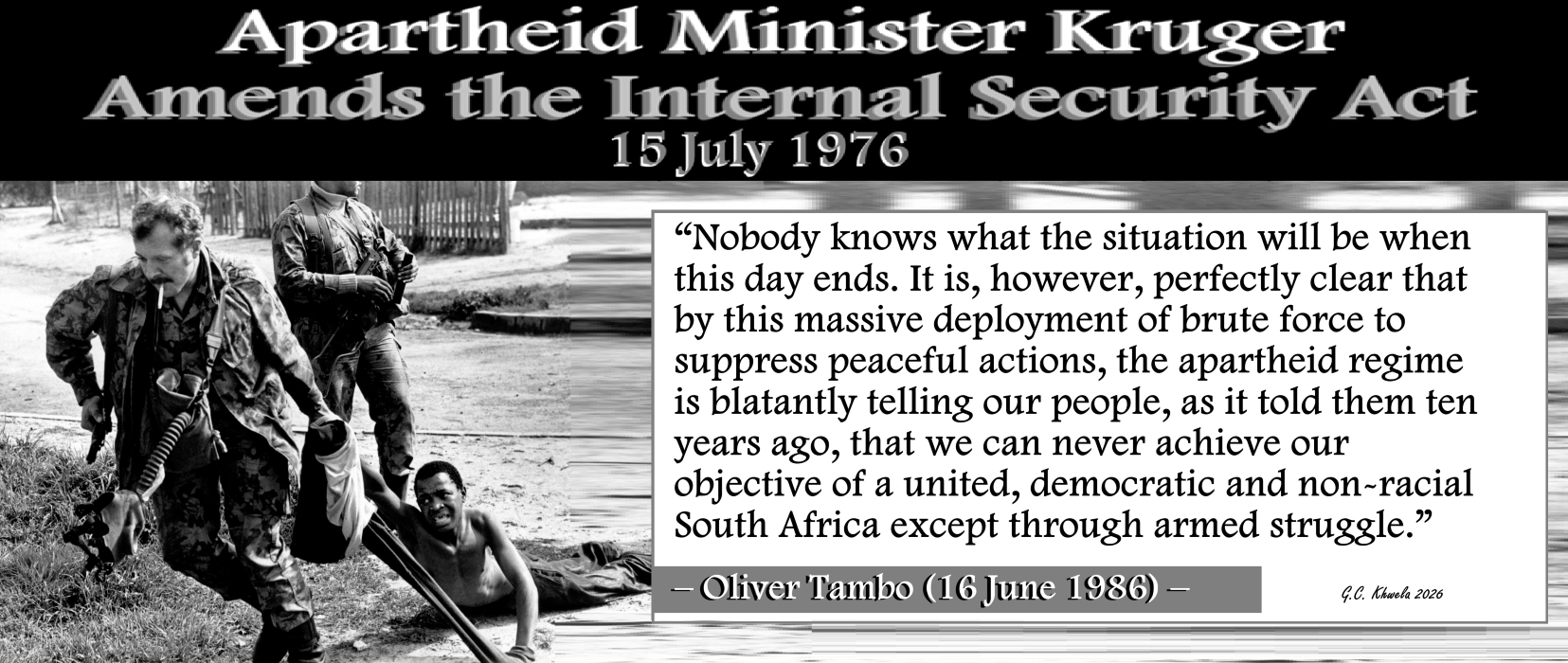
On 15 July 1976, almost a month after the June 16 Soweto Uprisings, and in the midst of the unrests, the Minister of Justice, James Thomas “Jimmy” Kruger, announced that the provisions of the Internal Security Amendment Act, 1976 (Act No. 79 of 1976), allowing for the unlimited detention without trial of persons deemed to be threatening public order, were amended. The new amendments were meant to apply in the Transvaal Province with immediate effect for one year. The government amended the Internal Security Act, essentially the Suppression of Communism Act, 1950 (Act No. 44 of 1950), which had just been renamed the Internal Security Act earlier that year, in order to provide for what was termed ‘preventive detention’.
While the law technically capped this specific implementation at 12 months, it granted the state sweeping authority to hold political activists in solitary confinement without judicial oversight. Theoretically, the detention was not meant to exceed twelve months. However, this allowed the apartheid police to enact unlimited detention without trial for up to 12 months for any individual deemed a threat to public order. Moreover, all public gatherings were banned and schools in Soweto and other areas affected by unrests were closed. The government was hoping that the closure of schools would put an end to the unrest, to crack down on the student uprisings by closing schools in Soweto and banning all public gatherings to prevent activists from meeting.
Alongside the detention decree, Minister Kruger ordered that Black schools across the heavily affected Pretoria-Witwatersrand-Vaal (PWV) industrial complex remain indefinitely closed to prevent student mobilisation. The state also enacted a nationwide prohibition on all public gatherings under the Riotous Assemblies Act to suppress the spreading civil unrest. The clampdown directly escalated tensions. On the exact same day, 15 July 1976, high-profile Black Consciousness Movement (BCM) activist Mapetla Mohapi was detained under the Terrorism Act; he died in police custody less than three weeks later.
The Internal Security Amendment Act No. 79 of 1976, as it came to be notoriously known, fundamentally altered the nature of state repression, transforming the affected townships into militarised zones. By replacing the Suppression of Communism Act, it gave the apartheid regime sweeping powers to enforce “preventive detention”, ban organisations, and suppress information. The specific regional impacts across the urban hubs manifested through various heavy-handed tactics. The Pretoria-Witwatersrand-Vaal (PWV) region, as the epicentre of the uprisings, bore the immediate brunt of the Act’s implementation.
The South African Police used preventive detention to systematically arrest members of the Soweto Students’ Representative Council (SSRC) and Black Consciousness movements. Holding figures indefinitely without trial successfully disrupted organised command structures. Schools were indefinitely closed by ministerial decree. Security forces used the empty premises as tactical deployment posts, effectively turning community school grounds into paramilitary bases to prevent student gatherings. All public gatherings, including funerals of slain activists, were explicitly banned under the aligned Riotous Assemblies Act. Police presence in townships like Vosloorus and Alexandra escalated into routine house-to-house raids and street checkpoints.
The unrest migrated rapidly to the Western Cape by August 1976, prompting the state to extend the Act’s special provisions beyond the Transvaal Province. Townships in Cape Town saw strong alignment between high school students and migrant workers. The state used the Act to isolate community organisers and break massive political stayaways and strikes. Furthermore, the police manipulated the legal immunity provided by security laws to stir up conflict. They actively encouraged conservative migrant hostel dwellers to attack student demonstrators in Nyanga and Guguletu, protected by a wall of state-sanctioned impunity.
In Natal, the impact was shaped by the strong presence of the Black Consciousness Movement (BCM) and growing trade unionism. The Security Branch heavily deployed the Act around the University of Natal (Black Section) and local townships. Activists were served with strict banning orders that subjected them to house arrest and prevented them from being quoted in public. Police used the witness-detention clauses of the Act to round up labour union organisers and student activists pre-emptively, neutralising localised sympathy strikes before they could paralyse Pietermaritzburg and Pinetown industrial areas and particularly Durban’s critical economic ports.
Port Elizabeth (now Gqeberha) possessed a highly organised, militant labour and political tradition that faced aggressive legal retaliation. The Eastern Cape Security Branch used the Act’s lack of judicial oversight to run clandestine interrogations. This environment directly facilitated the torture and subsequent custody deaths of prominent regional figures, especially in August 1976. The local state apparatus heavily monitored industrial auto-manufacturing hubs, utilising targeted workplace arrests under the Act to prevent township unrest from bleeding into the factories.
Ultimately, the 1976 amendment failed to permanently quell the resistance. Instead, it forced liberation movements underground and triggered a massive exodus of thousands of young South Africans who fled across borders to join armed resistance wings like Umkhonto we Sizwe (MK) and the Azanian People’s Liberation Army (APLA). The legal architecture established in 1976 laid the groundwork for the highly militarised, nationwide States of Emergency that came to define the 1980s.
The introduction of the amendments to the Internal Security Act widened an existing, profound racial and ideological schism across South African civil society and religious institutions. While Black civil society and ecumenical bodies viewed the law as a tyrannical escalation to crush legitimate resistance, White civil society was heavily polarised between conservative endorsement and liberal legal protest. The response of religious bodies split along sharp racial, theological and denominational lines, separating the state-aligned Afrikaans churches from the anti-apartheid ecumenical movement.
Mainstream, predominantly Black and English-speaking churches – united under the South African Council of Churches (SACC) – unconditionally condemned the Act. Leaders from the Anglican, Lutheran, Methodist, Roman Catholic and Congregational churches declared the law “unchristian” and an offense to basic human rights. They heavily critiqued the removal of judicial oversight and the normalisation of indefinite solitary confinement.
The SACC’s Dependants’ Conference directly defied the state’s intimidation. They provided emergency financial relief, medical aid, and counselling to the families of those placed in preventive detention under the new Act. Through its Division of Justice and Reconciliation, the SACC channelled millions in legal aid to pay for advocates and lawyers defending student activists captured under the security laws.
In stark contrast, the White Reformed churches, primarily the Nederduitse Gereformeerde Kerk (NGK), offered theological and moral cover to the state. The NGK leadership actively supported Minister Jimmy Kruger’s measures. They framed the internal security laws as a necessary defence against a “Total Onslaught” of godless communism. Sermons heavily emphasised biblical obedience to the governing authorities (Romans 13), telling their white congregants that the state was acting as a legitimate protector of Christian civilization.
For Black civil society, which was already targeted by the police, the Act was seen as a declaration of structural war. Organisations like the Black Consciousness Movement (BCM) and the South African Students’ Organisation (SASO) refused to back down. They publicly denounced the Act at heavily monitored political funerals, utilising these spaces as rallies despite the national assembly bans. Because the law allowed the state to ban organisations instantly, it destroyed any remaining belief that change could be achieved through legal, open political channels. It accelerated the decision of thousands of young activists to skip the borders to join armed wings like MK and APLA.
White liberal bodies reacted with intense alarm, fearing the total erasure of the rule of law, yet their actions remained strictly bound to institutional frameworks. The Progressive Reform Party (PRP) fiercely debated the bill in parliament, arguing that eliminating the courts’ ability to review detentions turned South Africa into a permanent police state. The Black Sash, which was a prominent organisation of white liberal women, staged silent, public placard protests against indefinite detention without trial. They established advice offices to help families navigate the complex maze of finding where security police were secretly holding their detained relatives.
Newspapers like ‘The Rand Daily Mail’ and ‘The Star’ wrote biting editorials warning against the absolute powers granted to Jimmy Kruger, exposing the names of detainees whenever legally possible before censorship tightened further. Other mainstream media platforms reacted to the amended Internal Security Act along deeply divided racial and ideological lines, ranging from explicit state propaganda to targeted defiance that resulted in total state bans. The media landscape reacted through distinct operational categories.
Black-centred publications went far beyond passive editorial warnings; they acted as active visual and narrative disruptors of the apartheid state’s narrative. ‘The World’ and ‘Weekend World’, led by iconic editor Percy Qoboza and news editor Aggrey Klaaste, were the definitive newspapers for Black readers in Johannesburg and other urban areas. ‘The World’ famously published Sam Nzima’s historic photograph of the dying Hector Pieterson. While white papers often focused on parliamentary debates, ‘The World’ bypassed state information blackouts by publishing eyewitness accounts of police firing on children and naming activists secretly missing in preventive detention.
When Minister Jimmy Kruger came to recognise that ‘The World’ was giving a national voice to the Soweto Students’ Representative Council (SSRC) and the Black Consciousness Movement, he used his expanded powers. Subsequently, Kruger officially banned both ‘The World’ and ‘Weekend World’, threw Qoboza and Klaaste into detention without trial, and proscribed the Union of Black Journalists (UBJ).
Meanwhile, the state’s broadcast media acted as a direct ideological extension of Jimmy Kruger’s ministry, actively weaponising the Internal Security Act’s parameters. Both SABC (South African Broadcasting Corporation) television, which had only launched nationally in January 1976, and SABC radio network broadcasts strictly adhered to state dictates. They entirely scrubbed the word “protest” or “uprising”, categorising the township events exclusively as “riots”, “arson” and “communist-inspired thuggery”.
The SABC’s ethnically segregated radio stations, collectively named “Radio Bantu”, were used for algorithmic compliance. They repeatedly broadcasted government warnings, read out the strict bans on public gatherings, and warned Black parents that keeping their children out of school violated state laws, effectively acting as an audio enforcement tool for the state security apparatus.
Mainstream Afrikaans-language newspapers provided the moral and political justification that the National Party required to enforce unlimited detention without trial. For example, ‘Die Burger’ and ‘Die Transvaler’ newspaper publications largely validated Kruger’s narrative. Their editorials framed the expansion of the Internal Security Act not as a violation of human rights, but as a lawful, Christian defence mechanism against a “Total Onslaught” directed by foreign communist agitators. They heavily focus-shifted toward property damage, looting, and instances where white officials were killed, using these events to systematically validate why the security police required arbitrary powers of arrest without judicial oversight to restore “law and order”.
Outside South Africa, the international community reacted to the passing of the amendments to the Internal Security Act and the subsequent July 15 enforcement with deep outrage, marking a global turning point that permanently isolated the apartheid regime. Viewed not in isolation, but as the regime’s brutal legal response to the Soweto Uprisings, the global backlash manifested through formal diplomatic measures, institutional actions and grassroots pressure. The United Nations, for instance, transitioned from standard verbal critiques to passing binding resolutions that directly targeted South Africa’s legislative tyranny.
UN Security Council Resolution 392, which was passed unanimously on 19 June 1976, just as the bill was being finalised and implemented, directly condemned the South African government’s violent repression, as it formally declared that the apartheid legal structure was “a crime against the conscience and dignity of mankind” and a threat to international security. The UN Special Committee Against Apartheid specifically monitored Jimmy Kruger’s invocation of the Act on 15 July 1976. In its official global reports, the committee exposed how the “preventive detention” clauses were being used to systematically jail leaders of the South African Students’ Organisation (SASO) and the Black People’s Convention (BPC).
African nations led the charge in demanding immediate, punitive retaliation against Pretoria. The Organisation of African Unity (OAU) meeting in Mauritius in late June and early July 1976, passed fierce resolutions condemning the massacres and the new legal crackdowns. They formally recognised the total legitimacy of the armed struggle against the regime and urged member states to increase financial and military aid to the ANC and the Pan Africanist Congress (PAC). Neighbouring countries like Zambia, Tanzania and Mozambique cited the Internal Security Act as proof that peaceful negotiation with Pretoria was impossible. They opened up their borders to provide safe havens, training bases and logistical routes for the influx of student refugees fleeing Kruger’s police state.
The draconian nature of the Act placed Western allies – who traditionally shielded South Africa due to anti-communist alignments – in an impossible diplomatic position. The US Ford administration, guided by Secretary of State Henry Kissinger, publicly rebuked the escalating violence and arbitrary detentions. Kissinger met with South African Prime Minister John Vorster in mid-1976, warning him that the continuous implementation of total police-state tactics was rendering South Africa a diplomatic liability to the West. On the other hand, European nations issued joint diplomatic demarches protesting the use of indefinite detention without trial. The introduction of these laws severely damaged South Africa’s creditworthiness, causing international banks to hesitate to provide long-term loans to the state.
At the grassroots level, the combination of township massacres and the Internal Security Act sparked a massive wave of global mobilisation. Anti-apartheid groups in the United Kingdom, United States and New Zealand used the state’s legislative overreach to justify a total sports isolation. This directly influenced the boycott of the 1976 Montreal Olympic Games by more than 20 African nations protesting New Zealand’s rugby tour of South Africa.
Organisations like Amnesty International launched major global letter-writing campaigns, publishing the names of activists held under the “preventive detention” banner. They successfully kept international attention pinned on the lack of judicial oversight and the rampant torture occurring inside South African prisons. The international reaction to the 1976 amendments permanently broke any illusions that the apartheid state could reform itself. The global condemnation generated during this specific period directly laid the groundwork for the unanimous UN mandatory arms embargo passed under Security Council Resolution 418 in late 1977.
While the National Party successfully utilised its brutal new police-state powers to temporarily suppress the 1976 uprisings, it inadvertently destroyed its own economic, diplomatic and military foundations. The structural decline of the regime post-1976 occurred across four definitive phases. Firstly, the draconian images of children being detained without trial destroyed international investor confidence. Foreign capital began fleeing South Africa in unprecedented volumes. International banks refused to roll over short-term loans, creating a permanent balance-of-payments crisis.
The backlash directly birthed the Sullivan Principles in 1977, forcing massive multinational corporations, such as General Motors, Barclays and Mobil, to completely withdraw their operations from South Africa over the following decade. To counter internal resistance and regional wars, the regime had to divert massive chunks of its shrinking GDP into military spending and duplicating separate apartheid bureaucracies, like the Bantustans, which structurally bankrupted the state.
Secondly, the global outrage over the Internal Security Act and the subsequent 1977 death of Steve Biko in police custody forced the West to abandon Pretoria militarily. In November 1977, the UN Security Council passed Resolution 418, making the arms embargo against South Africa strictly mandatory. Cut off from importing modern jet fighters, radar, and advanced weaponry, the apartheid South African Defence Force (SADF) gradually lost its technological edge. This culminated in their strategic military checkmate against Soviet-backed Cuban forces at the Battle of Cuito Cuanavale (1987–1988), breaking the myth of SADF invincibility.
Thirdly, by making open, peaceful protest completely illegal under the Internal Security Act, Jimmy Kruger inadvertently accelerated the exact outcome he sought to prevent, an active armed underground insurrection. Thousands of student activists who fled the Internal Security Act’s dragnet crossed into neighbouring frontline states. They provided Umkhonto we Sizwe (MK) and the Azanian People’s Liberation Army (APLA) with an endless supply of highly motivated recruits. By the mid-1980s, these trained cadres returned. Aligned with the newly formed United Democratic Front (UDF), they successfully executed the ANC’s strategy to “make the country ungovernable”. The regime completely lost physical administrative control over black urban areas.
Lastly, the laws enacted in 1976 failed so entirely to restore order that the racist regime had to abandon normal governance altogether. By 1985, President P.W. Botha was forced to declare a rolling State of Emergency, which became nationwide in 1986, effectively admitting that the Internal Security Act was no longer enough to keep the regime afloat. Botha’s combative 1985 “Rubicon Speech” – where he refused to release Nelson Mandela or fundamentally scrap apartheid – led to immediate, devastating international financial sanctions that crippled the value of the Rand.
By 1989, South Africa was totally isolated, economically broken, and facing a continuous internal uprising. Botha was ousted by his own party. His successor, F.W. de Klerk, recognised that the state faced absolute collapse, leading directly to the unbanning of liberation movements in February 1990 and the democratic transition of 1994.
Sources:
Wikipedia.
South African History Online (SAHO).
Helena Pohlandt-McCormick, “‘I Saw a Nightmare…’ Doing Violence to Memory: The Soweto Uprising, June 16, 1976”, UN Resolutions on Soweto 1976”, 19 June 1976.
Michael T. Kaufman, “Witnesses Tell What They Saw When Riots Came to Soweto”, The New York Times, 28 June 1976.
African Union (AU), “Resolution on the Soweto Massacres in South Africa: CM/Res.476 (XXVII)”, African Regional Bodies: African Union (AU), 3 July 1976.
Christopher Merrett, “Detention Without Trial in South Africa: The Abuse of Human Rights as State Strategy in the Late 1980’s”, Africa Today, Vol. 37, No. 2, 1990.
SAHA, “SAHA in the Classroom: Formal Repression in the 1980s”, South African History Archive (SAHA), 1994.
SA Government Communications, “Internal Security Amendment Act 79 of 1976”, South African Government Communications, 1995.
South African Council of Churches, “Submission to the Truth and Reconciliation Commission”, South African Council of Churches (SACC), August 1997.
Truth and Reconciliation Commission, “Truth and Reconciliation Commission of South Africa Report, Vol. 3”, Truth and Reconciliation Commission (TRC), 29 October 1998.
Amnesty International, “Malaysia: The Internal Security Act (ISA)”, AI Index: ASA 28/06/2003, Amnesty International, March 2003.
Kalemba Mwambazambi, “’A Missiological Glance at South African Black Theology”, Verbum et Ecclesia, Vol. 31, No. 1, 2010.
Sue Valentine, “Mandela’s Legacy of Media Freedom Stands Its Ground”, Committee to Protect Journalists (CPJ), February 2014.
Subry Govender, “Writing in a Time of Racism”, The Journalist, 16 June 2015.
Khanya Working Class History Project, “Chronology of an Uprising: June to August 1976”, Khanya, No.35, June 2016.
Will Gordon, “Examining Support of South African Defence Force Conscription by the Mainstream Afrikaans Sister Churches (1968-1991)”, Scientia Militaria: South African Journal of Military Studies, Vol. 50, No. 3, 2022.
Elshaday Hagos, “The Role of the Press Media in Resistance During the Apartheid in South Africa”, Institute for Peace and Security Studies (IPSS), 30 May 2026.
Rebecca M. Kulik, “Soweto Uprising: South African History”, Encyclopaedia Britannica, 8 July 2026.
Padraig O’Malley, “1976. Internal Security Amendment Act No 79”, O’Malley The Heart of Hope, https://omalley.nelsonmandela.org/index.php/site/q/03lv01538/04lv01828/05lv01829/06lv01966.htm
Apartheid Museum, “The Struggle in the Church: Fighting a False Gospel”, Apartheid Museum, chrome-extension://efaidnbmnnnibpcajpcglclefindmkaj/https://www.apartheidmuseum.org/uploads/files/The-struggle-in-the-church.-Fighting-a-false-gospel.pdf
Castro Khwela
Good morning fellow Compatriots!🙏🏾✊🏾👊🏾
Discover more from CASTRO KHWELA
Subscribe to get the latest posts sent to your email.