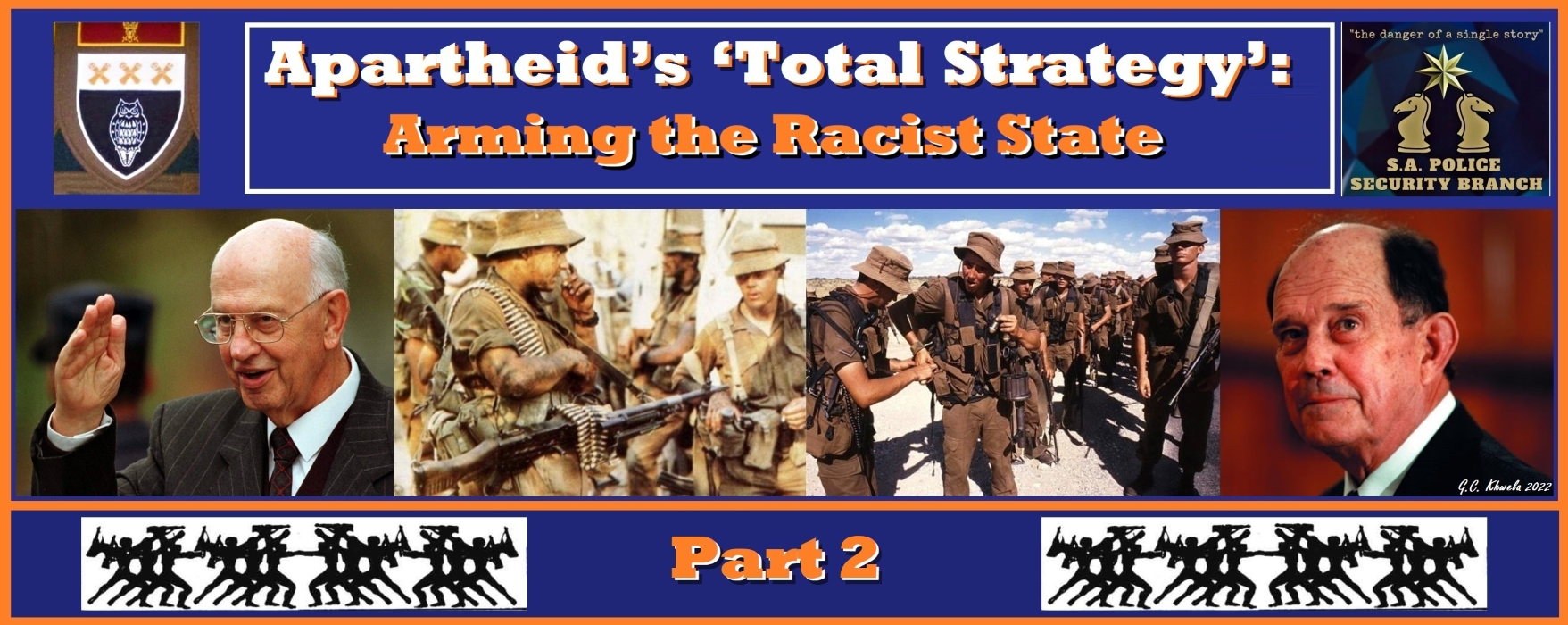
Apartheid’s ‘Total Strategy’: Arming the Racist State – Part 2
As concluded in Part 1, the acceptance of the “total national strategy” had two important effects – it changed the organisational structures, and it changed the way in which policy, particularly security policy, was made. These effects were witnessed in two practical aspects: the intensive and extensive militarisation of particularly White South African society; and the introduction of the national security management system.
The Militarisation of South African Society
The Defence Amendment Act of 1977 extended compulsory military service for white male South Africans from one to two years, provided for military censorship of the media, and for the commandeering of goods and equipment. In that year, in order to counter the United Nations arms embargo, the apartheid government issued a proclamation under the National Supplies Procurement Act of 1970, enabling the Minister of Economic Affairs to order the manufacture and delivery of any goods and to take over any supplier which refused to comply.
The Armaments Development and Production Amendment Act of 1977 transferred responsibility for the procurement of arms from the Armaments Board to The Armaments Corporation of South Africa (Armscor), thus streamlining the production and acquirement of arms and military material. Armscor was originally established in 1968 as an arms production company, primarily as a response to the international arms embargo by the United Nations due to apartheid policy, which began in 1963 and was formalised in 1977. The corporation pursued both covert arms deals and black-market purchases in an effort to acquire restricted defence technologies as rapidly as possible. The embargo encouraged South African efforts in diversifying suppliers while assuming indigenous production of some equipment.
The Civil Protection Act of 1977 gave provincial authorities the power to enact ordinances for civil protection and gave the Minister of Defence the power to declare an immediate three-month state of emergency without prior recourse to Parliament. In addition, there were a number of other ‘tightening up’ measures which the regime has taken, like the Explosives Amendment Act of 1977 and the Civil Aviation Offences Act of 1978, which, in turn, attempted to curb bomb threats and hoaxes and to improve aircraft and airport security.
But it was not enough for the regime to prepare an armoury of legislation to close up all conceivable loopholes in its system of repression. It had also to prepare the minds of white society for the coming conflict. Therefore, from time white children were at school, they were taught so-called ‘Youth Preparedness’ courses – courses which did no more than prepare them for the violent adulthood of white supremacy. More and more white schoolchildren were being involved in cadet training – basic military preparation for their post-school years.
Once in the Defence Force itself, young soldiers were being subjected to intensive propaganda, which was a programme of civil-military relations emphasising loyalty to the apartheid state and a deep hatred for so-called “communism”, which was in fact conceptualised as a threat to “necessary white supremacy” and “free-market capitalism” in the South African context. As the ‘Defence White Paper’ of 1975 put it: “The ideal is to motivate every young person in uniform … and to promote a positive approach to citizenship. Knowledge of subjects such as modern ideological tendencies and world trends, a deeper insight into the problem of Africa, and the part R.S.A. can play in it, has become vital to every citizen of the state.”
In addition, newspapers, magazines, radio, television, the cinemas, commercial advertisers were frantically glorifying the military and its soldiers and justifying their role as the ‘defenders of western civilisation in Africa’. At the same time, White civilians specifically were being increasingly drawn into the militarisation process. Over 700 White civil defence units were established throughout the country to “maintain the community’s essential services in times of emergency”, and more than 750 000 Whites were issued with licences to carry civilian arms. White women were being encouraged to join the Defence Force, and many began to do so.
In accordance with the apartheid tactic of divide and rule by drawing Blacks into its repressive apparatus, unemployed African, Indian and Coloured youths were being recruited into special racial units – like the 21 Battalion that was based at Lenz – and some of these black units were being sent into the front line against the South West African People’s Organisation (SWAPO) in Namibia. Also, South African trained and equipped Bantustan armies were being pushed into battle against Umkhonto we Sizwe (MK), as it happened in Bophuthatswana, Venda and the Transkei. These three “independent” Bantustans became used as barriers to the infiltration of Umkhonto combatants into South Africa due to their proximity to the borders with neighbouring African states.
Accordingly, through this policy of “Total Strategy”, all the resources of the regime were being channelled into the suppression of the people’s revolutionary struggle and what was referred to as a “Border War” in Angola, Namibia and Rhodesia. While some people were backing away from the seemingly unshakeable power that the racists were building up, what in reality was being witnessed was the final desperate attempts of a doomed regime to halt the inevitable march of history.
In spite of all its attempts to stand in the path of history, the regime was finding history to be more resourceful than it had bargained for. For instance, one of the problems that the racist military faced was that not all white South Africans were willing to give their lives in defence of apartheid. In 1976, for example, of the 63 104 men called up for military service, 37 518 (60%) applied for exemption or desertion, and 36 448 were successful. In the same year, 3 566 men failed to report for training, an offence which carried a stiff penalty. This meant that in 1976, 17% of the men obliged to report for military service failed to do so.
The number of men failing to report for duty was increasing every year. In 1975, it was 3 314 men. It grew to 3 566 in 1976 and 3 814 in 1977. Whatever the reasons for the growing unwillingness to fight for the regime, whether political opposition to apartheid or plain self-preservation, the racist regime was faced with a problem of demoralisation, a problem that was growing as the struggle was developing. The importance of this factor in weakening the military might of the racist regime was expressed in their own words: “Although we may possess the most modern and sophisticated weapons and equipment, we would still not be proof against attack or internal disintegration if the men and women who have to handle and maintain the weapons and equipment did not possess the right inspiration, dedication …” (Defence White Paper 1973).
In addition to this problem, the military machine of fascism in South Africa had other flaws and weaknesses. One of the biggest challenges, was the 1979 Iranian revolution, which threatened South Africa’s largest source of oil. Before the revolution, 95% of South Africa’s oil came from Iran. All of South Africa’s airplanes, tanks, ships and armoured cars were useless without fuel to run them. The massive international campaigns to end links with South Africa, especially in the economic and military spheres, implied that the regime had to spend valuable time, effort and resources in trying to create alternative sources of fuel, arms, equipment and finance. Eventually, the involvement of many of the country’s economically active White population in the military also became a huge strain on the economy.
The militarisation of South African society demanded comprehensive changes in public administration and the allocation of resources, and the apartheid regime had to integrate efforts of the entire state in what was coined as the National Security Management System (NSMS). The NSMS was essentially established to integrate the efforts of the entire government and its assets towards sustaining white supremacy and protecting the racist state with the SADF, Police and Intelligence services as the core of the system and managed by the State Security Council (SSC).
The National Security Management System (NSMS)
In order to effectively implement and execute the ‘Total Strategy’ and to muster all the resources and the country’s, particularly White, population, the Botha apartheid administration introduced the National Security Management System (NSMS) on 16 August 1979. Since ‘total strategy’ in this context was a state of affairs wherein all the elements of the elite – politicians, bureaucrats, businessmen, the press, and state security apparatus – had their activities tied down to a single overriding objective of defeating the ‘total onslaught’, the NSMS became a centralised state structure of administration with immense political power, outside of parliament, and in which the police, military and intelligence agencies played an important role. The task of the NSMS was to manage South Africa’s four power bases, that is, the political, economic, social/psychological and security as an integrated whole.
The official perceptions of the situation towards the end of 1979 were that those associated with the SADF produced a superior understanding of the threats facing the apartheid state, and the best ideas at an appropriate time on how these should be countered. When comparisons were undertaken of the various departments responsible for national security, it was ultimately conceded that the SADF was more efficient and prepared, with serious wrongs being attributed to civilians. Bureaucrats and politicians often claimed that the military produced superior and timely ideas, that military men were leaders, and that the SADF best knew how to do things. From beyond official circles, even the highly critical interpretation that the NSMS was the real but covert government, ironically supported such a line of reasoning.
The NSMS was headed by the State Security Council (SSC), which was an existing body that had already been established following the report of the Potgieter Commission of enquiry into security matters headed by Judge HJJ Potgieter. The B.J. Vorster regime in 1972 established the State Security Advisory Committee (SSAC), as a single national security agency to co-ordinate information from subordinate bodies. This was followed by the adoption of the Security Intelligence and State Security Council Act of 1972, which thus became a single voice to advice the Cabinet on ‘matters relating to the security of the state’. However, the SSAC was rendered ineffective under Vorster as it remained politically and legally subordinated to the Cabinet.
In 1979, and in particular with the adoption of the ‘Total Strategy’ concept, the SSAC was changed into an effective, integrated mechanism under PW Botha’s leadership, and it was rechristened the State Security Council (SSC). The SSC became technically a cabinet committee responsible for making and implementing decisions related to state security and the focal point of all national decision-making and governmental power. Along with three similar bodies – for economic, welfare and constitutional matters – the SSC was responsible for direction and overseeing the NSMS, while the other three committees being in charge of the National Welfare Management System.
The NSMS was chaired by the Prime Minister, later the State President, and it included the most senior minister in the Cabinet, primarily the Ministers of Defence and Home Affairs, the Ministers of Constitutional Development and Planning, Finance, Law and Order and Justice. Also included were the Chief of the SADF, the Commissioner of Police, the Director-Generals of Home Affairs, Justice and Foreign Affairs, and an appointed Secretary of the SSC, who was largely selected from the SADF. Other minister could be co-opted as necessary to attend specific meetings.
Within the SSC, was a Working Committee, which was the engine, as it did most the preparatory work and made recommendations to the Council. It co-ordinated the activities of the directors-general of government departments and the chairpersons of the Cabinet working committees with regard to security. The Working Committee, chaired by the Secretary of the SSC (at that time it was Lt General van Deventer) consisted of 14 members, which included the heads of government departments and the chairpersons of the Cabinet Committees for finance and economic affairs, social issues and constitutional matters.
The SSC Secretariat – also chaired by the Secretary of the SSC – co-ordinated and evaluated the work of all intelligence systems, as a vehicle through which Cabinet security decisions were passed for implementation by the NSMS as a whole. It was made up of four branches: strategy, national intelligence interpretation, strategic communication and administration. It had a staff of 45 personnel, of whom 70 percent were SADF, 20 percent national intelligence and the last 10 percent foreign affairs.
Below the SSC was the Interdepartmental Committee (IDC) that coordinated public sector activities of the NSMS in the security field. It was powered to refer strategies or particular problems to the relevant government department, as most of the national security policy recommendations originated from it. The IDC was composed of the interdepartmental committees for Manpower, Civil Defence, Transport, Security, National Supplies and Resources, Government Funding, National Economy, Telecommunications and Electrical Power Supply, Science and Technology, Community Services, Culture and Political Affairs. Each committee had a member of the SADF sitting in it.
The other important component of the NSMS, was the Joint Management Centre (JMC), which was responsible for co-ordinating all government departments in the implementation of area strategies to deal with security problems. JMC areas were based on the 11 SADF Command boundaries, and this was expected to change as economic development evolved. The JMC was composed of three branches: The Joint Intelligence Committee; the Political, Economic and Social Committee; and the Communications Committee. Except for the Department of Justice, all other government departments were represented in the JMC, and the SADF Area Commander was also a member, and it was either chaired by a senior military or police officer.
There were 60 Sub-Joint Management Centres nationally, which were basically JMCs that operated at a regional level, with the SADF regional commander being a member. At a local authority level, 338 Mini-Joint Management Centres were established, covering just about every population area in the country, with the chief of police being a member.
The Efficacy of the NSMS
During one of the presentations conducted at the 4th “War and Society in Africa” Conference at the University of Stellenbosch in September 2003 on the contribution of Umkhonto we Sizwe (MK) to the defence of the African Revolution in Angola, one of the former senior SADF officers questioned MK’s military prowess in the battlefield. His argument was that going toe-to-toe MK could not defeat the SADF militarily.
It was agreed with him that this was true, however that was why MK defeated the SADF, because the entire war was not being fought militarily in the battlefield. It was fought on the ideological and political sphere, where MK rendered the SADF ineffective, as its ideological and political foundation was weak: Afrikanerdom. Despite having a well-structured and financed national security management system, the best military capabilities in the continent and being able to fight effectively as far as Angola, the whole enterprise was bound to fail, as it was created and institutionalised to promote and protect white supremacy.
Undoubtedly, the national security management system was clearly a centralised state structure which enabled government to undertake certain measures in the area of security which were seen as critical to the support of the social order and to the organisation and marshalling of forces against the South African revolution. For Umkhonto we Sizwe cadres that were operating on the ground inside South Africa, the Joint Management Centres (JMCs) network, which covered the whole country, posed a serious problem. The Joint Intelligence Committee allowed the police, the military, the intelligence service and military intelligence to pool intelligence at a local level. Such coordinated action gave the racist regime an improved capability in identifying individuals and groups that were opposed to it.
The system was hugely effective that they knew precisely who was at what meeting and what was discussed, by whom and who responded. Tabs were kept on important community figures that their movements were always under observation. the state. Whereas secrecy formerly mainly concerned events related to the central government, the NSMS created undisclosed spending on regional, sub- and mini- regional, and local levels. Furthermore, the NSMS perpetuated battles among security agencies over how best to manage South Africa’s security challenges.
Despite its efficacy in countering the revolutionary efforts of the national liberation movements inside the country and in South West Africa (Namibia), especially the ANC and SWAPO respectively, enduring differences concerned the weight to be given to international or regional and domestic security, with emphasis on relatively high technology and labour-intensive spending. The domestic preoccupation of the NSMS certainly favoured increased funds for the apartheid police and other policing institutions, rather than the SADF, and hence the more dire needs of some communities were met, albeit on a very selective basis. Rechannelling of funds to meet the regional needs of the SADF in its so-called “Border War” and sustaining its efforts in Angola, strained the security budget earmarked to maintain the NSMS.
As a result of a mounting revolutionary situation inside the country, in April 1986, the SSC developed guidelines to adopt a counter-revolutionary war by using anti-revolutionary groups within South Africa to counter the arming of black communities by Umkhonto we Sizwe through the arming and training of anti-ANC groups. On 9 May 1986, the SSC received a document concerning the need for an establishment of a new force to counter revolutionary forces and consensus was reached in the council to create such a force. This resulted in the formation of the Civil Cooperation Bureau (CCB) as a front company, which was launched by the SADF Special Forces that May.
In June 1986, Operation Marion was approved by the SSC with the SADF Directorate Military Intelligence being responsible for training Zulu Inkatha paramilitary forces to counter ANC forces in the townships particularly in Natal and later in the Pretoria-Witwatersrand-Vaal areas. With the relative success of this strategy in Natal, it would be attempted in the Ciskei, Transkei and KwaNdebele Bantustans. As revolutionary fire spread throughout the country, on 12 June 1986, the apartheid government, which had cancelled the limited State of Emergency on 7 March 1986, re-extended it to the whole country. Its purpose was to restore law and order, normalise life in the townships so as to create “a circumstance for constitutional, economic and social development”.
However, in spite of all these interventions, the NSMS failed to dampen the revolutionary situation and counter the “Onslaught” it was designed to contest. There were a number of factors that were attributed the failure of the “Total Strategy”, and its efficiently designed NSMS, which were combined with strategic errors. Primarily was the fractious inability of the ruling elite to deliver reforms that were sufficiently substantial to curtail an emerging revolution. Central to this was the destruction of the untenable apartheid system, the inability to dismantle the apartheid apparatus, and the failure to recognise the growing support for the anti-apartheid liberation movement, both internally and internationally.
The inability to define precisely the political complexity of South Africa’s population in order to defeat the emerging revolution waged by the liberation movements was largely due to the failure to recognise that the apartheid system was ultimately doomed to collapse and the myopia to respond positively to the growing popularity of the anti-apartheid resistance movement globally. Apparently, the apartheid regime failed to recognise the fact that the war they were facing was political rather than military and could not be won in the battlefield. Resources were consumed on expanding and bolstering security and military capabilities instead of creating conducive conditions to engage the national liberation movements to find a mutually beneficial political solution.
Other views correctly contend that “total strategy” erroneously became a policy managed by generals instead of politicians, who waged a war through conventional means against a politically driven revolution, which implied that nothing was learnt from the Indochinese and Algerian experiences. The fact that the armed struggle led by the African National Congress and its People’s Army, Umkhonto we Sizwe, was the struggle of the oppressed, who increasingly sided with and shielded the guerrillas, while at the same time exposed their enemy, implied that the militarisation of the racist state was to ultimately be in vain. Based on historical experiences, “no military machine can in the long run suppress the popular struggle of an armed, organised and determined people”.
Sources:
Wikipedia.
South African History Online (SAHO).
Sechaba Correspondent, “S.A.’s ‘Defence’ Strategy”, Sechaba, April Issue 1979.
Colonel James T. Murray, “The Growing Political Influence of the South African Military”, Air War College, Air University, Maxwell Air Force Base, Alabama, March 1986.
Comrade Ramat, “Pretoria’s Security System: The Network that Spreads Across the Country”, Sechaba, January 1987.
James Selfe, “The Total Onslaught and the Total Strategy: Adaptations to the Security Intelligence Decision-Making Structures under P W Botha’s Administration”, MA: University of Cape Town, 1987.
Annette Seegers, “South Africa’s National Security Management System, 1972-90”, The Journal of Modern African Studies, Vol. 29, No. 2, June 1991.
GC Kwhela, “Umkhonto We Sizwe’s Contribution to the Defence of the African Revolution in Angola”, Southern Journal for Contemporary History, Vol. 28, No. 2, 2003.
Isaac Mohlolo Siko, “A Critical Review of South Africa’s Approach to the Concept of National Security Since 1994”, Master of Security Studies (Mss): University of Pretoria, January 2007.
Niël Barnard, “Secret Revolution: Memoirs of a Spy Boss”, Tafelberg, 2015.
Castro Khwela
Good evening fellow Compatriots!
Discover more from CASTRO KHWELA
Subscribe to get the latest posts sent to your email.