The Gugulethu Seven: 40 Years On
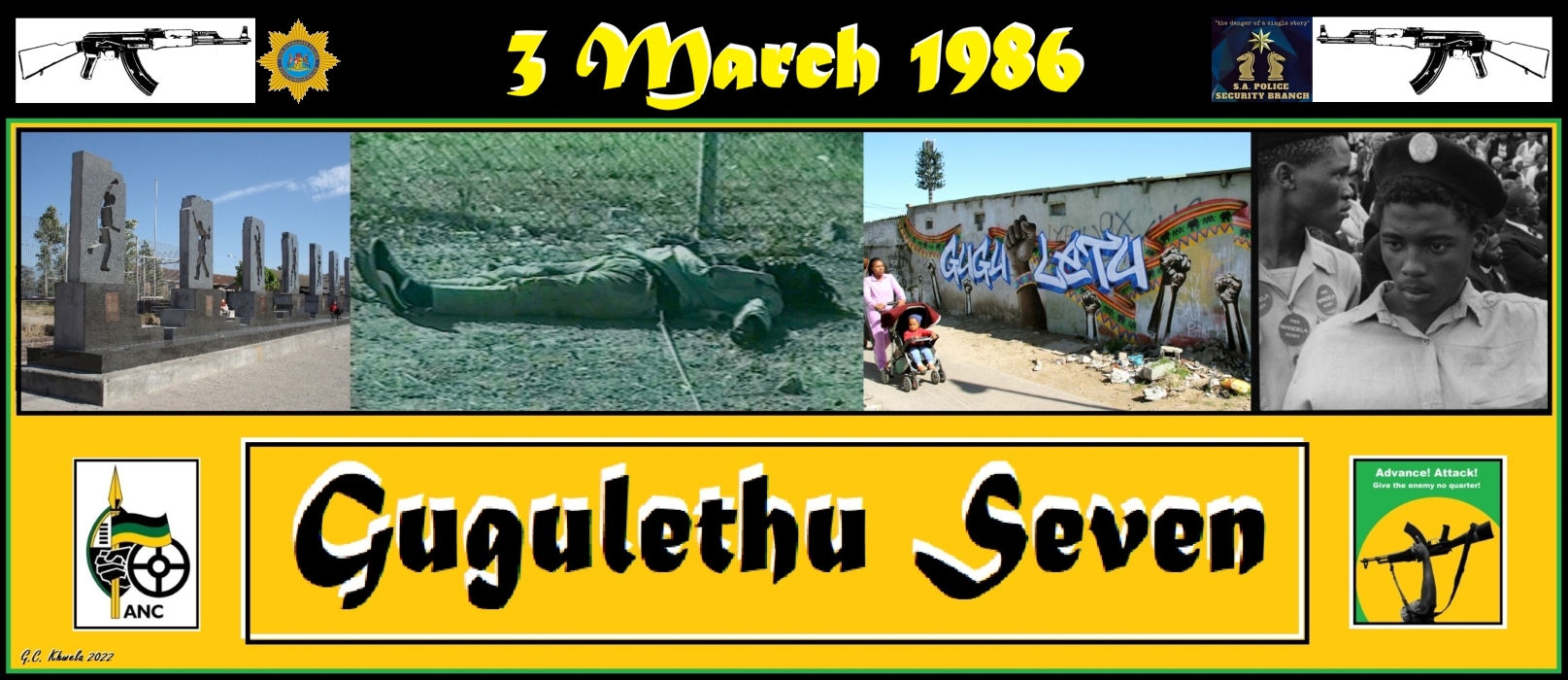
On 3 March 1986, an anti-apartheid group of young activists between the ages of 16 and 23 were shot and killed by members of the apartheid police force in the Gugulethu township of Cape Town, who were thereafter referred to as “The Gugulethu Seven”. The seven young men included Mandla Simon Mxinwa, Zanisile Zenith Mjobo, Zola Alfred Swelani, Godfrey Jabulani Miya, Christopher Piet, Themba Mlifi and Zabonke John Konile. It was later uncovered that the police operation that unearthed the Gugulethu Seven’s plans had been in the works for some time.
In the mid-1980s, there was a dramatic rise in Umkhonto we Sizwe (MK) operations, the armed wing of the African National Congress (ANC). In response, General Griebenouw of the Western Cape Security Branch called upon Brigadier Schoon of the Security Branch Headquarters in Pretoria as well as the assistance of an apartheid death squad, led by Vlakplaas commander, Eugene de Kock. De Kock chose Sergeant Rian “Balletjies” Bellinghan to lead an operative team ordered to intervene with anti-apartheid operations. The men chosen as part of the team were Thapelo Johannes Mbelo, Joe Coetzer, and other Vlakplaas askaris like Gladstone Mose (aka “Jackson Mlenze”), Eric “Shakes” Maluleke and Xola Frank “Jimmy” Mbane.
The operative team was based in Koeberg. In early January 1986, they drove into Cape Town aboard three vehicles, one of which was a minibus with weapons and explosives concealed inside. After several failed attempts to infiltrate Mbelo into the Gugulethu underground unit, after having acted as a political detainee in police cells in the Cape Town police stations, Mbane and Maluleke were sent in. Mbane and Maluleke, who reported to Bellinghan and Johannes Liebenberg, were successful at slipping-in and gaining the trust of the Gugulethu unit over time.
At first, they were given weapons and grenades and went to the home of Yamile (the squatter-camp leader), where they told Yamile that they were commanders from exile and showed him their weapons in the minibus. Yamile then introduced Mbane and Maluleke to Christopher “Rasta” Piet, a member and the supposed leader of the Gugulethu unit. It is said that Mbane and Maluleke even helped fix Piet’s own faulty AK-47 at one point.
Over the next two months, Mbane trained the youth in basic military combat techniques while Maluleke gave them political education. Piet seemed to be the only youth that had previous combat training. Mbane and Maluleke also had the youth write down their autobiographies, which was a standard practice within MK. It was later discovered that Mbane gave those to Bellinghan. Eventually, an attack was planned for 3 March 1986 that was to target a police bus that ferried senior policemen to Gugulethu station every morning. Mbane informed Bellinghan and Liebenberg, who began making preparations for the event.
On 3 March 1986, 25 heavily armed police were briefed and deployed at Wingfield Naval Base at 03:00. The intended target area was surrounded and occupied by police by 05:00. Mbane, driving a stolen bakery van, dropped the seven youth off at the site around 07:25. Allegedly, grenades were thrown by the Gugulethu unit and the police started firing from all sides. Reports say that Piet was the only one who had time to fire back, as they were all instantly killed. It was later reported that Piet suffered 12 bullet wounds to his head.
After the killings, witnesses made shocking allegations to a local newspaper, with one claiming that a man with his hands in the air was shot without any mercy. Another witness alleged that a badly wounded man had been shot through the head several times and finished off as he lay dying. The Gugulethu Seven’s deaths led to an inquest in 1986, and a trial in 1987, which was later reopened in 1989. The findings by Wynberg magistrate, Hoffman, were that the seven men had died in a legitimate anti-terrorist operation.
Ultimately, the apartheid police officers successfully applied for amnesty at the Truth and Reconciliation Commission (TRC) for the killings. These were Rian Bellinghan, Thapelo Mbelo and Xola Frank “Jimmy” Mbane. However, the TRC amnesty hearings exposed the full inhumanity of those who had participated and how they had glibly lied, planted weapons and gloated at their work and their lawlessness. The official legend by the apartheid security police was that they had been ambushed by a “terrorist” unit, members of MK, the ANC’s banned armed wing, who surprisingly attacked them, and they had simply retaliated, killing all the insurgents.
For their help in exposing and leading the Gugulethu Seven into fire, Mbane and Maluleke were given bonuses of R7000 (one thousand rands for each victim) each. The apartheid Minister of Law and Order, Adriaan Vlok, presided over the occasion and the video was used to get Cabinet to approve further funds for the Vlakplaas budget. Mbane was said to be the central character in this entire episode, whom Joe Mamasela (a fellow Askari) described as a serial killer, who was mentally unstable, and a rapist.
If one compares the Gugulethu Seven episode to the COSAS 4 Chapter, wherein four young students were locked in a storeroom near a mine shaft, and blown with explosives by the same Vlakplaas Unit, Mbane played a similar role to that of Ephraim Tlhomedi “Shorty” Mfalapitsa.
On 21 March 2005, Human Rights (or Sharpeville) Day, a monument was erected in Gugulethu honouring the lives of the Gugulethu Seven. It is outside the Gugulethu police station on the corner of NY1 and NY111, right near where the Seven, including Christopher “Rasta” Piet, were shot in cold blood.
THEIR DEATHS WERE NOT IN VAIN!
Sources:
Wikipedia.
South African History Online (SAHO).
Grassroots Reporter, “Big Show of Support: Thousands Display ANC Colours as Seven Buried”, Grassroots, Vol. 7, No. 2, March 1986.
Truth and Reconciliation Commission, “Truth and Reconciliation Commission of South Africa Report”, Vol. 2, Chapt. 3, Subsection 43, Truth and Reconciliation Commission (TRC), 29 October 1998.
Truth and Reconciliation Commission, “Truth and Reconciliation Commission of South Africa Report”, Vol. 3, Chapt. 5, Subsection 34, Truth and Reconciliation Commission (TRC), 29 October 1998.
Antjie Krog, Nosisi Mpolweni and Kopano Ratele, “There was this Goat: Investigating the Truth Commission Testimony of Notrose Nobomvu Konile”, UKZN Press, 2009.
Jacob Dlamini, “Askari: A Story of Collaboration and Betrayal in the Anti-Apartheid Struggle”, Jacana, 2014.
Thula Simpson, “Umkhonto we Sizwe: The ANC’s Armed Struggle”, Penguin, 2016.
Robin Binckes, “Vlakplaas: Apartheid Death Squads 1979 – 1994”, Pen and Sword Books, 2018.
Marianne Thamm, “Mass murder for a bigger budget — killing of Gugulethu Seven was a cover-up worse than Watergate”, Daily Maverick, 12 May 2024.
Castro Khwela
Good day fellow Compatriots!
Discover more from CASTRO KHWELA
Subscribe to get the latest posts sent to your email.