Bantu Authorities Law Establishes Ethnic Fragmentation, Land and Citizenship Theft
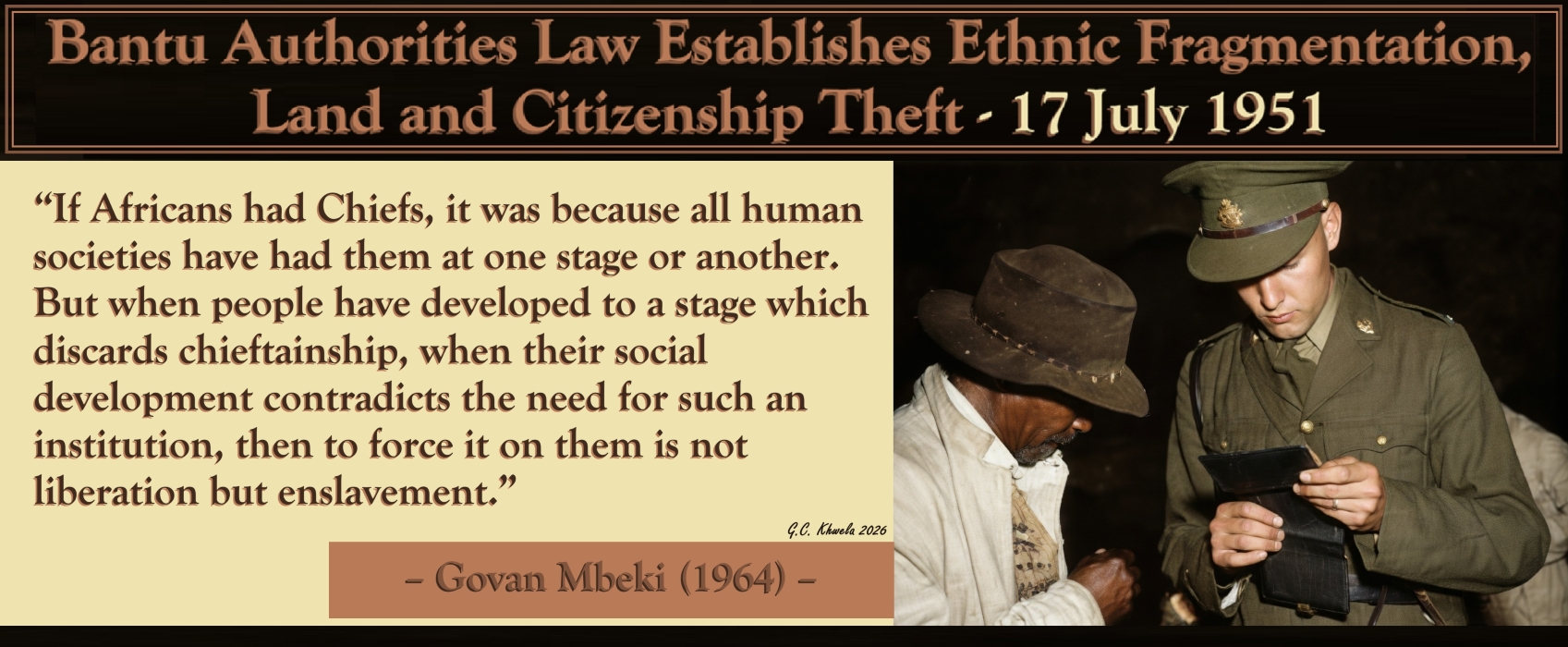
On 17 July 1951, exactly 75 years ago, the Bantu Authorities Act, 1951 (Act No. 68 of 1951) officially came into effect in South Africa. This cornerstone apartheid legislation abolished the Natives’ Representative Council and established a system of tribal, regional, and territorial authorities, laying the groundwork for the creation of Bantustan “homelands” designed to strip Black South Africans of their citizenship. The Act was a critical turning point that institutionalised geographic segregation and land dispossession. By establishing these separate authorities, the apartheid government aimed to force Black South Africans to exercise political rights only within designated Bantustans, effectively denying them a voice in the central South African government.
This legislation structurally altered the country by establishing local councils headed by traditional chiefs approved by the apartheid regime. It combined multiple tribal authorities to manage larger geographic areas and created the highest level of administrative governance for each specific ethnic group. The legislation laid the legal groundwork for the subsequent 1970 Bantu Homelands Citizenship Act and fragmented the Black majority into distinct ethnic identities to weaken unified national resistance. The Act effectively achieved this by dismantling inadequate “democratic” representation and replacing it with a severe state-controlled hierarchy that bound political rights directly to fragmented, ethnically defined pieces of land.
The Act stripped Black South Africans of the national political voice by abolishing the ineffective Natives’ Representative Council and enforcing a strict, state-controlled hierarchy wherein the Minister of Native Affairs established local councils. The government appointed traditional chiefs to lead them, filtering out any leaders who opposed racist and oppressive state policies. These bodies grouped multiple tribal authorities together where they managed larger geographic areas under the strict supervision of white native commissioners. This highest level combined regional authorities into single administrative bodies for entire ethnic groups, for example, Zulu, Xhosa and Tswana, and thus served as the proto governments, with quasi-sovereignty, for what would become the Bantustans.
What this Act did in effect was that it turned the colonial reserves – which made up just 13% of South Africa’s land under the 1913 and 1936 Land Acts – into permanent, state-managed ethnic enclaves. By legalising these distinct Bantustan “homelands”, the regime ensured that the remaining 87% of the land, including all major cities and economic hubs, was legally preserved for the white minority. The fundamental purpose of this tier system was to shift the political focus of Black South Africans away from the central government and by forcing individuals into local territorial units, the state argued that Black South Africans were not citizens of the wider Republic of South Africa, but rather citizens of their respective tribal homelands.
This structural division directly enabled the passage of the Bantu Homelands Citizenship Act of 1970. That law finalised the plan, stripping millions of Black South Africans of their South African citizenship overnight and turning them into aliens in the land of their birth. The Bantu Authorities Act of 1951 provided the essential administrative machinery and destination dumping grounds that made the mass forced removals of the 1950s and 1960s logistically possible. While the Group Areas Act of 1950 served as the legal weapon to evict people from urban “white” areas, the Bantu Authorities Act created the bureaucratic pipelines to receive and control them in the rural reserves.
Before the state could evict millions of people from cities and fertile farming “black spots”, it needed designated places to put them. The Act legally formalised the fragmented rural reserves into distinct territorial units, which served as the geographical destination points where urban deportees and evicted farm workers were dumped. The state used the Act to replace independent, resistant traditional chiefs with government-salaried collaborators. These state-appointed tribal authorities were given the administrative duty to verify tribal affiliations, issue homeland documentation and process incoming displaced people. Traditional leaders who resisted state-ordered land consolidation or refused to accept relocated populations were stripped of power, banished or jailed.
This piece of legislation worked in tandem with the Native Laws Amendment Act of 1952 to enforce strict influx controls, that were largely referred to as the “pass laws”. Black South Africans in urban spaces had to prove employment or family ties to remain in those areas. Anyone who failed to meet these strict urban criteria was declared an “idle or undesirable person” and was systematically processed through the tribal authority network to be deported back to their designated homeland.
The regime used the Act’s framework to ethnically cleanse the rural landscape, for example, black farmers who owned land outside the designated reserves – designated as “black spots” – were forcibly removed. Their ancestral property was expropriated and sold cheaply to white farmers, while the families were forced into the overcrowded, barren borders managed by the territorial authorities.
Because the Act legally established that a Black person’s true home and political destiny lay in the rural Bantustan homelands, the apartheid state felt justified in flattening vibrant, multi-racial urban neighbourhoods. This directly enabled the destruction of communities like Sophiatown in Johannesburg (1955), where over 60,000 residents were uprooted at gunpoint and segregated into distant townships or rural reserves.
The apartheid regime created ten distinct Bantustans, which were structurally designed to be economically unviable, geographically fragmented, and politically dependent on the white minority government. The homelands were purposefully carved out of South Africa’s least productive land, accounting for only 13% of the total country’s land. Most Bantustans were not continuous territories, as for example, Bophuthatswana was split into seven separate enclaves, and KwaZulu was a patchwork of roughly 40 distinct fragments of land. The borders were carefully drawn to exclude all major cities, industrial hubs, valuable mineral deposits, and fertile farming regions, leaving the homelands ecologically degraded and overcrowded.
The primary strategy of the Bantu Authorities Act was to divide the Black majority into ten artificial, ethnic “nations” to prevent unified resistance against the white minority. Four were granted nominal “independence” (the TBVC states), though no foreign nation ever recognised them, and the other six remained “self-governing” territories. The Bantustans were never intended to be self-sufficient nations; they functioned as storage zones for the labour required by white-owned industries. Because the Bantustans lacked local industries or commercial agriculture, millions of men were forced to leave their families to work in white-owned mines, factories and farms on temporary contracts.
The administrative budgets of these homelands were funded almost entirely by direct subsidies from Pretoria, ensuring the puppet governments remained loyal to the apartheid state. Pretoria installed, financed and armed local Black elites who were willing to enforce apartheid rule in exchange for personal wealth and power. Dictators like Kaiser Matanzima in Transkei and Lucas Mangope in Bophuthatswana used brutal police forces, banishments and states of emergency to violently crush anti-apartheid resistance, trade unions and liberation movements within their borders.
The imposition of the Bantu Authorities Act shattered the fragile peace in South Africa’s rural reserves, sparking a wave of violent peasant rebellions and organised armed resistance throughout the 1950s and early 1960s. Rural populations did not passively accept the loss of their land and citizenship; instead, they fiercely resisted the apartheid state’s encroachment. The system triggered widespread rural revolts due to specific structural changes. Historically, traditional leaders ruled by popular consensus, but the Act fundamentally broke this contract by making chiefs accountable to white Pretoria officials rather than their own communities.
Chiefs were given salaries and armed power to enforce unpopular laws, collect taxes and facilitate forced removals. Communities viewed collaborating chiefs as traitors and “stooges” and resistance often began locally, with villagers burning down the homes and seizing the livestock of government-appointed chiefs who supported the Act. The Legislation was used to enforce top-down agricultural restructuring programmes, known as “Betterment Planning”, without consulting the local people. The apartheid state claimed the reserves were overpopulated and mandated the forced culling of African livestock, rigid land fencing and the relocation of traditional homesteads into concentrated villages. To rural peasants, cattle represented wealth and survival. Therefore, forcible culling and the division of arable land felt like a deliberate plot to impoverish them and force them into cheap mine labour.
As detailed by liberation leaders like Govan Mbeki in “The Peasants’ Revolt, several major rebellions erupted in quick succession.: The most significant and highly organised rural rebellion was the Mpondoland Revolt (1950 – 1961). Villagers in the Eastern Cape explicitly rejected Bantu Authorities and formed a rival mountain-based administration known as the “Intaba” (Mountain) Committee. They boycotted white-owned businesses and refused to pay taxes. Similarly, the Sekhukhuneland Uprising (1958), in the northeastern Transvaal, the Pedi people rose up against the state’s attempts to depose their rightful leaders and replace them with submissive tribal authorities.
The Marico (Zeerust) Revolt (1957 – 1958), which was spurred heavily by the state’s attempt to extend the dreaded “pass laws” to Black women, local communities and traditional leaders refused to comply, leading to widespread riots, arson and a brutal police crackdown. Also, the Witzieshoek Rebellion (1950) in the Orange Free State, Basotho farmers took up arms to resist stock culling, resulting in open firefights with the apartheid South African police.
Because these uprisings threatened the entire economic foundation of grand apartheid, the Nationalist government responded with overwhelming military and legal force. The racist regime passed harsh emergency regulations, such as Proclamation 400, which effectively banned all meetings and allowed indefinite detention without trial in rural areas. The army occupied rebellious regions. On 6 June 1960, during the Ngquza Hill Massacre in Pondoland, apartheid security forces used helicopters and automatic weapons to gun down a peaceful assembly of protesters, killing at least 11 people and executing dozens more via hanging in Pretoria thereafter.
The liberation movements, primarily the African National Congress (ANC) and the newly formed South African Communist Party (SACP), recognised the Bantu Authorities Act as an existential threat to Black political unity. They launched extensive campaigns, shifted their organising strategies, and ultimately pivoted toward armed struggle partly because of the state’s violent enforcement of this law. The liberation movements responded to the Act through several key strategic actions by completely rejected the premise of the Act, which sought to classify Black South Africans as members of separate “tribes” rather than citizens of a single nation.
The ANC countered this ethnic balkanisation by emphasising a shared national identity. This vision was solidified in the Freedom Charter of 1955, which famously declared: “South Africa belongs to all who live in it, black and white”. Liberation media and speakers consistently unmasked the Bantustans as fraudulent, hollow structures designed to legitimise white minority rule to the international community. Historically, the ANC had been largely an urban, middle-class intellectual movement. The Bantu Authorities Act forced a massive strategic shift toward the rural areas. The M-Plan (Mandela Plan), developed by Nelson Mandela, created a decentralised, underground cell structure to keep the ANC operational under restrictive conditions, as it allowed urban organisers to safely connect with rural activists.
Key leaders like Govan Mbeki, Elias Motsoaledi, and Flag Marutle embedded themselves within rural communities, providing legal aid, printing leaflets, and helping to coordinate the local resistance movements, such as the “Intaba” Committee in Pondoland. The liberation movements worked to isolate collaborating chiefs while shielding traditional leaders who refused to comply with the Act. The South African Congress of Democrats (COD) and other allied organisations helped publicise the horrors of the rural crackdowns to urban audiences and international observers.
The ANC politically and legally backed defiant leaders, such as Chief Albert Luthuli, the ANC President-General, who was stripped of his chieftainship by the government in 1952 because he refused to choose between his allegiance to his people and his obedience to the apartheid state. The brutal military suppression of the rural revolts triggered by this Act – such as the Ngquza Hill Massacre in 1960 – convinced liberation leaders that peaceful protest alone would never defeat apartheid.
Seeing peaceful rural peasants gunned down by state helicopters proved to the leadership that the state had closed all avenues of legal dissent. When the ANC formed its armed wing, Umkhonto we Sizwe, in 1961, and the PAC formed Poqo, they drew heavy inspiration and recruitment from the angry, displaced rural populations. Many veterans of the rural revolts fled into exile to receive military training, returning as guerrilla fighters determined to dismantle the homeland system by force.
Sources:
Wikipedia.
South African History Online (SAHO).
Govan Mbeki, “South Africa: The Peasants’ Revolt”, Penguin, 1964.
Truth and Reconciliation Commission, “Truth and Reconciliation Commission of South Africa Report, Vol. 2”, Truth and Reconciliation Commission (TRC), 29 October 1998.
Shane Moran, “Identikit: The Politics of Critical Thought”, Alternation, Vol. 9, No. 2, 2002.
Thembela Kepe and Lungisile Ntsebeza (Ed.s), “Rural Resistance in South Africa: The Mpondo Revolts after Fifty Years”, UCT Press, 2012.
Clement Timase Tlhoaere, “The Interface Between Traditional Leadership in Shared Rural Local Governance”, Master of Arts: Public Management and Governance, June 2012.
Laura Evans, “Apartheid and the Bantustans from Reserves to Reincorporation” In: Daniel Magaziner, (Ed.), “The Oxford Handbook of South African History”, Oxford University Press, 2025.
Greg Hutson, “On This Day: Historic Moments That Shaped Nations, Sparked Revolutions and Changed the World”, Daily News, Independent Online (IOL), 17 July 2026.
Overcoming Apartheid, Building Democracy, “Forced Removals”, South Africa: Overcoming Apartheid, Building Democracy, https://overcomingapartheid.msu.edu/multimedia/kid=163-582-18/
Knowledgebase, “The Former Bantustans”, Knowledgebase. Land, https://knowledgebase.land/the-former-bantustans/
Castro Khwela
Good morning fellow Compatriots!🙏🏾✊🏾👊🏾
Discover more from CASTRO KHWELA
Subscribe to get the latest posts sent to your email.