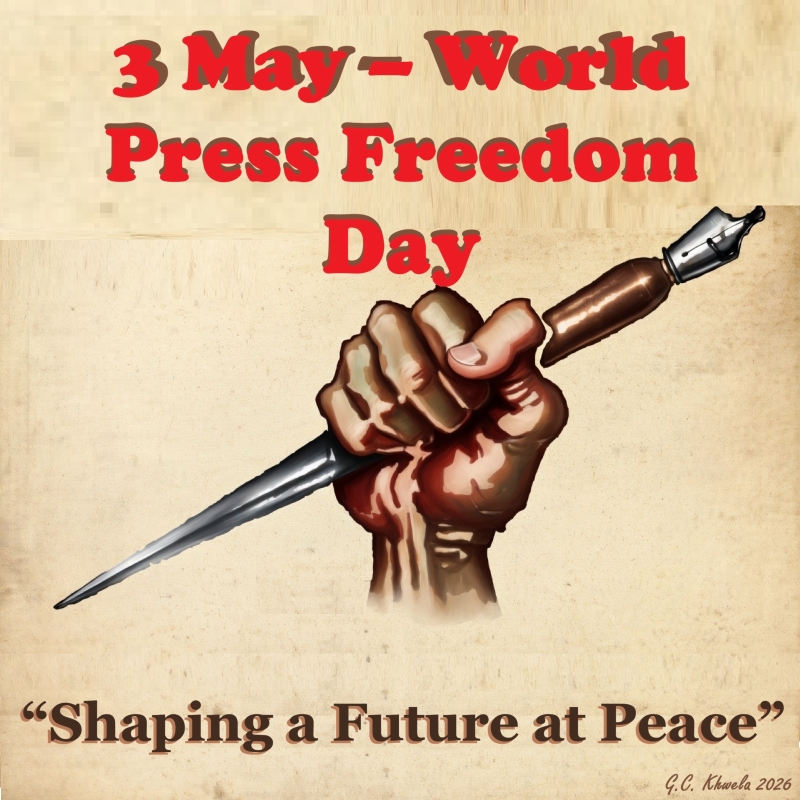
3 May – World Press Freedom Day: “Shaping a Future at Peace”
World Press Freedom Day is celebrated annually on the 3rd of May to highlight the fundamental importance of media independence and to honor journalists who risk their lives to provide reliable information. The 2026 theme is “Shaping a Future at Peace”, focusing on how free and independent journalism contributes to global stability, human rights, and security. The 3rd of May commemorates the anniversary of the Windhoek Declaration, which was a 1991 statement on free press principles developed by African journalists.
The day serves as an opportunity to celebrate the principles of press freedom; assess the state of press freedom worldwide; defend the media from attacks on its independence; and to pay tribute to journalists that continue to face harassment in the line of duty or who have lost their lives, as we have witness these occurrences, especially the killing of journalists by Israeli forces in Palestine. In an era of rising digital threats, disinformation, and conflict, independent journalism is often cited as a cornerstone of democracy and peace. The day reminds the international community that access to reliable information is a human right, even as media professionals face increasing intimidation and violence globally.
World Press Freedom Day holds profound significance for the African continent, as its very origins are rooted in a movement led by African journalists to secure democratic reforms and media independence. The day is celebrated on May 3 to commemorate the Windhoek Declaration, a landmark statement of press freedom principles adopted by African newspaper journalists in Windhoek, Namibia, in 1991. The declaration emerged during a period of democratic transitions across the continent, including the end of the Cold War and the dismantling of apartheid in South Africa. It was the first in a series of regional declarations that eventually led the United Nations General Assembly to officially proclaim World Press Freedom Day in 1993.
In Africa, the day serves as a critical annual benchmark for assessing how well governments uphold the right to information. A free press is essential for investigating corruption, abuse of authority, and ensuring accountability within political systems. It promotes a pluralistic media landscape that allows for diverse perspectives, preventing the monopolisation of news by state or commercial interests. The day therefore provides a high-profile platform for African media advocates to highlight specific regional threats.
Commemorations often honor those working under intense pressure in conflict zones like Sudan, the Democratic Republic of Congo, and the Sahel, where journalists face physical violence and legal harassment. Modern challenges include the “criminalisation of journalism” through misused national security laws, cyber surveillance, and the spread of disinformation via under-regulated digital platforms. In 2026, there is a strong focus on the impact of Artificial Intelligence (AI) on African media, with calls for ethical AI use to protect information integrity and prevent further digital divides.
World Press Freedom Day fosters regional cooperation through organisations like the Federation of African Journalists (FAJ) and the Media Institute of Southern Africa (MISA). Africa frequently hosts the global commemoration, as seen with the 2026 Global Conference in Lusaka, Zambia, co-hosted by the United Nations Educational, Scientific and Cultural Organisation (UNESCO) and the Government of Zambia. Advocacy on this day pushes African states to enact legislation against Strategic Lawsuits Against Public Participation (SLAPPs) and to decriminalise defamation.
In post-apartheid South Africa, World Press Freedom Day is a critical reminder of the hard-won democratic transition from a state-controlled media environment to one of the world’s most progressive constitutional protections for journalists. The primary significance lies in the move from apartheid-era censorship – where banned persons and organisations could not be quoted or photographed – to the enshrinement of freedom of expression in Section 16 of the 1996 Constitution. This provision explicitly protects the freedom of the press and other media; the freedom to receive or impart information or ideas; and the instrumental function of the press as a guarantor of democracy by exposing corruption and misgovernance.
For South Africa, this day celebrates the media’s role in maintaining the checks and balances essential to a young democracy. Investigative outlets play a pivotal role in uncovering large-scale corruption within the state. Broadcast media are viewed as essential during elections to provide platforms for debate and to prevent electoral fraud through public oversight. In South Africa, World Press Freedom Day also serves as a critical annual checkpoint for social media platforms, highlighting their dual role as both powerful enablers of democratic expression and engines for digital threats.
For the social media platforms – and the users who inhabit them – the day underscores the following key shifts and responsibilities in the 2026 landscape. While the 1991 Windhoek Declaration originally focused on traditional newspapers, the 2026 World Press Freedom commemorations reflect the role that “the press” is playing in shaping social lives, which now includes any mobile or digital screen.
Global giants like Meta, Google, and Amazon capture a massive share of ad spend (estimated at nearly 44% in 2024), siphoning funds away from traditional South African newsrooms. Platforms like Facebook are increasingly deprioritising news content in favour of personal posts, which drastically reduces traffic and revenue for local investigative outlets.
In post-apartheid South Africa, social media has democratised the ability to receive and impart information under Section 16 of the Constitution. Platforms allow marginalised citizens to share direct daily experiences that mainstream media might overlook. Every user sharing news effectively becomes a “citizen journalist” with a social responsibility to verify facts and avoid spreading misinformation.
World Press Freedom Day also highlights how the digital era has put media workers at risk, particularly on social platforms. In South Africa, for instance, journalists (especially women) frequently face online bullying and orchestrated harassment campaigns from political groups on social media. Moreover, the 2025/2026 focuses on Artificial Intelligence, highlighting how deepfakes and AI-generated misinformation on social media can undermine public trust and credibility.
Advocates use World Press Freedom Day to call for stronger accountability from tech companies, especially that platforms are urged to be more transparent about how they moderate content and stop the spread of disinformation. The South African Human Rights Commission (SAHRC) Social Media Charter emphasises that while these platforms foster debate, they must not be used to incite violence or infringe on the right to privacy.
While the media is legally free, World Press Freedom Day also highlights persistent and emerging threats in the current period. Journalists continue to face harassment from political parties, including online bullying and physical exclusion from political events. The 2026 theme also emphasises the impact of Artificial Intelligence (AI) and “information disorders” that blur facts and fiction, often used to manipulate public opinion.
There are ongoing debates about media transformation – the concern that news agendas still largely serve urban elites while marginalised rural communities remain underserved. Fears also persist over the Protection of State Information Bill (the “Secrecy Bill”) and the potential misuse of cybercrime laws to target whistleblowers.
Future developments arising from World Press Freedom Day 2026 centre on a “coordinated action” model where media, technology, and legal sectors unite to address the global decline in press freedom. Globally, what is expected is a shift toward human rights–based governance of digital platforms to counter the 10% drop in freedom of expression seen over the last decade. High-stakes debates will continue around the Digital Services Act to create transparent online ecosystems and mandate accountability from tech giants. There is also an urgent global push for laws against the Strategic Lawsuits Against Public Participation (SLAPPs) to prevent wealthy actors from using the courts to silence journalists.
The 2026 theme, “Shaping a Future at Peace”, frames Artificial Intelligence as a pivotal influence that requires immediate ethical standards. Legal and technical mechanisms are being developed to counter “liar’s dividends”, where real media is dismissed as fake due to the prevalence of AI-generated content. While AI streamlines content production, global media councils are committing to transparency guidelines for AI-assisted news to maintain public trust.
In South Africa, the future involves a push for “Sustainable Journalism” to survive the current economic fragility. Following the Lusaka Declaration on Media Self-Regulation, we should expect South African media to reject state control in favour of multi-stakeholder councils that uphold ethics voluntarily. In 2026, audience trust is moving toward personality-led journalism on platforms like TikTok (used by 33% for news) and YouTube (42%), forcing traditional newsrooms to pivot. Governments and media houses are expected to implement Media and Information Literacy (MIL) programmes to help citizens distinguish fake feeds from reliable reporting.
The 2026 conference co-hosted by Zambia marks a new era of continental solidarity. A new regional platform will likely emerge to share best practices and address common challenges like cross-border misinformation. Furthermore, advocacy would enhance the efforts towards the protection of women journalists. We should expect increased advocacy for regional policies specifically targeting online violence against female reporters.
Sources:
Wikipedia.
South African History Online (SAHO).
South African National Editors’ Forum.
United Nations Educational, Scientific and Cultural Organisation (UNESCO).
Castro Khwela
Good morning fellow Compatriots!🙏🏾✊🏾👊🏾
Discover more from CASTRO KHWELA
Subscribe to get the latest posts sent to your email.