MK Special Operations – ‘Operation Blackout’
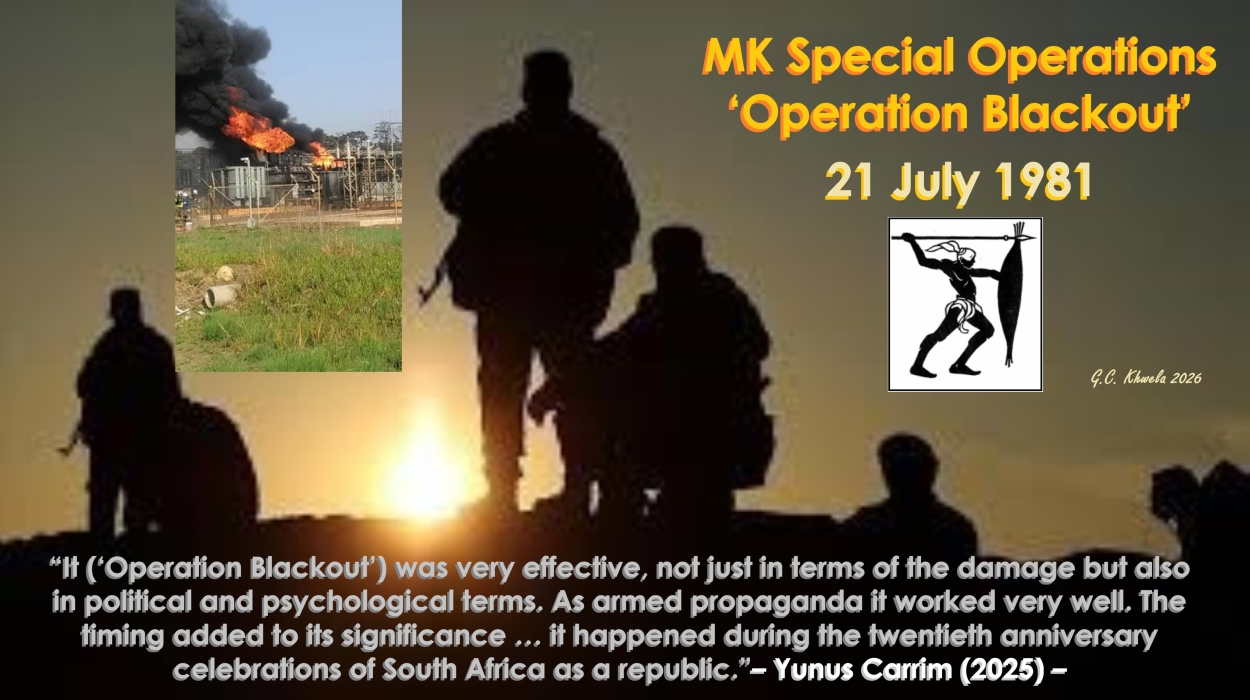
45 years ago, on 21 July 1981, six massive explosions detonated just before 02:00, in the early hours of the morning, at the Camden Power Station, near Ermelo, in the Eastern Transvaal (now Mpumalanga), destroying five transformers and five generator couplings, which ignited a day-long fire and plunging the town of Ermelo into darkness. Roughly 10 minutes later, nine distinct blasts followed at the Arnot Power Station, situated near Middelburg, destroying three transformers and several electricity pylons. After the main power station attacks, approximately an hour later, an additional device exploded at a partially constructed transformer facility at the Delmas (Njala) Substation, on the outskirts of Pretoria.
The African National Congress (ANC) claimed that its underground military wing, Umkhonto we Sizwe (MK), executed a coordinated sabotage operation against critical energy infrastructure. The assault caused millions of Rands in damage and temporarily disrupted the region’s power supply. The operation was part of the MK Special Operations Unit’s ‘Operation Blackout’, targeting strategic sites, such as the power grid, using limpet mine devices, timed to detonate in close succession. No injuries or deaths were reported from any of the three blast sites, aligning with MK’s early strategies targeting state infrastructure rather than civilian personnel.
The coordinated attacks took place on the exact morning a major political terrorism trial of the ANC “Sasol Three”, including Anthony Bobby Tsotsobe, Johannes Shabangu and David Moisi, reopened in Pretoria, delivering a direct symbolic challenge to the apartheid security apparatus. This incident marked a significant escalation in MK’s armed campaign, which included highly publicised infrastructure targets such as power stations, which had become a key target as part of efforts to weaken the apartheid regime by causing blackouts and undermining the economy. The Electricity Supply Commission (Eskom) initially recorded massive financial losses from the crippled high-voltage transformers and generation infrastructure.
‘Operation Blackout’ was led by the Chief of Staff on MK Joe Slovo, and was coordinated by Aboobaker Ismail (aka “Rashid’) with the Operational Commander being Johannes Mnisi (aka “Victor Molefe”). Mnisi was also the Commander of the unit that attacked Arnot Power Station, which included Matome and Derrick, with Philemon Malefo, who was based in Mamelodi, providing transport and logistical support. The Unit that attacked Camden Power Station was commanded by Tebogo Kgope and included Pule and Desert. The final unit which hit the Delmas (Njala) Substation on the outskirts of Pretoria was commanded by Phiwe and it included Danny Boy.
The reconnaissance for the power station bombings was a highly secretive multi-phased intelligence operation managed by MK Special Operations Unit. This unit, created under the direct guidance of ANC President Oliver Tambo, specialised in high-impact infrastructure sabotage. Historical records and the Truth and Reconciliation Commission (TRC) archives revealed that the intelligence gathering was completed using several strategic steps. Primary information for ‘Operation Blackout’ was largely based on documents provided by Frene Ginwala’s Research Unit on South Africa’s energy supply sources as well as by the Internationalist Unit that carried out reconnaissance on power stations, substations, pylons and electric lines.
MK units including White Internationalist allies, who were anti-apartheid and anti-imperialist activists like Klaas de Jonge, Helene Pastoors, Edward Wethli, Helena Dolny and Guido van Hecken initially mapped the targeted sites by driving casual routes around them. Special Operatives cross-referenced paths into South Africa from safe houses in Swaziland (now Eswatini). Under instructions from MK Special Ops commanders, scouts crossed border fences on foot before being picked up by localised support vehicles to bypass main checkpoints. These operatives stayed with trusted local contacts, such as old school friends or sympathetic workers, in areas like Pretoria and the Eastern Transvaal for up to three weeks to establish a secure base while scouting.
Highly trained Scouts, such as Johannes Mnisi and Makwale Nyalunga (aka “Mkhululi”), discovered that perimeter security at major Eskom hubs like Arnot, Camden and Hendrina was surprisingly minimal. They were able to note fencing layouts, gate schedules and guard rotations without triggering suspicion. The reconnaissance focused strictly on identifying vulnerable economic nodes rather than personnel areas. They mapped the exact physical positioning of high-voltage transformers, pylons and generator couplings. Special Ops commanders like Tebogo Kgope were sent into the field to execute final structural reconnaissance. This verified that the mapped paths to the transformers remained unobstructed before the weapon logistics phase began.
After international couriers successfully smuggled Soviet-made limpet mines into the country, the combat teams deployed to the Eastern Transvaal. A final physical perimeter check was carried out by the operational unit on the night immediately preceding the attack. This step confirmed no new guard posts or security alterations had been introduced, clearing the path for teams to cut the fences and place the timed explosives. Cars, including a Volkswagen Kombi and a Passat were then purchased from South Africa, which were then left outside Manzini, in Swaziland, for collection the days prior to the execution of the operations.
Directed by Rashid as the overall commander operating from neighbouring front-line states, they all agreed to meet at the border fence between South Africa and Swaziland around midnight. The operation was carried out in several distinct phases. MK logistics cells had successfully transported military-grade Soviet SPM magnetic limpet mines and demolition charges across the Swaziland and Mozambique borders. The explosives and timers were transferred to underground operatives via a series of pre-arranged rural dead-letter boxes (DLBs) and concealed caches located across the Transvaal.
The unit split into distinct, highly insulated operational cells to target different installations simultaneously, ensuring that if one cell was captured, the others could still proceed. During the afternoon of 20 July, Johannes Mnisi and Malefo collected Phiwe and Danny Boy and left them in Pretoria to hit the Delmas (Njala) Substation. They then left in the Ford Ranchero to the border, where they collected Kgope, Pule and Desert. These experienced guerrilla operatives calibrated their mechanical delay fuses precisely to guarantee that the blasts would occur in rapid succession, minimising the state’s ability to alert neighbouring stations.
Tebogo Kgope then drove in the Passat with his unit towards Camden Power Station, while Mnisi’s unit headed towards Arnot in the Ranchero. Under the cover of total darkness, at around 22:00, the commandos approached the Arnot and Camden power stations on foot. They used industrial wire cutters to breach the minimal perimeter security fences at soft, unmonitored entry points. Operating in complete silence to adhere to MK’s strict policy of avoiding civilian or guard casualties at the time, the teams crept directly past the manned main security checkpoints straight toward the heavy infrastructure.
The guerrilla operatives placed two magnetic limpet mines directly onto the main transformers and five generator couplings at the Camden Power Station. Simultaneously, a separate cell at the Arnot Power Station mounted three distinct explosive charges to three primary transformers and nearby electricity pylons. They pulled the pins to activate the mechanical delay fuses before initiating their escape. The combat teams withdrew quietly through the breached fences to waiting getaway vehicles positioned on dark, secondary dirt roads. At 01:40, the charges at Arnot ripped through the facility. Exactly ten minutes later, at 01:50, the Camden explosives detonated, sparking massive transformer fires. An hour later, a final unit triggered a device at the Delmas (Njala) Substation near Pretoria, completing the highly organised sequence.
Following the successful explosions, the escape of the MK operatives into Swaziland was a highly structured, timed evacuation managed by the ANC’s underground regional networks. By exploiting geographical proximity and a dedicated network of safe houses, the operatives successfully evaded the massive South African Police (SAP) dragnet through several key tactics. The Arnot and Camden power stations in the Eastern Transvaal were strategically selected partly due to their proximity to the Swaziland border. The Camden plant near Ermelo sat roughly 60 kilometres from the western border of Swaziland, enabling a rapid vehicular retreat before the state could fully lock down the province.
Operatives avoided the main national highways, where SAP highway patrols and military roadblocks were most likely to form. Instead, getaway drivers mapped out untarred farm roads and secondary forestry routes to slip out of the towns undetected. Rather than rushing directly toward heavily fortified border posts, the operatives utilised a series of pre-arranged rural safe houses and farms owned by underground anti-apartheid sympathisers in the Transvaal. The drivers who picked up the sabotage commandos near the power plants were frequently different from the couriers who guided them to the border. This strict “cut-out” cell structure ensured that if a getaway driver was intercepted, they could not reveal the location of the border crossing point or the identity of the next handler.
Operatives completely avoided legal border gates like Oshoek or Nerston, which were immediately placed on high alert by the SAP Security Branch. Guided by local cross-border networks, the teams utilised the “Green Routes” – unmonitored sectors of the border fence cutting through plantations and rugged, mountainous terrain. Operatives abandoned their South African getaway vehicles, cut through or climbed the wire perimeter under the cover of night, and crossed into Swaziland on foot. Once inside Swaziland, the operatives were immediately sent through secure transit hubs as the ANC leadership safely organised their subsequent overland travel to safe houses in Mozambique.
According to statements, reports, and records filed at the time by the Electricity Supply Commission (Eskom) and the apartheid South African Police (SAP), the consequences of the bombings, internally named ‘Operation Blackout’ by MK, centred heavily on significant financial damage and immediate gaps in security infrastructure. Eskom reported “extensive damage” specifically concentrated on high-value primary transformers, electricity pylons, and generator couplings. Five generators at Camden and three massive transformers at Arnot were completely knocked out.
The state utility admitted the strikes severely aggravated existing power shortages plaguing the national grid during the twentieth anniversary of the South African Republic. While exact calculations were kept guarded for state morale, Eskom acknowledged the replacement costs for the rare, imported high-voltage machinery stretched deep into “several millions of Rands”, which was a massive sum at the time. Realising the vulnerability of the energy grid, Eskom immediately launched a massive capital project to radically upgrade and improve perimeter fencing, lighting and armed guard deployments across all major thermal power plants. The SAP Security Branch officially classified the coordinated blasts as high-level, sophisticated acts of “terrorism” and economic sabotage executed by banned anti-apartheid actors.
In response to the breach, the apartheid security forces, mainly the SAP coordinated with the South African Defence Force (SADF) to establish aerial reconnaissance flights. These flights were rapidly introduced to monitor cross-country power lines, map vulnerabilities, and to protect high-voltage lines from further tampering. Because the final bomb exploded at a Pretoria substation just as a major “political terrorism” trial of the “Sasol Three” reopened in the capital, the SAP flooded urban areas with security forces, setting up extensive roadblocks around the Transvaal province to intercept the fleeing operatives. Unfortunately for them, they were already long gone!
“It (‘Operation Blackout’) was very effective”, according to Yunus Carrim, “not just in terms of the damage but also in political and psychological terms. As armed propaganda it worked very well. The timing added to its significance. It came after the major attacks on Sasol the year before and … when the country was experiencing electricity shortages. Moreover, it happened during the twentieth anniversary celebrations of South Africa as a republic. And it coincided with an escalation of mass struggles and operations carried out by other MK units.”
Sources:
South African History Online (SAHO).
Washington Post Foreign Service, “Guerrilla Mines Hit S. African Electric Plants”, The Washington Post, 21 July 1981.
The SANDF Nodal Point, “Submission IRO the Former SADF: SA Defence Force Involvement in the Internal Security Situation in the Republic of South Africa”, Truth and Reconciliation Commission (TRC), August 1997.
TRC Amnesty Committee, “Applications in Terms of Section 18 of the Promotion of National Unit and Reconciliation Act, No.34 of 1995: Aboobaker Ismail and 6 Others”, 16 January 2000.
TRC Amnesty Committee, “Applications in Terms of Section 18 of the Promotion of National Unit and Reconciliation Act, No.34 of 1995”, January 2001.
Claire Moon, “Narrating Political Reconciliation: South Africa’s Truth and Reconciliation Commission”, Lexington Books, January 2008.
Aboobaker Ismail (Rashid), “The ANC’s Special Operations Unit”, The Thinker, Vol. 58, 2013.
Jo-Ansie van Wyk, “Nuclear Terrorism in Africa: The ANC’s Operation Mac and the Attack on the Koeberg Nuclear Power Station in South Africa”, Historia, Vol. 60, No. 2, November 2015.
Ronnie Kasrils, Muff Anderson and Oscar Marelyn (Ed.s), “International Brigade Against Apartheid: Secrets of the People’s War that Liberated South Africa”, Jacana, 2021.
Yunus Carrim, “Attacking the Heart of Apartheid: The ANC’s MK Special Operations Unit”, Penguin, 2025.
Padraig O’Malley, “Umkhonto we Sizwe – Structure, Training and Force Levels (1984 to 1994)”, O’Malley: The Heart of Hope, Nelson Mandela Foundation, https://omalley.nelsonmandela.org/index.php/site/q/03lv02424/04lv02730/05lv02918/06lv02961.htm
Castro Khwela
Good morning fellow Compatriots!🙏🏾✊🏾👊🏾
Discover more from CASTRO KHWELA
Subscribe to get the latest posts sent to your email.