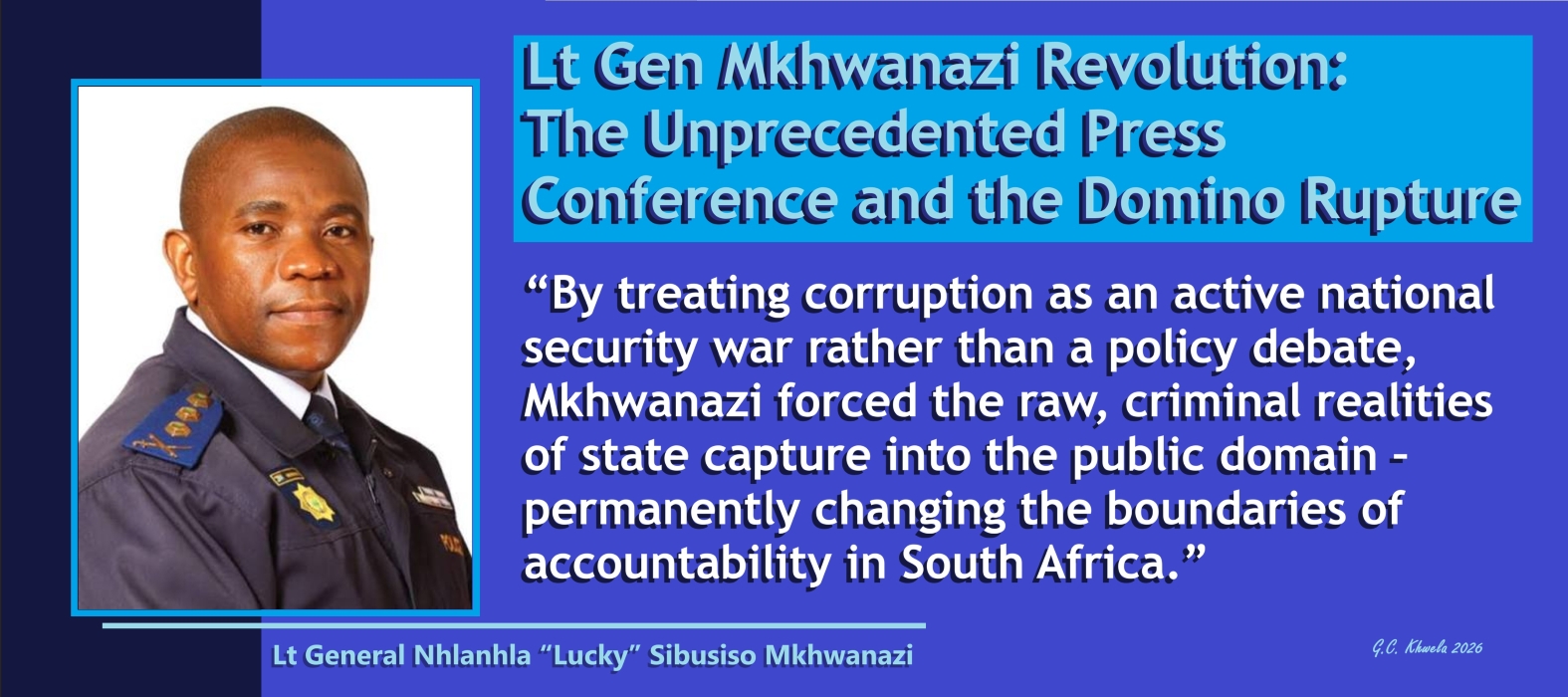
Lt Gen Mkhwanazi Revolution: The Unprecedented Press Conference and the Domino Rupture
Whether Lieutenant General Nhlanhla “Lucky” Sibusiso Mkhwanazi’s actions can be termed “revolutionary” depends on the definition used: while it was not a literal overthrow of the state, his unprecedented public rebellion against political superiors to expose systemic corruption can be considered institutional and culturally revolutionary for South African law enforcement. In a deeply hierarchical system, on Sunday, 6 July 2025, Mkhwanazi took the extraordinary step of publicly accusing his direct superiors – including political figures like the Police Minister – of protecting drug cartels and interfering in investigations. This radical break from institutional protocol upended traditional civil-police relations.
Historically, internal police corruption in South Africa has been handled through quiet, bureaucratic channels or actively covered up. By holding highly visual press conferences in combat gear flanked by armed tactical units to declare he “will die for this badge”, Mkhwanazi radically shifted the public paradigm on accountability. His public whistleblowing was not just a minor dispute; it fundamentally disrupted the state apparatus. His allegations forced national interventions, including presidential actions, suspensions of top officials, and the establishment of the Madlanga Commission of Inquiry to investigate state capture within the justice system.
From a legal and political theory perspective, a “revolution” aims to overthrow or replace the existing system. Mkhwanazi’s actions were fundamentally reformist and conservative; he was acting to enforce the existing South African Constitution, protect the rule of law and make the South African Police Service (SAPS) function exactly as it was legally mandated to do. Though his methods were aggressive and externalised, he continues to operate as an official of the state, utilising official commissions, testimonies and the court systems to push for justice rather than operating outside of legal boundaries.
Ultimately, while his goals were to restore constitutional order rather than overthrow it, his disruptive methods and refusal to capitulate to political interference have introduced a radically aggressive, “revolutionary” template for anti-corruption and accountability within South Africa’s state security organs. Mkhwanazi’s revolution significantly impacted other state sectors, exposing a deeply integrated network of state capture that directly compromised the general administration, judiciary, correctional services and public procurement frameworks of South Africa.
The systemic effects of his disruptive actions ripple across the broader state architecture in several key ways. Mkhwanazi explicitly stated that the political interference he faced was meant to protect an organised crime cartel with tentacles reaching far beyond the police. His revelations forced the state to acknowledge that corruption was crossing strict territorial institutional boundaries. He directly implicated the Department of Correctional Services, exposing how prison syndicates and corrupt correctional bureaucrats manipulate the system from within; the National Prosecuting Authority (NPA) and Judiciary, by challenging the integrity of legal outcomes by alleging that criminal networks were actively trying to influence or shield illicit activities within prosecuting and judicial structures.
Mkhwanazi’s unprecedented defiance broke the historical template of passive civil service compliance. By directly accusing high-ranking executives – such as then-Police Minister Senzo Mchunu – of dismantling elite crime units to shield political and financial ambitions, he fundamentally shifted the boundaries of state administration. His actions demonstrated that a senior bureaucrat could successfully challenge unlawful political directives, inspiring a more rigid demand for a professional, apolitical civil service as mandated by Section 195 of the South African Constitution.
The evidentiary findings resulting from his 6 July 2025 press conference triggered deep dives into broader state governance. Parliamentary ad hoc committees and the Madlanga Judicial Commission of Inquiry unearthed massive procurement irregularities, including the manipulation of massive health risk management tenders and the abuse of covert state funds. This cast a spotlight on how public sector financial and contracting processes are weaponised by state officials for private gain. The fallout from his allegations forced President Cyril Ramaphosa’s administration into structural damage control.
Beyond arrests within law enforcement, it forced the deployment of specialised task teams across multiple state clusters; parallel parliamentary investigations reviewing oversight compliance across general state administration; and the implementation of a systemic “Reset Agenda” across administrative and service delivery institutions to restore public confidence. By refusing to capitulate, Mkhwanazi effectively proved that police corruption does not exist in a vacuum; it acts as the enforcement arm for a broader, compromised civil ecosystem where corrupt politicians, state business interests and compromised bureaucrats work in tandem.
Mkhwanazi’s actions can be accurately characterised as an unprecedented event that triggered a classic “domino rupture” in South African politics and law enforcement. While it was not a traditional “revolution” involving a civilian uprising or a regime overthrow, it functioned as an institutional revolution. A single, highly unorthodox event shattered long-standing systemic norms and set off a chain reaction of political and legal consequences. His actions align with the definition of a political rupture through several distinct factors. A political rupture requires a sharp break from standard operating procedures.
Mkhwanazi bypassed all traditional protocols of the South African Police Service (SAPS). He held a televised press briefing clad in combat camouflage and flanked by the heavily armed Special Task Force. By violating the entrenched “code of silence” within the police force to openly accuse his own superiors, he created a point of no return. The press conference was not an isolated incident; it served as the first falling domino that completely destabilised the executive and judicial status quo. Over the subsequent months, this single event caused a cascade of high-level disruptions.
The allegations directly led to the historic fracturing of the security cluster, culminating in the suspension of Police Minister Senzo Mchunu and Deputy National Commissioner Shadrack Sibiya. The shockwaves forced President Cyril Ramaphosa to institute the Madlanga Judicial Commission of Inquiry. This effectively pivoted national attention into a deeper investigation into the capture of the criminal justice system. The 121 seized dockets concerning politically motivated assassinations were forced back into active investigation, restarting stagnant high-profile cases.
Before 6 July 2025, the internal friction within the state’s security apparatus was managed behind closed doors. Mkhwanazi’s briefing caused a systemic shift by exposing an alleged network where organised crime syndicates, politicians and elements of the judiciary intersected. The event fundamentally ruptured the public’s remaining trust in senior law enforcement structures, forcing a permanent change in how political interference in policing is handled and debated in Parliament.
With regards to the 20 June 2026 marches against undocumented and illegal foreign nationals, the argument that anti-migrant protests – primarily driven by civic movements like March and March – are a direct manifestation of the “Mkhwanazi revolution” highlights a profound sociological shift in South Africa. While Mkhwanazi himself did not initiate or endorse these marches, his systematic dismantling of institutional silence provided the public with an explicit vocabulary to diagnose and protest state failure. His structural exposure directly fuelled the ongoing immigration protests through several distinct dynamics.
Before Mkhwanazi’s July 2025 exposé, grassroots frustrations surrounding unmonitored borders, undocumented migration and pressure on public infrastructure were often dismissed by leadership as baseless “xenophobia”. By proving before the Madlanga Commission of Inquiry that high-ranking state officials were actively accepting bribes to protect international drug cartels and criminal networks, Mkhwanazi validated community suspicions. Protesters weaponised his findings as definitive proof that the breakdown of immigration control was not an accidental administrative failure, but a lucrative, corrupt enterprise engineered by compromised bureaucrats within the Departments of Home Affairs, Justice and SAPS.
Mkhwanazi publicly stated that unrest occurs because the state consistently fails to action community memoranda and legitimate grievances. This acknowledgement from a top General radically legitimised the public’s frustration. Protest movements leveraged this “revolutionary” template, arguing that because the internal administration of state systems had been thoroughly compromised by corrupt networks, the public was forced to take to the streets to demand basic law enforcement and border integrity. The most volatile culmination of this dynamic is the rise of “civic vigilantism”. Movements like March and March began conducting localised “citizen verifications” of immigration statuses and targeting foreign-owned businesses. Protesters argued that if state security structures are too corrupt to enforce their own laws, citizens must fill the vacuum.
However, this is where Mkhwanazi has strictly distanced himself from the movement’s actions. Recognising the dangerous precipice of lawlessness, Mkhwanazi has repeatedly issued stern public warnings against these marches acting beyond their constitutional rights. He explicitly stated that civilians have absolutely no legal right or skill to verify documentation status. Furthermore, he warned that targeting individual foreign nationals amounts to vigilantism, which bypasses the rule of law and inevitably leads to violence. Accordingly, he has instructed communities to funnel their information to the police rather than staging illegal raids.
Nevertheless, the pressure from the public – emboldened by the anti-corruption climate Mkhwanazi created – ultimately forced the state’s hand into a hyper-visible defensive reaction. To appease an angry populace that watched Mkhwanazi expose the rot, the Department of Home Affairs heavily accelerated its enforcement, resulting in mass repatriation processes, including the processing and deportation of over 45,000 undocumented foreign nationals at the Musina border.
Ultimately, the immigration marches represent a complex, double-edged legacy of Mkhwanazi’s actions. On one hand, his bravery gave South Africans the leverage to demand a professional, uncompromised state apparatus. On the other hand, by revealing just how broken and corrupt the law enforcement mechanisms truly were, it inadvertently lowered public trust to a point where citizens felt justified bypassing state authority altogether, turning structural anti-corruption into a volatile grassroots movement on the streets.
In the near future, the intersection of the Madlanga Commission of Inquiry and the Parliamentary Ad Hoc Committee is anticipated to trigger severe structural shakeups, criminal prosecutions and systemic legislative changes across South Africa’s security, municipal and administrative sectors. The critical developments that are expected to unfold in the coming weeks and months include the tabling of damning recommendations. The Ad Hoc Committee has finalised extensive reviews of its preliminary findings regarding political interference and procurement fraud – most notably the R228-million to R360-million SAPS medical services contract awarded to Medicare24 Tshwane.
The final report is expected to officially seal the political fate of figures like former Police Minister Senzo Mchunu (already on special leave) and formally request the National Assembly to institutionalise stricter, apolitical boundaries for executive oversight in law enforcement. Implicated in allegations of misconduct and administrative interference, the head of the Investigating Directorate Against Corruption (IDAC), Andrea Johnson, is scheduled to face aggressive, public cross-examination. Legal experts anticipate that her testimony could destabilise the upper management of IDAC, potentially leading to her immediate suspension or structural removal to salvage the anti-corruption unit’s credibility.
Observers note that unlike the politically fractured parliamentary committee, the Madlanga Commission has fiercely resisted delay tactics. It recently forced open-session hearings for high-profile figures seeking postponements (such as businessman Sulieman Carrim), signalling a relentless final phase of public accountability. President Cyril Ramaphosa extended the commission’s deadline to 16 November 2026 to allow its evidence leaders to finish parsing through immense cross-sector data. While the commission establishes the institutional truth, the National Prosecuting Authority (NPA) is translating these revelations into criminal charges.
A massive, high-profile consolidated criminal trial is rapidly taking shape. Key figures currently or soon-to-be appearing before the courts include National Police Commissioner Fannie Masemola alongside 12 senior police officials, and Deputy Crime Intelligence Head Feroz Khan; Ekurhuleni Metro Police Deputy Chief Julius Mkhwanazi and Tshwane Metro Police Chief Omarie Dlamini face heavy scrutiny regarding municipal law enforcement complicity in cartel activities; and the state is aggressively expediting the prosecution of individuals accused of murdering key Madlanga Commission whistleblowers (such as the case against those accused of killing Marius van der Westhuizen, widely known as “Witness D”).
Evidence presented by anti-corruption experts to Justice Madlanga exposed that despite massive “unexplained wealth” among senior bureaucrats, South Africa had failed to convert a single internal lifestyle review into a formal lifestyle audit over a five-year period. The commission’s final report is anticipated to recommend legally binding, independent, and automated lifestyle audits for all high-ranking state officials, removing the discretionary loopholes currently exploited by corrupt actors.
Because the testimonies have uncovered profound rot stretching into the Department of Correctional Services and the broader judiciary, civic groups and security analysts are heavily lobbying the President to extend the Madlanga Commission’s operational lifespan. Experts argue that fully routing out the inter-departmental cartels will require a multi-year effort, rather than wrapping up abruptly in late 2026.
Lieutenant General Nhlanhla “Lucky” Mkhwanazi’s revolution fundamentally intercepted and upended the state’s managed political narrative. By bypassing the structured boundaries of the presidency’s National Dialogue, his explosive whistleblowing pierced the corporate diplomacy of that initiative, forcing concrete criminal and institutional accountability. The collision between Mkhwanazi’s raw disclosures and the presidency’s managed administrative processes highlights several critical realities.
The presidency-initiated National Dialogue, supported by various prominent civic foundations, was designed as a long-term, consensus-building platform for citizens and elites to safely debate South Africa’s systemic crises. While the National Dialogue sought to address “governance” through broad administrative workshops, Mkhwanazi’s visual, combative July 2025 press conference forced immediate exposure of an active criminal syndicate cutting through parliament, prosecutors and the judiciary.
Prominent dialogue figures, such as Gift of the Givers founder Imtiaz Sooliman, noted that Mkhwanazi’s immense bravery essentially hijacked the pre-planned National Convention. The dialogue could no longer speak of theoretical state reform; it was forced to pivot directly to the concrete evidence of high-level criminal infiltration.
Nowhere is the difference between the managed dialogue and Mkhwanazi’s exposure more stark than on the Phala Phala scandal. While formal state mechanisms and political agreements kept the 2020 farm currency theft caught in legislative gridlock, information brought forward by Mkhwanazi’s standard-setting defiance tore open hidden state security dimensions. Evidence presented to Parliament’s Ad Hoc Committee following Mkhwanazi’s revolution – including testimony by former intelligence analyst Philasande Dotyeni – revealed a highly compromised, off-the-books operation run by Crime Intelligence.
The disclosures proved that late Major General Sindile Mfazi had been secretly tracking how Crime Intelligence funds and state resources were diverted unlawfully. This was done to conduct an illegal tracking operation of the Phala Phala thieves and actively suppress the political fallout without opening official SAPS case dockets. The Parliamentary Ad Hoc Committee was further forced to parse a highly explosive prison letter introduced via Mkhwanazi’s structural disclosures. The document detailed corrupt, high-level political links involving controversial tender figures like Vusimusi “Cat” Matlala and senior cabinet elements, directly dragging the upper echelons of the executive back into the criminal spotlight.
Ultimately, the National Dialogue provided a space for diagnostic discussion, but it lacked teeth. Mkhwanazi’s revolution produced immediate, unmanaged friction that a state-sanctioned forum never could. His actions didn’t just generate conversation; they led directly to the ongoing Madlanga Commission of Inquiry, the immediate placing of Police Minister Senzo Mchunu on leave, the downfall of entrenched generals, and forced the presidency to hand Mkhwanazi himself control of the country’s new National Organised Crime Strategy to aggressively clean out the state.
By treating corruption as an active national security war rather than a policy debate, Mkhwanazi forced the raw, criminal realities of state capture into the public domain – permanently changing the boundaries of accountability in South Africa.
Sources:
Alex Patrick, “Truth, Trust, Tough Talks: National Dialogue Will Talk Criminal Justice, Mkhwanazi’s Claims”, News24, 11 July 2025.
Khanyisile Ngcobo, “Top Policeman Shakes South Africa with Explosive Allegations About His Boss”, BBC News, 19 July 2025.
No Author, “The Madlanga Commission’s First Week: A Brief Summary”, Corruption Watch, 22 September 2025.
M Lekganyane, “Lieutenant General Nhlanhla Mkwanazi: Ad Hoc Committee to Investigate Allegations Made by Lieutenant General Nhlanhla Mkwanazi”, Parliamentary Monitoring Group, 7 October 2025.
Innocentia Nkadimeng, “Nhlanhla Mkhwanazi Warns Against Antiforeigner Protests After Attacks in KZN”, Business Day, 22 April 2026.
Vincent Cruywagen, “Understanding Mkhwanazi’s ‘War’ — A Deeper Look at SA’s Policing and Justice Crisis”, Daily Maverick, 24 June 2026.
Vincent Cruywagen, “How Mkhwanazi’s Allegations Reshaped the Fight Against Organised Crime in the SAPS”, Daily Maverick, 5 July 2026.
Nkosikhona Malinga-Mnisi, “One Year Since Mkhwanazi’s Exposé of Corruption Allegations Within Law Enforcement”, Eyewitness News (EWN), 6 July 2026.
David Bruce, “Mkhwanazi Opened SA’s Eyes to the Scale of High-Level Police Corruption”, Institute for Security Studies Today, 9 July 2026.
Thanduxolo Jika, “Murdered General’s Secret Phala Phala Probe”, Times Live, 19 July 2026.
Castro Khwela
Good evening fellow Compatriots!🙏🏾✊🏾👊🏾
Discover more from CASTRO KHWELA
Subscribe to get the latest posts sent to your email.