Bapedi Warriors Crushingly Defeat the Boer Invaders: 150 Years Ago
150 years ago, on 1 August 1876, the Bapedi warriors under the leadership of King Sekhukhune waSekwati crushingly defeated the Boers during a protracted Boer-Bapedi land ownership dispute. On 16 May 1876, the Volksraad of the Boer South African Republic declared war on Sekhukhune and his followers. A Boer commando under President T.F. Burgers, armed with 7 pounder Krupp guns, reached the Bapedi stronghold on 1 August. The Bapedi, also armed with rifles, offered stiff resistance and inflicted a humiliating defeat on the well-armed Boer force.
The Bapedi people achieved a monumental victory against European colonial forces when King Sekhukhune I decisively defeated the army of the South African Republic (ZAR) at their mountain stronghold of Thaba Mosega. This clash was the climax of the First Sekhukhune War, a bitter conflict rooted in encroaching white settlement, taxes and independent African sovereignty. Tensions between the ZAR (Transvaal Boers) and the Bapedi escalated significantly during the late 1860s and early 1870s. King Sekhukhune, a highly strategic leader, had systematically fortified his kingdom.
To strengthen his kingdom and guard against European colonisation, he had his young subjects work in white mines and on farms so that their salaries could be used to buy guns from the Portuguese in Delagoa Bay. This procurement of modern firearms transformed the Bapedi army into a formidable, well-equipped force, also armed with muskets obtained from Lesotho. When on 16 May 1876, the ZAR Volksraad formally declared war, King Sekhukhune’s forces were ready for confrontation. President Thomas François Burgers personally led a massive Boer commando unit alongside a strong force of Swazi allies – who were historical regional rivals of the Bapedi.
Equipped with advanced 7-pounder Krupp artillery guns, the Boer-led forces reached the main Bapedi mountain stronghold on 1 August 1876. Utilising the treacherous mountain terrain and heavy rifle fire, the Bapedi warriors launched a fierce and unyielding defence. The Swazi allies of the Boers, frustrated by the perceived hesitation or cowardice of the Boer forces, abandoned the front lines. The Bapedi offered stiff resistance and inflicted a humiliating defeat on the well-armed Boer force. By 2 August, the ZAR commando disintegrated into a full-scale retreat. President Burgers was forced to fall back to Steelpoort, leaving behind only a small band of volunteers to build forts and disrupt Bapedi agriculture.
The Bapedi victory at Thaba Mosega had massive historical ripple effects across Southern Africa. The failed military campaign and the cost of maintaining volunteer border garrisons nearly bankrupted the young Transvaal Republic. Citing the ZAR’s inability to “pacify” the Bapedi and the resulting threat of regional instability, the British Empire used this weakness as a primary pretext to annex the Transvaal in April 1877. The British inherited the land dispute, leading to further heavily contested campaigns before Sekhukhune was finally captured in December 1879 by a massive combined British and Swazi army.
King Sekhukhune I’s resistance was not just a series of brave battles, but a masterclass in state-sponsored resource mobilisation, economic subversion and asymmetric fortification. Faced with a lack of traditional dynastic legitimacy after seizing power from his half-brother Mampuru II, Sekhukhune used innovative economic and military strategies to consolidate his authority and transform the Bapedi kingdom into a regional superpower. Long before white governments regulated migrant labour, Sekhukhune used it as a state-sanctioned weapon to fund his military defence.
The brave son of Sekwati, Sekhukhune systematically dispatched regiments of young Bapedi men under the strict authority of appointed headmen to work on white farms and the diamond mines of Kimberley. The Bapedi Kingdom heavily taxed the wages earned by these labourers and used the collected tax revenue to buy modern firearms and cattle directly from Portuguese traders at Delagoa Bay, now Maputo, in Mozambique, since the ZAR strictly banned the sale of guns to black Africans. This Bapedi Royal Leadership-controlled trade network transformed the Bapedi army into one of the most technologically advanced African forces of the 19th century.
The wealth generated from this system allowed Sekhukhune to buy cattle to distribute to smaller, vulnerable communities. This encouraged non-Pedi groups to shift their allegiances to his leadership, rapidly expanding his empire without requiring military bloodshed. The Bapedi military doctrine rejected European-style open field battles, choosing instead to maximise the defensive advantages of natural geography. Sekhukhune fortified the natural boulder caves and stone-walled terraces (“marose”) of the Lulu Mountains. This layout completely neutralised the Boers’ modern Krupp artillery, because the stone enclosures absorbed shell fragmentation and hid Bapedi riflemen from view.
During the 1876 Boer offensive, Sekhukhune did not just wait out the siege. He employed mobile guerrilla warfare, by deploying small, mobile raiding parties behind the advancing Boer lines to strike undefended farms. This strategy caused widespread psychological panic and a wave of desertions among the Boer commandos, who abandoned the front lines to protect their families. Even the support of an impi of Swazis, sworn enemies of Sekhukhune, could not secure a victory for Burgers. After the final assault on 2 August, the Boer commando retreated and went home, leaving a corps of volunteers behind under command of Captain C. von Schlickmann, a former German officer.
The victory on 1 August 1876 was a defining moment in 19th-century Southern African history. For King Sekhukhune I and the Bapedi people, the defeat of the South African Republic (ZAR) brought immediate geopolitical dominance, but it also set off a chain reaction that ultimately sealed the kingdom’s fate. In the immediate aftermath, the victory cemented the Bapedi Kingdom as the undisputed heavyweight power in the eastern Transvaal. The battle proved that Sekhukhune’s radical economic and military modernisation – buying firearms through migrant labour and perfecting the “marose” cave defences – could successfully repel a Western-style army.
Sekhukhune’s legitimacy soared. Weak or vacillating chiefdoms in the region soon realised that the ZAR could not protect them or enforce its laws, leading many to pledge loyalty and pay tribute to Sekhukhune instead. For a brief window, the Bapedi secured their ancestral lands, free from the immediate threat of Boer encroachment, forced labour or illegal taxation. The defeat was a humiliating existential crisis for the Boers, which directly altered the balance of power. The ZAR commandos mutinied and went home, refusing to fight what they saw as an unbeatable African power under King Sekhukhune waSekwati.
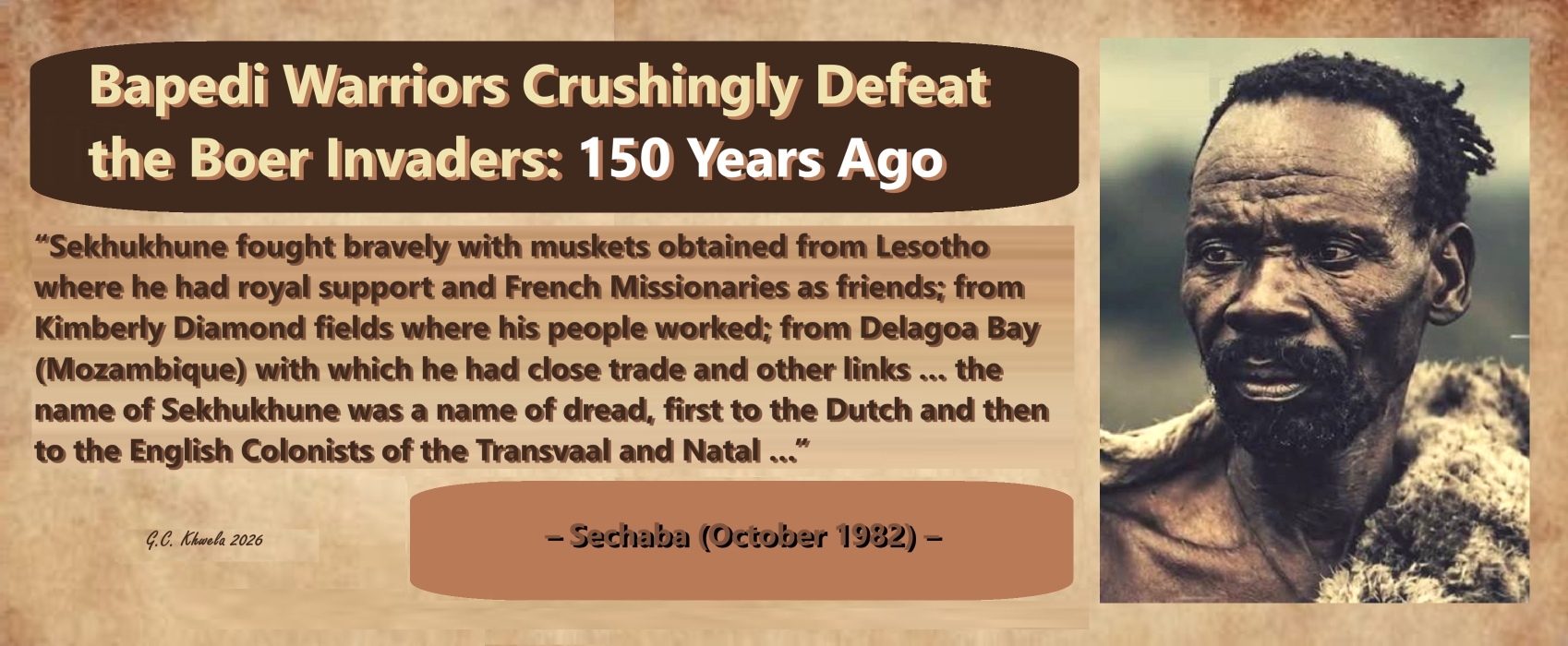
The October 1982 issue of Sechaba, taking the last portion from The London Times newspaper, dedicated an article to Sekhukhune after his death on 30 August 1882, and acknowledged the heroism of Bapedi under King Sekhukhune. The article maintained that “Sekhukhune fought bravely with muskets obtained from Lesotho where he had royal support and French Missionaries as friends; from Kimberly Diamond fields where his people worked; from Delagoa Bay (Mozambique) with which he had close trade and other links … the name of Sekhukhune was a name of dread, first to the Dutch and then to the English Colonists of the Transvaal and Natal …”.
The war completely emptied the ZAR treasury. The Boer Republic could no longer afford to govern, maintain its infrastructure or secure its borders. Paradoxically, the Bapedi’s total victory over the Boers sounded the death knell for their independent kingdom, as the British Empire was watching closely. The British feared that a weak, bankrupt Boer republic would invite a massive African uprising across the region, threatening British colonial interests in Natal and the Cape. Citing the ZAR’s inability to defeat Sekhukhune and the “imminent danger” of the Bapedi power, British envoy Sir Theophilus Shepstone marched into Pretoria and annexed the Transvaal into the British Empire.
By crushing the Boers, Sekhukhune inadvertently brought a much larger, wealthier and more aggressive adversary (the British Empire) to his doorstep, which controlled the massive colonies of Natal and the Cape. The British Empire inherited the land dispute but possessed far more resources, professional soldiers and regional alliances than the Boers ever did.
For the Bapedi people, nevertheless, the victory created an enduring legacy of resistance that survived colonial conquest and Apartheid. It proved that African nationalities were not passive victims of colonialism, but active, highly sophisticated geopolitical actors capable of out-thinking and out-fighting European forces. Today, the battle remains a cornerstone of Pedi national identity and pride and a huge inspiration during the liberation war against apartheid colonialism and imperialism.
Sources:
Wikipedia.
South African History Online (SAHO).
C.W. De Kiewiet, “The Imperial Factor in South Africa: A Study in Politics and Economics”, Cambridge University Press, 1937.
Clement Francis Goodfellow, “Great Britain and South African Confederation, 1870–1881”, Oxford University Press/University of Cape Town, 1966.
Keith W. Smith, “The Campaigns Against Sekhukhune”, Doctoral Dissertation: Rhodes University, 1967.
H.O. Mönnig, “The Pedi”, Van Schaik,1967.
Keith W. Smith, “The Fall of the Pedi Polity”, Archives Year Book for South African History, Government Printer, 1969.
D.J. Potgieter, et. al. (Eds.), “Standard Encyclopaedia of Southern Africa, Vol. 9”, NASOU, 1970.
D.W. Kruger, (Ed.), “Dictionary of South African Biography, Vol. 2”, Human Sciences Research Council, 1972.
H.W. (Nick) Kinsey, “The Sekukuni Wars: Part I”, Military History Journal, Vol. 2, No. 5, June 1973.
H.W. (Nick) Kinsey, “The Sekukuni Wars: Part II”, Military History Journal, Vol. 2, No. 6, December 1973.
M.S. Appelgryn, “Thomas François Burgers: Staatspresident 1872–1877”, University of South Africa (UNISA), 1979.
No Author, “We Remember Sekhukhune I”, Sechaba, October Issue 1982.
Peter Delius, “The Land Belongs to Us: The Pedi Polity, the Boers, and the British in the Nineteenth-Century Transvaal”, University of California Press and Ravan Press, 1984.
Felix Malunga, “The Anglo-Boer South African War: Sekhukhune II Goes on the Offensive in the Eastern Transvaal, 1899–1902”, Journal for Contemporary History, Vol. 25, No. 2, 2000.
J.A. Van Schalkwyk and B.W. Smith, “Insiders and Outsiders: Sources for Reinterpreting a Historical Event”, in A. M. Reid and P. J. Lane (Eds.), “African Historical Archaeologies”, Springer, 2004.
Peter Delius, et. al. “Bokoni: Old Structures, New Paradigms? Rethinking Pre-colonial Society from the Perspective of the Stone-Walled Sites in Mpumalanga”, Journal of Southern African Studies, Vol. 38, No. 2, 2012.
Peter Delius, “The King, the Missionary and the Missionary’s Daughter”, Journal of Southern African Studies, Vol. 39, Issue 3, 2013.
Dolphin Mabale, “Contested Cultural Heritage in the Limpopo Province of South Africa”, Master of Arts: University of Venda, 2017.
Castro Khwela
Good evening fellow Compatriots!🙏🏾✊🏾👊🏾
Discover more from CASTRO KHWELA
Subscribe to get the latest posts sent to your email.