Post-Rivonia Arrests and Repression Intensified
On 3 August 1963, in the early hours of the morning, Stephen Mtshali was arrested at his aunt’s home, in Durban, and was taken to the Wentworth Police Station for interrogation by apartheid Detective Warrant Officer Nicolaas J. Grobler. On the same morning, at a house in Durban’s Windsor Park suburb, Ronnie Kasrils gave Bruno Mtolo some money to buy some meat and vegetables at Kloof, and to arrange for Stephen Mtshali to visit the recently established hideout. Mtolo left the hideout at around 11:00, and when he reached Kloof Railway Station, he was apprehended by Officers Grobler and Wessels, who then took him to Pinetown Police Station.
On 7 August 1963, the apartheid Security Branch, under the leadership of Lieutenant Steenkamp, arrested Sonny Singh, who was working as a waiter in a Durban restaurant. Two days later, on 9 August, two members of the apartheid Security Branch went into the main section of the library of the University of the Witwatersrand, where they found Ruth First, who was a renowned Marxist academic, underground member of the South African Communist Party (SACP) and wife of Joe Slovo, a co-founder of Umkhonto we Sizwe (KM), searching for specific books. Ruth First was arrested, as the students were watching in silence, and placed under the ninety-day clause.
During this Rivonia era, African National Congress (ANC) members who were not arrested and remained inside the country continued with the struggle underground and were involved in different activities, such as helping cadres to find their way into exile and distributing revolutionary reading material. Women also played a crucial role in ensuring that the underground network of the ANC was fully functional. Because the apartheid regime’s security police primarily targeted high-profile male figures, women leveraged their perceived domestic roles to operate below the state’s radar, executing highly strategic and dangerous logistical operations.
Women created and maintained an elaborate information highway. They acted as couriers between isolated underground cells and handled secret communications linking internal operatives to the external mission. They took huge personal risks to secure safe houses, hiding activists who were actively fleeing the police or awaiting transport out of the country. Women operatives were responsible for finding safe storage for banned propaganda materials, publicity equipment and sometimes weaponry. Working closely with remaining leaders, they coordinated the logistics of smuggling cadres across heavily monitored borders into neighbouring countries like Botswana and Swaziland.
With her husband Walter Sisulu sentenced to life on Robben Island, for example, Albertina Sisulu became a foundational pillar of the underground. She managed key courier lines and kept the “Congress tradition” alive during intense periods of state suppression. Alongside figures like Joyce Sikhakhane and Shantie Naidoo, Winnie Madikizela-Mandela also bravely spearheaded the slow, dangerous process of rebuilding broken underground structures specifically within the Soweto region. In addition, Frene Ginwala, who even prior to the trial, played a pioneering role by helping to smuggle Deputy President Oliver Tambo into Tanzania, she later established the ANC’s critical External Department of Information and Publicity.
Ordinary women not officially blacklisted by the state used local languages and familiarity with rural border terrains – such as the South Africa-Swaziland border – to move cadres and information undetected. According to South African History Online, “These women organised safe accommodation for individuals on the run from the police, and storage facilities for propaganda and publicity equipment They managed an elaborate communications system and courier network linking the different units.”
At that time, the ANC President-General, the Chief, Inkosi Albert Luthuli, was banned and restricted to Groutville in rural Natal, and the Deputy President-General, Oliver Tambo, as well as NEC members Moses Kotane and Duma Nokwe were in exile. By mid-1963, several members of the underground National Executive Committee (NEC) were in detention, being among those arrested at Rivonia or shortly before. The coordinator of the National Secretariat, Govan Mbeki, as well as Secretariat members Alfred Nzo, Bartholomew Hlapane, Henry Makgothi and John Mavuso were either in detention or had been sentenced to terms of imprisonment.
Moreover, Ruth Mompati and Thomas Nkobi had been smuggled out of the country. The remaining leaders in the National Secretariat were Gabula Mahlasela, Michael Dingake and Dan Tloome. Consequently, Josiah Jele was co-opted onto the National Secretariat during the second half of 1963 in order to augment the structure. The clampdown on liberation organisations in the wake of the arrests at Liliesleaf Farm placed all structures under siege, requiring a reassessment of the South African Communist Party’s (SACP’s) approach to underground operations.
In late 1963 and early 1964 an underground document headed “Time for Reassessment” was circulated, discussing new police bugging devices, the dangers of detention and the seductiveness and reality of betrayal. In response, it also outlined a series of safeguards: each cell was now to have a security officer to monitor the safety habits of its members; disguises were recommended as an expedient within the repertoire of underground life; if a member of the SACP were detained, special precautions had to go into immediate effect; and no one was to be regarded as wholly reliable.
The Party had been under surveillance for some time, with meetings being tape-recorded, infiltration by police agent Gerard Ludi, and interception of mail at a post box opened by Ludi for Party use. In addition, by mid-1963 most of the legal congresses, which had provided an important platform for communication with ANC members and sympathisers, had been rendered inoperative. The Congress of Democrats (COD) was banned in 1962, while the South African Indian Congress (SAIC), the Coloured People’s Congress (CPC) and the South African Congress of Trade Unions (SACTU) were in disarray following the arrests, banning orders or departure into exile of their leaders.
In these most challenging of circumstances, the ANC leadership still inside the country concentrated on keeping the organisation intact. Propaganda became a priority, as pamphlets and leaflets became largely produced to refute government claims that the ANC had been decimated. Political slogans were also painted on the walls of buildings in urban areas, with the assistance of the legal entities within the Congress movement. The underground ANC structures also used these propaganda items to commemorate certain historic events, such as December 16 (Heroes Day), May Day (Workers’ Day), 26 June (Freedom Day), and to boost morale among the startled membership.
There were no messages that were being given, particularly organising political messages, because the membership had lost touch with the leadership. The leadership was leaving the country or was underground. Wilton Mkwayi, Michael Dingake, Dan Tloome and Josiah Jele, for example, moved from one safehouse to another for months at a time. Activists played a central role in finding secure accommodation and meeting places for these leaders. Later on, Radio Freedom came about, at least members could listen to revolutionary broadcasts and take back to the people what was happening.
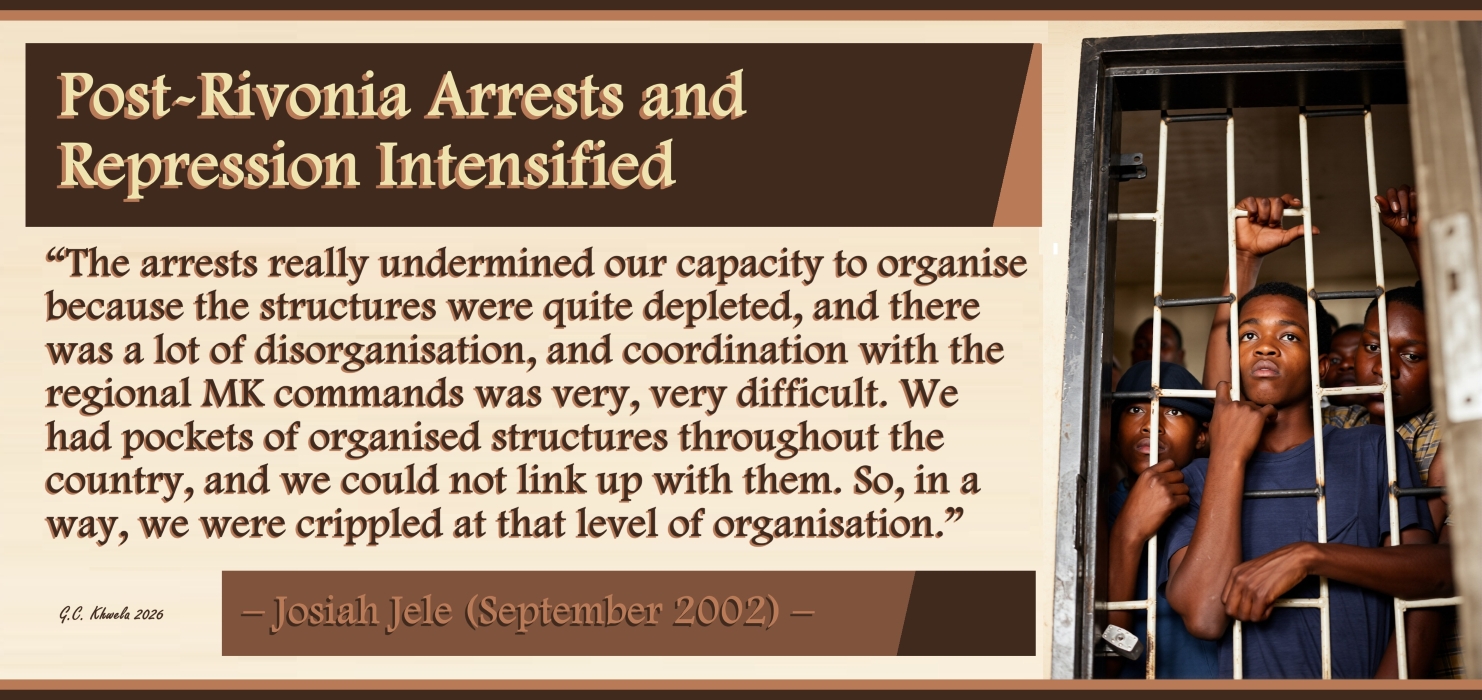
At that time members had to deal with the situation as it was, since there was no real ideological mobilisation. Nonetheless, the ANC underground was also instrumental in assisting the families of members who had been imprisoned by providing them with money for their daily needs. MK and ANC leaders still in the country faced the constant threat of arrest, and many chose to go underground. The arrests really undermined the capacity to organise because the structures were quite depleted, and there was a lot of disorganisation; and coordination with the regional MK commands was very difficult to sustain.
On 10 July 1964, Steve (aka “Nandhagopal” or “Nandha”) Naidoo was arrested at around 17:00, while he was walking on Wills Road, close to 21 Pearse Street, where he had been residing with Mac Maharaj since the middle of 1963. Nandha Naidoo had agreed to the request of the ANC leadership to report to Johannesburg for further engagement in Umkhonto we Sizwe (MK) activities.
His arrest followed the arrest of Lionel Gay by apartheid Security Branch policemen, in the morning of 27 June 1964, at his home on 13th Street, Parkhurst, in Randburg. Lionel Gay then served on the logistics committee of the MK National High Command before the Rivonia arrests. In mid-1964, while serving on the second National High Command, he was detained because of his political activities on the Wits University campus and subsequently appeared as a state witness in the trial of members of the second High Command.
Lionel Gay joined the Congress of Democrats (COD) in Durban, in 1961, and was recruited into the regional technical committee of MK by Ronnie Kasrils. After moving to Johannesburg to take up a post at the University of the Witwatersrand, Gay was recruited by Kitson into the Johannesburg MK technical committee. David Kitson had taken Joe Slovo’s place in MK on behalf of the South African Communist Party (SACP) when Slovo left the country in May 1963 to seek outside help based on orders from the Central Committee.
On 3 July, the same year, the Rand Daily Mail newspaper reported that in the previous week, several Umkhonto we Sizwe (MK) members had been arrested in separate swoops, which included Ian David Kitson, John Edward Matthews and Cyril Jones. Again, on 4 July, the Rand Daily Mail reported that raids and searches were conducted on 3 July resulting in “at least 17 people” being jailed under the ninety-day clause.
On 5 July 1964, the apartheid Minister of Justice, John Vorster, released a statement in Pretoria to the effect that “Certain persons have also been detained, and it is expected that the various discoveries made will possibly lead to the destruction of the Communist-inspired subversive campaign”. The following day, after John Vorster’s statement, Mac Maharaj and his wife Tim were arrested at the servants’ quarters where they were staying in Pearse Street, Doornfontein.
The Rivonia arrests became a major breakthrough for the apartheid Security Branch, who had gained the upper hand against the revolutionary upsurge. People began to believe that the ANC had been annihilated, as the power and reach of the state exerted every effort to ensure that people accepted that the ANC was dead. Newspaper coverage of the ANC in this period became infinitesimal, primarily due to restrictive legislation. However, what coverage did occur was extremely negative or dismissive in tone, reflecting the bias of the white-owned newspapers.
To the extent that the ANC was building an underground presence within the country, its existence depended on highly secretive and unobtrusive organisational activities. The stakes were very high; the odds were stacked against such efforts. Any publicity would have doomed these attempts. In this sense the conditions of underground operations in general had come – at the level of appearances or visibility – to lend support to the view of the ANC’s absence.
The arrests at Rivonia, and subsequent trials, ended the first phase of MK activity – the sabotage campaign between December 1961 and mid-1963. Efforts were then undertaken with the deployment of Patrick Baphela and his fellow MK cadres in late 1964, which marked a critical, highly dangerous effort by the Second National High Command to revive South Africa’s internal armed struggle after the devastating Rivonia arrests. Under the leadership of Wilton Mkwayi, the newly reconstituted National High Command desperately needed to replace imprisoned leadership, standardise guerrilla operations and integrate local labour resistance with underground political warfare.
Following the July 1963 raid on Liliesleaf Farm, the Second National High Command had been formed in secret to pick up the pieces, requiring external reinforcement to train local cells in explosives and revolutionary theory. In response to the second National High Command’s request, the External Mission – then based primarily out of Dar es Salaam, Tanzania – dispatched a specialised five-man team back into South Africa between August and October 1964. This team included Patrick Baphela, McDonald Masala, Siegfried Bhengu, Peter Metshane and Mnyamane Hlaya.
Four of these highly trained cadres were to be scattered across the country’s provinces to act as traveling military instructors and political organisers, hiding in communities to build a decentralised network of guerrilla cells. McDonald Masala was to be assigned to the Eastern Cape-Border region, Siegfried Bhengu to Natal, Peter Mmitshane to the Western Transvaal and Mnyamane Hlaya was to be sent to the Western Cape. Patrick Baphela was given the unique, distinct mandate of infiltrating and reorganising the South African Congress of Trade Unions (SACTU). The ANC and the SACP had recognised that underground military success was impossible without an organised, politicised labour force. SACTU, a key member of the anti-apartheid Congress Alliance, had been crippled by state bannings, detentions and the flight of its top union organisers into exile.
The mission faced immense peril. The South African security police, utilising brutal 90-day detention laws and a vast network of internal informants, aggressively monitored suspected unionists. The state successfully compromised the operation. Baphela was arrested by the Security Branch shortly after infiltration, and his confession was eventually weaponised by the state in the criminal case, State v Patrick Baphela, as his own written confession was read out in court by state prosecutor Pieter Heiberg. The trial ran concurrently with that of Peter Metshane and Mnyamana Hlaya. Baphela’s arrest coincided with a wider dragnet that captured members of the Second National High Command, including Laloo Chiba and Wilton Mkwayi.
Their subsequent 1964 trial, often referred to as the “Little Rivonia” trial, resulted in long-term life sentences on Robben Island, effectively closing this chapter of internal domestic revitalisation. By mid-1965, not only MK but also the ANC had effectively been decimated within South Africa. In 1968, for instance, Acting ANC President Oliver Tambo acknowledged the dominance of the apartheid government, wherein he said “… the bonds of bondage that bound millions of black people in South Africa twenty years ago have since been tightened”.
“Tambo had observed as early as 1968”, according to Luli Callinicos, “that the ANC’s exile status had forced upon the liberation movement ‘a gap’. The important task, he reflected, was to maintain strong and durable lines of communication between the leaders inside and outside. ‘It is to be expected that these lines of communication constitute one of the main targets of attack by the enemy’.”
Sources:
South African History Online (SAHO).
Luli Callinicos, “Oliver Tambo: Beyond the Engeli Mountains”, David Philip, 2004.
Raymond Suttner, “The ANC Underground in South Africa to 1976: A Social and Historical Study”, Jacana, 2008.
Gregory Houston, “Chapter 15: The Post-Rivonia ANC/SACP Underground”, The Road to Democracy in South Africa, Vol. 1, 1960 – 1970, South African Democratic Education Trust, 2015.
Thula Simpson, “Umkhonto we Sizwe: The ANC’s Armed Struggle”, Penguin, 2016.
Tshepo Moloi, “‘Freelance’ Underground Operatives: Forgotten Liberators in South Africa”, History Workshop, 20 February 2025.
SAHA, “Leading Women in the Wake of Sharpeville”, South African History Archive (SAHA), Women Hold Up Half the Sky, saha.org.za, 3 August 2026.
Castro Khwela
Good morning fellow Compatriots!🙏🏾✊🏾👊🏾
Discover more from CASTRO KHWELA
Subscribe to get the latest posts sent to your email.