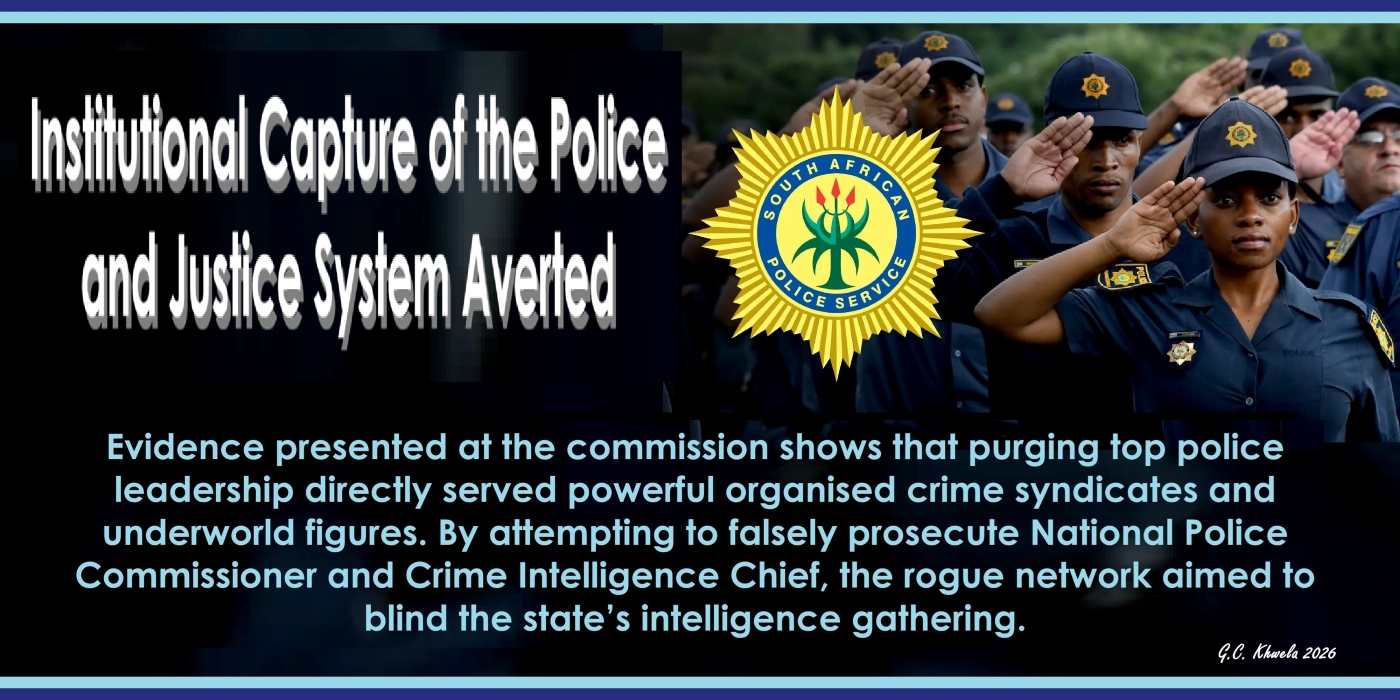
Institutional Capture of the Police and Justice System Averted
The recent Investigating Directorate Against Corruption (IDAC) exposé at the Madlanga Commission of Inquiry has strongly validated a narrative that top police generals were being deliberately targeted through a weaponised and captured criminal justice system. Rather than an intended state overthrow, the explosive evidence points to a well-orchestrated institutional capture, fabricated evidence and a sinister, coordinated plot within IDAC to systematically purge specific leadership figures from the South African Police Service (SAPS).
The commission revealed that high-ranking officials, including suspended National Police Commissioner General Fannie Masemola and Crime Intelligence head Lieutenant General Dumisani Khumalo, were heavily targeted by IDAC. Former IDAC head Advocate Andrea Johnson admitted under immense pressure that the unit acted completely outside its legal mandate by investigating Khumalo.
In a major blow to the state’s integrity, internal whistleblowers – including IDAC prosecutor Drushantha Ramsamy and senior investigator Mantsha Raphesu – testified that key evidence used to prosecute Crime Intelligence officials may have been outright fabricated. This forced the National Prosecuting Authority (NPA) to drop its corruption case against Khumalo as the underlying probe entirely unravelled.
Investigator Raphesu testified to a distinct “sinister motive” driving these actions, describing a highly secretive parallel operation designed to target specific generals. He further detailed how he was actively sidelined, removed from security cluster cases, and targeted by fellow investigators for refusing to comply with irregular directives. The inquiry played damning audio recordings where the former IDAC head, Andrea Johnson, used profane language to describe the commission and explicitly instructed a subordinate to “leave the country” if subpoenaed to avoid exposing the unit’s internal rot.
The unravelling of these operations represents a severe constitutional and institutional crisis. The exposure of these rogue tactics within South Africa’s premier anti-corruption unit has had immediate and far-reaching consequences. Following intense grilling over the unit’s decision-making and weaponisation, IDAC head Andrea Johnson resigned. Other senior figures, such as Chief Investigator Dylan Perumal, Senior Investigator Brian Padayachee and Investigator Suneel Bellochun, have been served with notices of intended suspension. The Department of Justice and the National Prosecuting Authority (NPA) have dismissed calls to completely disband IDAC, opting instead to enforce an independent, comprehensive audit of all past and active IDAC cases, paired with mandatory lifestyle checks for all employees.
In an unprecedented turn of events, law enforcement whistleblowers within IDAC are now actively opening criminal cases against their own colleagues for corruption and plotting malicious prosecutions. The ongoing hearings of the Madlanga Commission of Inquiry continue to pivot from gathering testimony to facilitating high-profile arrests. While the commission’s ultimate findings will not be legally binding, they serve as a powerful blueprint for the President and the Department of Justice to initiate an extensive structural reset of the criminal justice system to insulate law enforcement from deep-seated criminal and political manipulation.
The ongoing revelations at the Madlanga Commission of Inquiry and Parliament’s Ad Hoc Committee have heavily focused on this alleged parallel network. Multiple state witnesses and senior police generals have testified that private forensic investigator Paul O’Sullivan, working in tandem with specific factions inside law enforcement and the state ministry, actively sought to dismantle the current SAPS command structure to install aligned generals. The explicit details presented regarding the targeting of police leadership, the elevation of General Shadrack Sibiya, and the weaponisation of state resources against the Political Killings Task Team (PKTT) include testimony from senior IDAC investigator Mantsha Raphesu, who revealed that Paul O’Sullivan wielded unprecedented, extra-legal power inside state law enforcement agencies.
Evidence showed O’Sullivan sent a direct email to Brigadier Dineo Mokwele, giving her a 14-day ultimatum to resign or face public exposure and prosecution. O’Sullivan copied then-IDAC head Andrea Johnson, another senior police general and the police minister on the email months before any official case file against Mokwele was formally opened. This was the “Real State Capture”, as parallel parliamentary inquiries heard testimony that O’Sullivan ran high-level state operations out of his private residence. Witnesses labelled his ability to direct the Independent Police Investigative Directorate (IPID), the National Prosecuting Authority (NPA), and IDAC as a form of “surrogate state capture” designed to systematically purge uncooperative police leadership.
The commission has intensely scrutinised the factional agenda to position Lieutenant-General Shadrack Sibiya at the apex of the South African Police Service (SAPS). KwaZulu-Natal Police Commissioner Lieutenant-General Nhlanhla Mkhwanazi testified that O’Sullivan’s relentless public and media attacks against current police leadership were directly motivated by personal loyalty to Sibiya. Mkhwanazi stated that their coordinate relationship was an “open secret” aimed at clearing out rivals.
Cross-examinations highlighted a deep hypocrisy: while O’Sullivan’s organisation, Forensics for Justice, claimed to hunt corrupt officials, his network aggressively pushed for Sibiya’s elevation to National Commissioner despite Sibiya himself facing serious, unresolved allegations of corruption, abuse of power and illegal rendition activities from his previous tenures. The Political Killings Task Team (PKTT) – which has been highly effective in investigating politically motivated assassinations – became a prime target for this rogue network. The inquiry revealed that former IDAC Head Andrea Johnson took the highly irregular step of personally bypassing standard operational protocols to authorise a probe into the PKTT.
Under grilling from Commission Chairperson Mbuyiseli Madlanga, Johnson conceded she had no concrete reason or valid legal basis for targeting the unit. Evidence showed that IDAC abused its powers by demanding the travel logs and identities of specific PKTT members who had travelled to the Western Cape to arrest Member of Parliament Fadiel Adams. It emerged that Adams had fed unverified information to the now suspended Police Minister, alleging the PKTT was mismanaging its secret services slush fund. General Mkhwanazi reportedly intercepted these efforts, warning then-Police Minister Senzo Mchunu that there would be severe institutional and security consequences if the ministry proceeded with a baseless disbandment of the PKTT.
The Madlanga Commission’s record shows that this was not merely a set of standard administrative squabbles. Rather, it was a coordinated campaign where a private entity (O’Sullivan) successfully weaponised the state’s anti-corruption machinery (IDAC). By launching fabricated probes and pushing for the disbandment of elite units like the PKTT, the network actively sought to forcefully restructure SAPS leadership to serve specific political and factional interests. The evidence unfolding at the Madlanga Commission of Inquiry suggests that the weaponisation of the IDAC by private interests served a carefully orchestrated mix of factional criminal, political and commercial agendas.
The ultimate objective was not to “uncapture” the state, as private investigator Paul O’Sullivan claimed, but to achieve complete control over the law enforcement command structure. This control would be used to shield underworld syndicates, neutralise high-stakes political assassination probes and position factional allies at the apex of South Africa’s security cluster. The specific interests and political networks driving this operation break down into distinct areas. The sudden, highly irregular decision by former IDAC Head Andrea Johnson to aggressively probe the Political Killings Task Team (PKTT) reveals a desperate attempt to protect specific political actors.
The PKTT was actively investigating high-profile political assassinations, including the notorious murder of former ANC Youth League Secretary-General Sindiso Magaqa. When the PKTT went to the Western Cape to arrest National Coloured Congress (NCC) leader and Member of Parliament Fadiel Adams for defeating the ends of justice, the rogue network immediately swung into action. Andrea Johnson took the unprecedented step of bypassing IDAC’s operational structures to launch a counter-investigation into the PKTT. IDAC went so far as demanding the operational travel logs and identities of the PKTT officers who arrested Adams. This move effectively tried to freeze the task team’s operations and send a chilling message to any officer investigating politically connected individuals.
The inquiry has exposed how suspended Police Minister Senzo Mchunu and his Chief of Staff, Cedrick Nkabinde, were actively leveraged by this network. Unverified whistleblower reports from Adams were fed directly into the Ministry to provide political cover for trying to completely disband the PKTT. This plan was only halted when KZN Police Commissioner Nhlanhla Mkhwanazi threatened explosive institutional consequences if the Ministry interfered. Evidence presented at the commission shows that purging top police leadership directly served powerful organised crime syndicates and underworld figures.
By attempting to falsely prosecute National Police Commissioner Fannie Masemola and Crime Intelligence Chief Dumisani Khumalo, the rogue network aimed to blind the state’s intelligence gathering. Testimony from Witness X and other internal whistleblowers has detailed how top-tier policing posts were being engineered to ensure that payouts and protections flowed seamlessly to notorious underworld bosses. For instance, O’Sullivan’s own testimony linked suspended Crime Intelligence deputy head Feroz Khan to systematic protection rackets for figures like jailed Western Cape underworld boss Nafiz Modak. O’Sullivan’s network operated on a highly calculated model of commercialised, parallel justice.
Evidence and parliamentary briefings revealed that O’Sullivan effectively ran state-level intelligence operations out of his private residence. By manipulating IPID, the NPA, and IDAC through fabricated affidavits, his entity achieved “surrogate state capture” – wielding the power to hire, fire and suspend top police brass without holding any constitutional mandate. The ultimate goal was to forcefully replace independent officers with a compliant shadow command structure, centred around elevating General Shadrack Sibiya to National Commissioner.
Positioning Sibiya (O’Sullivan’s long-time close associate) at the top would allow this private-public network to dictate which corporate, political and criminal networks were protected and which ones were targeted for prosecution. The ultimate objective failed because the institutional resilience of generals like Nhlanhla Mkhwanazi, combined with internal IDAC whistleblowers refusing to sign fabricated affidavits, completely broke the network’s momentum. The Madlanga Commission of Inquiry has turned the tables, transforming what was meant to be a quiet bureaucratic purge into a public exposure of how a private actor successfully weaponised South Africa’s premier anti-corruption machinery.
A LOT IS STILL TO BE UNVEILED!
Sources:
Nkateko Joseph Mabasa, “MPs Question O’Sullivan’s IPID Control”, Mail & Guardian, 13 February 2026.
Babalo Ndenze, “Police Infiltration Not New, Paul O’Sullivan Tells Madlanga Commission”, Eyewitness News (EWN), 29 June 2026.
No Author, “Paul O’Sullivan Implicates Feroz Khan in Underworld Allegations”, eNCA, 30 June 2026.
Kamogelo Moichela, “Madlanga Commission Hears IDAC Sought Records of PKTT Members Who Arrested Fadiel Adams”, Independent Online (IOL), 28 July 2026.
Thabiso Goba, “Johnson Tells Madlanga Commission She Doesn’t Know Why She Authorised a Probe into the SAPS PKTT”, Eyewitness News (EWN), 28 July 2026.
Alpha Ramushwana, “Secret Recording Played at Madlanga Commission Exposes Former IDAC Head Johnson”, Eyewitness News (EWN), 30 July 2026.
Herman Moloi, “Madlanga Commission Prompts Audit; Lifestyle Checks for All IDAC Employees”, Times Live/Sowetan, 31 July 2026.
Alpha Ramushwana, “Madlanga Commission Hears Andrea Johnson Took Unusual Role in Assigning PKTT Investigation”, Eyewitness News (EWN), 31 July 2026.
Molete Seeletsa, “Fadiel Adams to Appear at Madlanga Commission Amid IDAC Fallout”, The Citizen, 31 July 2026.
No Author, “IDAC Senior Investigator Details Message Attributed to Mkhwanazi”, eNCA, 31 July 2026.
Kamogelo Moichela, “IDAC’s Raphesu to Open Case Against Colleagues, Urges Madlanga Commission to Step in Over Fears of Interference”, Independent Online (IOL), 1 August 2026.
Castro Khwela
Good day fellow Compatriots!🙏🏾✊🏾👊🏾
Discover more from CASTRO KHWELA
Subscribe to get the latest posts sent to your email.