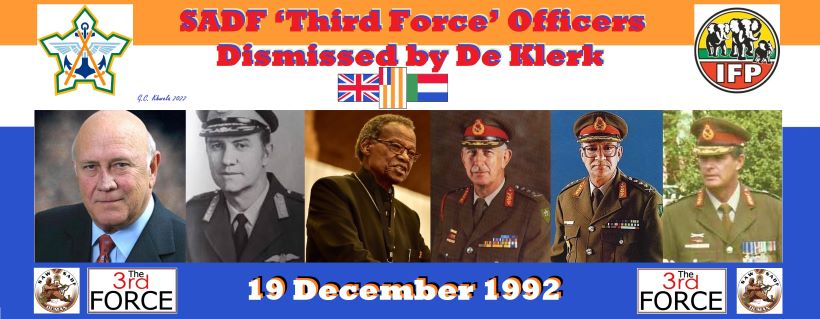
On 19 December 1992, apartheid State President F.W. de Klerk announced that 23 members of the South African Defence Force (SADF), including two Generals and four Brigadiers, were being forcibly retired or suspended. This followed the findings of a commission of inquiry into illegal or unauthorised activities by the SADF, set up under Lieutenant-General Pierre Steyn.
On 18 December, General Steyn presented his preliminary findings to President De Klerk and senior members of the government at Tuynhuys in Cape Town. He did not hand the President a report, as such, but gave a briefing based on contributions from a variety of intelligence sources. The account alleged that these SADF members were part of covert “Third Force” campaigns intended to discredit the African National Congress (ANC).
The activities included horrifying allegations of the involvement of SADF elements in fomenting and provoking violence between black factions in the townships; carrying out political assassinations; invoking a murderous reign of terror (specifically by the 5 Reconnaissance Regiment) on black commuter trains; stockpiling weapons; and collaborating with the Inkatha Freedom Party (IFP) in what seemed as an effort to provoke a military crackdown against new freedoms for black South Africans.
The substance of the presentation by General Steyn was that components of the SADF – the Military Intelligence’s Directorate Covert Collection (DCC), Army Intelligence, Special Forces and the 7th Medical Battalion – were involved in a wide range of illegal and/or unauthorised activity.
These included the establishment of arms caches and springboards for attacks; an attempt to overthrow General Bantu Holomisa’s government in the Transkei; the planting of weapons in Swaziland to discredit the ANC; corruption of DCC members in relation to arms deals; the selective leaking of information to right-wing groups; and corruption for personal gain.
While De Klerk refuted the notion that this was official policy of the SADF, he conceded that disciplinary action and possible criminal prosecution could follow, pending the completion of the probe. The offending units were immediately shut down and intelligence activities were restructured based on De Klerk’s instructions.
Though some of the allegations were referred to the Attorney-General and the Goldstone Commission, most were never resolved, as the report was allegedly largely based on deliberately destroyed and thus unproven evidence. All the relevant documentation was ultimately given to the Truth and Reconciliation Commission (TRC), which also appeared to have had equally little success in establishing the truth of Steyn’s provisional findings.
The TRC fingered De Klerk, accusing him of lying to Parliament and covering up the involvement of high-level army officers in murder and dirty tricks during the apartheid era. The Commission said that De Klerk had ignored the Steyn report’s recommendation that the charges be further investigated. Instead De Klerk had asked three army generals, SADF Chief General ‘Kat’ Liebenberg, Army Chief General Georg Meiring and Chief of Staff Intelligence, General CP van der Westhuizen, to draw up a list of Military and Police personnel who should be punished.
Twenty-three officers, including six generals, were dismissed or suspended. The top three generals, Liebenberg, Meiring and van der Westhuizen, who were themselves implicated as suspects in the report, were called to Tuynhuys, kept their jobs, with General George Meiring being appointed as Chief of the Defence Force.
F.W. de Klerk immediately rejected the Commission’s version of events, saying he was “astounded and disappointed” that the Commission would attack him without giving him the opportunity in advance to discuss the allegations. It was the first time the TRC had suggested wrongdoing by De Klerk himself, as it argued that he knew more than he admitted and was allowing top generals to escape unpunished. No prosecutions ever resulted from the report.
General Meiring did confirm that there were more names listed in the Steyn report than just those of the officers fired or suspended by De Klerk. However, those who were not exposed, suspended or fired were protected to prevent any further investigations into the activities of the apartheid SADF and its nefarious activities.
Castro Khwela
Good day fellow Compatriots!
Discover more from CASTRO KHWELA
Subscribe to get the latest posts sent to your email.