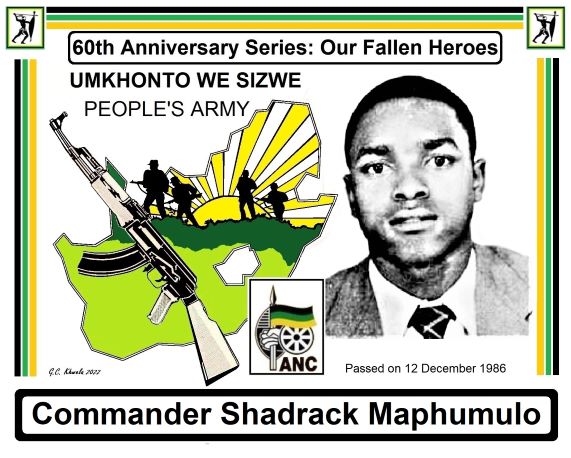
On 12 December 1986, at around 02:00 in the morning, Msizeni Shadrack Matthews Maphumulo, an African National Congress (ANC) Acting Representative in Swaziland, died in police custody after he had been confronted at home in Swaziland by a group of armed men.
Maphumulo was one of hundreds of people who died in police custody or who died in the liberation struggle against apartheid. Shadrack had been stationed in Swaziland for over five years having fled a banning order restricting him to the Inanda area of Natal following his arrest in 1977.
He was awoken at his apartment on the third floor Matsapa’s Magevini Flats by a loud bang, which was followed by the entrance of four men – two black and two white – brandishing guns. They shot through Maphumulo’s bedroom door, one of the bullets hitting him in the stomach. He was at that moment attempting to hide his three sons from the attack.
The attackers stormed and entered the bedroom, carried him out of the flat, while he was bleeding profusely, shoved him into the boot, and drove away with him at high speed in a Toyota Corolla with a South African number plate. He was later transferred into the back of a van, with no medical intervention, and on that long, arduous and agonizing journey to Durban, Shadrack bled to death.
Msizeni Shadrack Maphumulo was among the first Umkhonto we Sizwe (MK) cadres who were arrested and sentenced to spells on Robben Island, where they sharpened their political understanding and became more seasoned activists. They came off the island more determined and clear in their minds about what needed to be done to rebuild the ANC underground structures.
Maphumulo had been part of the MK Unit led by Justice “Gizenga” Mpanza, including Michael Mvula, which bombed the Natalier newspaper building in Umbilo Road in Durban, on 18 January 1963, as part of the Sabotage Campaign.
Following his release from prison, he was involved in reviving the underground structures in Natal. The newly established underground network suffered a huge blow in 1975 when people like Joseph Mdluli, Harry Gwala, Matthews Meyiwa and others were again arrested. Nevertheless, contacts were revived with cadres who were left behind – with people such as Mduduzi Guma, a vibrant legal practitioner and underground activist, and Shadrack Maphumulo, a former Robben Island prisoner – who survived the swoop of 1975 to 1976.
Maphumulo recruited Patrick Nyawose and Jabu Nzima, who doubled as operatives of the ANC underground, as well as leaders of the Black Allied Workers’ Union (BAWU). Subsequently, Maphumulo, Judson Khuzwayo and Petrus Nyawose remained behind to rebuild a “well-oiled” though small network, with Maphumulo acting as the major link between the underground and the ANC in Swaziland.
Khuzwayo and Nyawose later left the country, while Maphumulo was detained but never charged, ending up in Modderbee Prison, where he continued recruiting for the ANC. After his release from detention in 1979, he was banned and restricted to the Inanda area. He then escaped to Swaziland in 1981, where he remained until his abduction and murder on 12 December 1986.
A report compiled by apartheid Military Intelligence (MI) the following day, profiled a Swazi national, Grace Cele, as a member of the ANC and the South African Communist Party (SACP). She had also been abducted from her bedroom the same night as Maphumulo by three men. Another Swiss couple, Corinne Bischoff and Daniel Schneider were also abducted, and all four were taken to South Africa.
According to the MI report, they were all members of the Natal and Transvaal Implementation Groups involved in fulfilling ANC/SACP objectives, by offering courier services from Maputo, through Swaziland, and to the underground structures inside the country, as well as establishing infiltration routes for MK “terrorists”.
Bischoff and Schneider were later released that weekend following protests by the Swiss government, but Grace Cele spent two months in detention despite similar protests by the Swazi government, without proving the allegations against her. All four had been abducted by a 16-strong Special Forces team that ended up murdering Shadrack
Maphumulo in a mishandled abduction operation.
According to Joe Pillay, “In the nearly five years Shadrack spent in Swaziland, he saw to the needs of refugees affiliated with the ANC. He distributed funds and groceries on behalf of the organization, to its members. He acted as a liaison with the Swazi police and was involved in intelligence gathering. Always honest, fair and friendly, he was well liked by all who knew him. When his wife, Khumbuzile, worked nights as a nurse, Shadrack took care of their three small sons.”
Pillay continues to say, “Shadrack’s life was a struggle against oppression and racism. His goal was a South Africa in which all races lived in harmony, and the rights and freedoms of every South African entrenched in the constitution. He was a great supporter of the Freedom Charter, which he hoped would be implemented after liberation. He was a dedicated fighter for freedom, who in the struggle for a better life for all South Africans, lost his own.”
“We must never forget Shadrack, or the many people the world over, like him, who have lost their lives in the struggle to create a more just world; for all of us.”
Castro Khwela
Good day fellow Compatriots!
Discover more from CASTRO KHWELA
Subscribe to get the latest posts sent to your email.