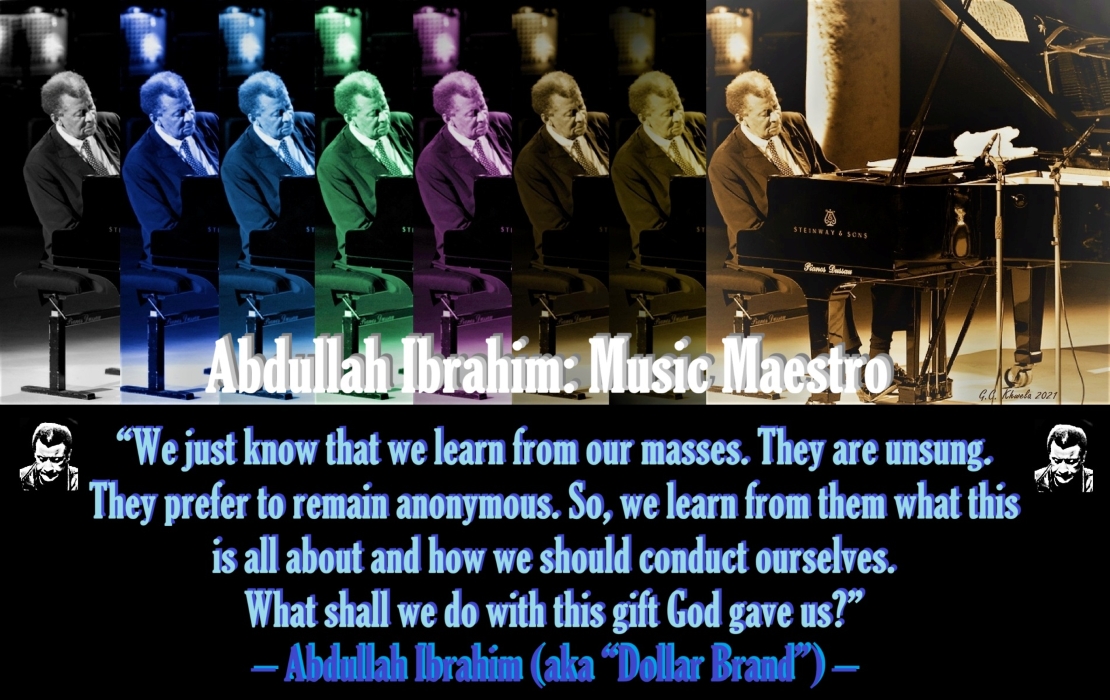
Abdullah Ibrahim: Music Maestro
“In Africa, the music legacy is passed on through families …”
“Our traditional music is very, very complex compared, for example, to western music. Many people won’t agree with us of course, but that is the absolute truth. One of the things we implore our educators to do is to focus on African traditional music, because of its complexity and to integrate it into our education system.”
“In our music there’s no such thing as a mistake and, actually, maybe in life itself there’s no such thing as a mistake either.”
“From my understanding, there is no such thing as a mistake. Something occurs in life that you have to deal with and you have to find a resolution. So this is how we think of the music – like Thelonious Monk said ‘The piano ain’t got no wrong notes’.”
“In South Africa at the moment there’s an amazing generation of young classical musicians. For instance, there’s one young bass player who has translated all the Bach solo cello suites to the bass. Another young man from South Africa has been studying classical conducting in Milan. So, with them, we are creating my own philharmonic orchestra and I know that they will discover there’s potential beyond just ‘reading’ music. It’s based in Johannesburg and it will spark their potential in a city where there is truly so much going on, both on the surface and also deep underneath!”
“I think it’s drawn from our tradition, our cosmology, the way we approach things. And, actually, in Japanese culture too. They have a principle of asymmetry, particularly in visual art, because if everything is symmetrical then the observer has nothing to do. If you present a fait accompli, then the mind has nothing to do, but if you don’t then you stimulate the brain. As Ellington said, the most important part of music is listening to it.”
“A lot of jazz musicians also gravitated towards that rhythmic and modal concept, because in Africa, all the music is modal and rhythmic, and there is a link.”
“Our audiences all over the world are not necessarily jazz audiences. Breath and life is a gift for everybody regardless. We just know that we learn from our masses. They are unsung. They prefer to remain anonymous. So, we learn from them what this is all about and how we should conduct ourselves. What shall we do with this gift God gave us? We invest in loss. That means we don’t expect anything in return. So, this is what we present to the audience when we play the music.”
Sources:
Alyn Shipton, “Abdullah Ibrahim interview: ‘In our music there’s no such thing as a mistake …’”, Jazzwise, 20 October 2021.
Jill de Villiers, “The South African Music Maestro In Munich”, Forbes Africa, 11 October 2023.
Castro Khwela
Good morning fellow Compatriots!🙏🏾✊🏾👊🏾
Discover more from CASTRO KHWELA
Subscribe to get the latest posts sent to your email.