Beginnings of the Northern Front in Angola
On 7 October 1987, Umkhonto we Sizwe (MK) dispatched two companies totalling 200 men and women to the area between Angola’s Uige, Cuanza Norte and Bengo Provinces, as the need heightened to protect the transport links connecting the African National Congress’ (ANC’s) camp networks in the north of Luanda against attacks by UNITA (Union for the Total Independence of Angola) forces, which were supported by the United States and apartheid South Africa.
The operational zone for the “Northern Front” was in contrast to the “Eastern Front” campaign that was undertaken in 1983 to 1984, which was centred in Malanje Province. For instance, during the Northern Front campaign, unlike in the Eastern Front, the contingent forces were exclusively MK, with little or no FAPLA (People’s Armed Forces for the Liberation of Angola) admixture. The Angolan FAPLA forces were heavily committed in the fight in the southern part of the country alongside the Cuban Revolutionary Army and PLAN (People’s Liberation Army of Namibia – of the South West African People’s Organisation – SWAPO) forces trying to repel an apartheid South African Defence Force (SADF) invasion.
UNITA had opened another front in the provinces of Zaire, Uige, Lunda and Cuanza Norte since 1986. During February and March 1986, UNITA forces captured three towns in the central provinces of Cuanza Norte, Uige, Huile and Lunda in which FAPLA forces were being continuously harassed, and these were indicators to the beginning of the “Northern Front” in the Angolan war. After failing to capture Cuito Cuanavale and after suffering heavy casualties in their campaign in the south, UNITA forces resorted to consolidating their guerrilla warfare efforts in central and northern Angola. The successes of UNITA in the north were bolstered by renewed United States’ support by the Ronald Reagan administration in the 1980s.
The United States was also conducting manoeuvres with the Zaïrean forces with the long-term intentions of providing UNITA forces with the necessary support to establish a base in Quimbele, north of Angola. Opposition to American involvement in Angola had come to a head in February 1976, when Congress, suspicious of CIA (Central Intelligence Agency) and executive branch action in southwest Africa, passed the Clark Amendment (named after its sponsor Senator Dick Clark), which “specifically prohibited any assistance that might involve the United States more deeply in the Angolan War”, which was also regarded as impacting negatively on relations with Zaïre. This effectively ended United States support to the factions in Angola, including UNITA. Albeit security analysts maintained that Israel stepped in as a proxy arms supplier for South Africa and UNITA after the Clark Amendment took effect. Israel and South Africa established a longstanding military alliance, in which Israel provided weapons and training, as well as conducting joint military exercises.
Nevertheless, when the Clark Amendment was repealed in 1985, with pressure from the Reagan administration, the CIA resumed funding to UNITA. From 1986, officially acknowledged covert aid from the US began to flow to UNITA, through Zaïre, increasing from an estimated $15 million a year at first to more than $50 million annually. A strong political base both in Congress and in the administration during the Reagan years, was the far-right ideology of the anti-Marxist crusaders, for whom UNITA Leader Jonas Savimbi became a high-profile symbolic hero. This group derived political force not only from true believers among the Reaganauts, but also from important sectors of the Democratic party seeking convenient ways to prove their anti-communist credentials.
The intentions of the United States’ military advisors were that the UNITA forces should get re-established in northern Angola with sufficient aid to capture the major bases and towns in Luena, the capital of the Moxico province. According to this plan, also dubbed “Operation Flintlock 88”, UNITA forces were to be based in Quimbele under the cover of joint US-Zaïrean exercises, with enormous armaments being supplied from Kitona, Kincuso, Kimpese, Kahemba, Dilolo and Kamina bases close to the Angolan border. From 1985 UNITA lobbying efforts took on a massive scale, with the employment of the well-connected public relations firm, Black, Manafort, Stone and Kelly as well as a shifting array of other smaller firms. By the end of the 1980s the total UNITA public relations budget was running at over $2 million a year.
In addition to escalating its military support for UNITA, the Reagan administration and its conservative allies also worked to expand recognition of Savimbi as a key United States ally in an important Cold War struggle. In January 1986, Reagan invited Savimbi to a meeting at the White House. Following the meeting, Reagan spoke of UNITA as winning a victory that “electrifies the world”. Two months later, Reagan announced the delivery of Stinger surface-to-air missiles as part of the $25 million in aid UNITA received from the United States government. Subsequent to this military assistance, on 8 February 1986, UNITA forces attacked Camabatela in Cuanza Norte province. Reports were received on 26 February, the same year, of an alleged massacre of civilians by UNITA forces in Damba, located in the Uige Province, later that month.
When the apartheid SADF could not move forward in the southern front, UNITA had no other option but to attack further north to ensure the sustainability of the Northern Front. For instance, UNITA managed to capture Muhango, since FAPLA had placed all its efforts into the confrontation with the SADF in the south. SWAPO’s PLAN forces got engaged in the battles in Cuito, while MK guerrillas clashed with UNITA elements at Malanje, Uige and Cuanza Norte. With the UNITA forces adopting the US-designed northern option under Operation Flintlock 88, it implied that the movement was slowly distancing itself from South Africa. The United States was also reported to have trained approximately 60 UNITA explosive experts alongside the Nicaraguan Contras in Central America.
For the Angolan government, reliance was placed on Major Matias Coelho Mzumbi’s hands, who was also relying on counter-insurgency operations carried out by MK forces from their training bases in the north and some who were moved north from Luanda. UNITA forces in the Northern Front were engaged in cutting roads and transport, blowing up supply dumps and sabotaging government facilities in Luanda, the north of Luanda, Malanje, Huambo and Bie provinces. Determined to renew offensive operations in 1986, the Soviets sent over 1,000 advisors and more than $1 billion worth of military equipment, including antiaircraft missiles and aircraft, to Angola. By May 1986 more than 20,000 FAPLA, 7,000 SWAPO, and 900 Cuban fighters had been assembled around Luena and Cuito Cuanavale for another push against the UNITA.
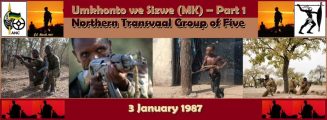
Following the arrival of MK combatants in the north of Luanda, peasants flocked back to their villages, such as Mdlaza, Quibna and Ton Angola, from which they had fled following UNITA attacks. From 1987 to 1989, MK units, eventually equipped with heavy weapons such as 122-mm rocket launchers and 81-mm mortars, effectively succeeded against UNITA in what came to be called the ‘‘Northern Front”. MK commanders involved in the northern front included Chris Hani and Timothy Mokoena, who was seriously wounded in an engagement in 1988. Timothy Mokoena was later in the same year promoted to become MK Army Commissar in the place of Steve Tshwete, who was moved to co-head the newly created Internal Political Committee (IPC) with Ronnie Kasrils.
UNITA forces at the Northern Front were engaged in cutting roads and transport, blowing up supply dumps and sabotaging government facilities in Luanda, the area north of Luanda and the Malanje, Huambo and Bie provinces. France’s secret service (Direction Générale de la Sécurité Extérieure [DGSE]) was providing training in sabotage to UNITA combatants at Cercottes in France. These UNITA members were posing as Zaïreans in order to save embarrassment for the French government and this training had been taking place since 1984, with the involvement of ADERI, a right-wing Paris-based organisation that had links with the racist government in South Africa.
UNITA attacks against the Umkhonto cadres in Angola were based on the perspectives shared by conservatives in the United States towards the South African liberation movement, especially if these attacks were placed within the greater context of discrediting the ANC as a “communist-inspired terrorist organisation” in the eyes of the American public. The Reagan administration’s support for UNITA and the shifting of its headquarters to Quimbele, close to the Zaïrean border, was partly motivated by the intention to ultimately remove MK bases that were located in the northern part of Angola. The presumption here is that the selection of the town of Quimbele was also caused by the need to establish a UNITA presence in the proximity of MK facilities and bases so as to make it impossible for the latter to continue with its normal military training.
It is also possible that according to the concordant prognoses of the UNITA, SADF and United States leadership, MK was anticipated to fail to absorb heavy casualties within its ranks, considering the experiences on the Eastern Front. With heavy casualties being meted out on a continuous basis alongside the Luanda to Uige route through continuous harassing ambushes, MK combatants were expected to be mutinous against their leadership, as they had done in 1984. The contemplation was that it could lead to an unmanageable situation in the north that would also allow UNITA to operate freely against FAPLA and ultimately control the route from the north to Luanda. With the capital being threatened, the joint FAPLA -Cuban-PLAN forces could be distracted from their focus on the southern front and be overstretched to contain the situation.
Nevertheless, the morale and enthusiasm of the Young Lions Detachment of MK who were essentially involved in the Northern Front was remarkably amazing. Despite the huge losses that MK suffered and the difficult conditions of operating within an unfamiliar territory, these combatants fought gallantly in defence of Angola. Despite the odds of being deployed within an intricate environment, they proved themselves as capable soldiers in the counter-insurgency campaigns that were undertaken on the Northern Front. MK cadres achieved gigantic successes in suppressing and routing UNITA forces within Angola’s northern provinces and were able to co-operate effectively with the Angolan population within the towns and villages wherein they were engaged. When convoys, travelling from Luanda on the route between ANC’s Angolan bases, entered villages in the operational area, they were cheered upon and applauded by locals.
UNITA’s successes were largely based on United States and South Africa’s apartheid government support, as it was regarded as a reliable ally in the Cold War fight against “communism”. In comparison, the Angolan government had a minimal Washington presence, and strong opposition to UNITA aid in Congress was confined to the Black Caucus and a handful of representatives with particular interest in Africa. After 1986, the Angolan government for the first time began serious lobbying in Washington. But even then, it was hampered by having little knowledge of the United States political scene and by lobbying efforts that were clumsy and uncoordinated in contrast with UNITA’s. Given the political lineup, the contest between pro- UNITA and anti-intervention forces was unequal to start with. But the lack of an effective Angolan government voice accentuated the gap.
The significance of MK’s involvement in the defence of Angola is that it defended the route from the then Zaïre to Luanda, which was vulnerable to joint UNITA-SADF-CIA forces and could have allowed them to destabilise the capital, Luanda. Accordingly, MK managed to play a strategic role in stifling what was probably a well-orchestrated effort by the UNITA-SADF-CIA forces to stretch the joint FAPLA-Cuban-PLAN forces along two fronts, in the north and the south of Angola. The opening of the Northern Front by the UNITA-SADF-CIA forces was deliberate, since these forces were suffering huge losses on the southern front. They therefore opted to open the northern front in order to threaten and ultimately take over the capital, Luanda, and accordingly cut off the joint FAPLA-Cuban-PLAN forces from their main supply source, which could have finally resulted in the latter’s annihilation.
Sources:
Wikipedia.
South African History Online (SAHO).
Director Central Intelligence, “Angola: Short-Term Prospects for UNITA: Special National Intelligence Estimate”, Central Intelligence Agency (CIA), 27 June 2011.
John Kelly Thornton, “Independence and Civil War in Angola”, Encyclopaedia Britannica, 6 October 2025.
Christopher Paul, et. al., “Paths to Victory: Detailed Insurgency Case Studies”, RAND Corporation, 26 September 2013.
Elizabeth Schmidt, “Kissinger’s Secret War in Angola”, Africasacountry, 12 July 2023.
Thula Simpson, “Umkhonto we Sizwe: The ANC’s Armed Struggle”, Penguin, 2016.
Maren Saeboe, “A State of Exile: The ANC and Umkhonto we Sizwe in Angola, 1976-1989”, Master of Arts: University of Natal, December 2002.
David S. Wiley, “Should the United States Give Support to Jonas Savimbi and the UNITA Movement in Angola?”, Michigan State University, 28 January 1986.
Sammie Floyd, A Clandestine Civil War: How the Secret U.S. Involvement in the Angolan Civil War had a Hidden Agenda”, Menlo School, 3 April 1979.
John Prendergast, Angola’s Deadly War: Dealing with Savimbi’s Hell on Earth”, United States Institute of Peace: Special Report, 12 October 1999.
SAHO, “The Angolan Civil War (1975-2002): A Brief History”, South African History Online (SAHO), 5 February 2015.
Didier Péclard, “The Legacies of Defeat: UNITA and the Changing Fortunes of Legitimacy in Post-War Angola, Civil Wars”, Vol. 27, No. 3, 2025.
GC Kwhela, “Umkhonto We Sizwe’s Contribution to the Defence of the African Revolution in Angola”, Journal for Contemporary History, Vol. 28, No. 2, 2003.
ADST, “The Search for Peace in Southern Africa – Oil, Angola, and the Proxy Wars”, Association for Diplomatic Studies and Training, August 2014.
Amy McKenna, “UNITA”, Encyclopaedia Britannica, 12 August 2025.
William, I. Robinson. “UNITA-Looking at the Past”, 26 May 2024.
Tetteh Hormeku, “US Intervention in Africa: Through Angolan Eyes”, Third World Network (TWN), Third World Resurgence No.89, January 1998.
Castro Khwela
Good day fellow Compatriots!
Discover more from CASTRO KHWELA
Subscribe to get the latest posts sent to your email.