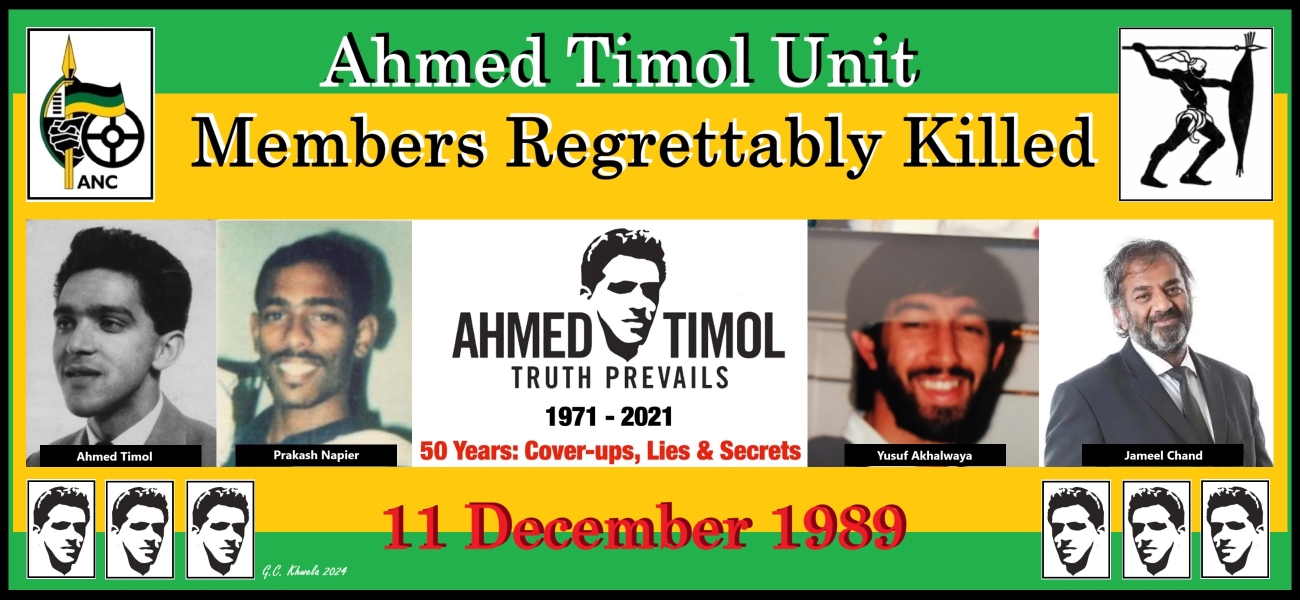
On the night of 11 December 1989, at around 23:30, a huge explosion hit the north part of Park Station, shattering windows and spraying glass over a wide area. The explosion resulted in the death of two persons, with one person’s body being badly burned and the other’s parts being severed from the body and his remains being tossed up to sixty metres from the scene. The third person, who was a bit far from them, had his body thrown off by the ground by the severity of the blast, but he survived with a Soviet pistol in his hands.
The three victims of the blast were members of Umkhonto we Sizwe’s (MK) Ahmed Timol Unit, who were on a mission to sabotage the police barracks in Hilbrow as well as the freight railway line and locomotives in Park Station.
The three members of the Ahmed Timol Unit were Prakash Napier, the Commander of the Unit, Jameel Chand, who was the Commissar, who were both trained MK cadres, and Yusuf Akhalwaya, who was a final year Physical Education student at the University of the Witwatersrand, from which he was suspended for trying to protect a fellow student from arrest. Yusuf was an active member of the Call of Islam and the Lenasia Youth League. Their mission was to support the Railway Workers’ strike, which unfortunately went awry.
They had begun by planting a limpet mine at the Hilbrow Police Barracks, where Napier and Chand were focused on ensuring that the mine was appropriately placed, while Akalwaya was on the lookout for police about fifty metres away.
From Hilbrow Police Barracks, they then walked to the Johannesburg Park railway station, where they were intending to plant their second mine. The mine, which was strapped to Napier, unfortunately exploded, with Akhalwaya suffering fatal burns, while Napier’s head and one of his legs were severed from his body, with his remains being tossed up to sixty metres away from the scene of the blast.
Chand was thrown off his feet by the blast and found himself lying on the ground with a Soviet pistol in his hands. Following the blast, soldiers rushed past him to the scene without noticing him and the pistol in his hand. He then stood up and walked away and deposited the gun in a rubbish bin.
The Ahmed Timol Unit – named after an anti-apartheid revolutionary who was in the underground South African Communist Party (SACP), the African National Congress (ANC) and MK, who died at the age of 29 from injuries sustained when he fell from the top floor of John Vorster Square police station in Johannesburg – was formed in 1986, with Prakash Napier being the Commander of the unit while Jameel Chand was the Political Commissar, and Yusuf Akhalwaya was recruited into the unit in 1987.
From 1986 to 1989, the Ahmed Timol unit carried out over forty acts of sabotage, making it one of the most active Umkhonto We Sizwe units at the time, and perhaps in the entire MK’s history as well. Carrying out more than two attacks a month, the members of the Ahmed Timol Unit were always wary that all their targets had to be politically motivated and that the attacks would spark confidence and revolutionary fervour amongst the struggling masses. That tragic night, as in operations before, their strategy was to create anarchy and mayhem for the racist forces with the simultaneous explosions of two limpets in the Johannesburg CBD.
Both Jameel and Prakash had undergone military training in Angola for several months, and they together spent six months in the Soviet Union in 1986 to obtain specialised training in urban guerrilla warfare. Eight of the thirty-three limpet mine sabotage operations carried out by the Ahmed Timol MK unit were on the homes of persons associated with local or parliamentary government structures such as the President’s Council and the Management Committees. The limpet mines were timed so that they would explode outside houses between 23:00 and 04:00 to avoid any possible injuries or deaths.
According to the Commissar of the Unit, Jameel Chand, “It was only after our Commander (Prakash Napier) had received confirmation that we would carry out the action. The unit always carried out the attacks between 11pm and 4am. We would also monitor the scene of the intended action. The limpet would be placed in a location that would not cause injury or death. If explosion did not take place within the time it was scheduled to have we would contact the police and inform them of the device. We would also do dummy runs and evaluate afterwards.”
A few days after the tragedy, ANC Cadre Chand, who survived the explosion, briefed Neeshan Balton, the political head of the Ahmed Kathrada Area Political-Military Committee, and Hassen Ebrahim, who was Commander of the Kabwe Machinery, pointing to faultiness of the explosive device and not any miscalculation or reckless handling of the device.
Chand was later granted amnesty by the Truth and Reconciliation Commission (TRC) for a number of explosions in and around the Johannesburg area. His amnesty included the fact that he, as part of the MK Ahmed Timol Unit, planted limpet mines at the offices of the House of Delegates, Lenasia Management Committee and also the National Peoples Party on 1 October, 1987.
“Between the anvil of united mass action and the hammer of the armed struggle, we will crush the white minority racist regime.”
Castro Khwela
Good evening fellow Compatriots!
Discover more from CASTRO KHWELA
Subscribe to get the latest posts sent to your email.