

The first January 8th statement of the African National Congress (ANC) in exile was issued in 1972, which signified the 60th Anniversary of the founding date of the Movement. This statement outlined the organisation’s programme for the year, but was unlike the Statements that followed afterwards, which had a theme for each year.
The next January 8th statement was issued in 1979, “The Year of Isandlwana”, following a hiatus of six years, wherein the ANC issued statements related to major events or issues, and those became known as Special Statements. From 1979, the January 8th Statements were largely prompted by efforts towards People’s War, and these resulted in the following 10 years being declared the Decade of Liberation.
During the Decade of Liberation, which began from 1980, “The Year of the Freedom Charter”, the President of the ANC and Commander-in-Chief of Umkhonto we Sizwe (MK), then President Oliver Tambo, declared the period as a “a great decade – great in the new victories that our efforts shall surely bring, in the noble struggle against imperialism and reaction”.
Accordingly, marking the anniversary of the founding of the Movement with a January 8th statement that had a central theme became a tradition over the years, particularly as analysis of the previous years provided a foundation for new orders to be issued for the oncoming year and this became a buildup towards final victory.
1980, “The Year of the Freedom Charter” was followed by “The Year of the Youth” in 1981, “The Year of Unity in Action” in 1982, “The Year of United Action” in 1983, “The Year of the Women” in 1984, and “The Year of the Cadre” in 1985. The other years, from 1986, “The Year of Umkhonto we Sizwe – The People’s Army”, related to Advance, United Action and Mass Action for People’s Power in 1987, 1988 and 1989 respectively. The Decade of Liberation was finalised with “The Year of People’s Action for a Democratic South Africa” in 1990.
Today, and this year, is the 40th Anniversary of “The Year of the Cadre”, which was largely based on turning the tide against the apartheid regime, as the revolution was entering the second half of the 1980s that was supposed to blossom the Decade of Liberation.
According to then ANC President Oliver Tambo, “When we cast our minds back to the Year of the Charter – 1980 – and the subsequent years, the one feature that stands out is the ever expanding and visible role of the masses of our people in the making of this history. As we enter this second half of the Decade of Liberation, it is necessary that we examine not only our striking power, but, even more important, the direction in which to strike and how to deliver the blow. In particular, it is necessary that we ask the question: at what pace – how fast – are we advancing towards the conquest of power?”
The issue of the pace was extremely critical to the success of the project, since its failure could mean the reversal of all the efforts that had been undertaken since the beginning of the 1980s. Hence, the emphasis that, “The pace of our forward march depends on our success or failure to strengthen the first and the third of the four interlinked elements (pillars) we have referred to, namely, the all-round activity of the underground structures of the ANC and the armed offensive spearheaded by Umkhonto we Sizwe.”
“With regard to these two decisive elements of our revolutionary struggle, we should neither dramatise our shortcomings nor blind ourselves to the reality that we have not advanced on these two fronts at a pace corresponding to our advance on the other two.”
“To move forward to victory with the greatest speed,” Tambo averred, “we must pay particular attention this year to the task of building a strong underground presence of well-organised revolutionary cadres, drawn from the fighting masses and integrated among them. Such a body of cadres constitutes the dynamising factor in our situation – a force capable of bringing together the various strands of our struggle, and assisting in the further development and consolidation of all our political and military combat forces into a mighty army of liberation.”
What this required was to “take it as our special task to strengthen and reinforce our vanguard organisation, the African National Congress. Already we have made great strides in this regard. And yet the imperatives of our struggle demand that we do not any longer postpone execution of the task we elaborated last year – to strengthen and expand the underground structures of the ANC, ensuring the active presence of our movement everywhere in the country.”
Achieving this was not any easy task, as it involved the development of unique characters, revolutionary cadres, whose distinctive feature was “a high level of discipline, dedication and courage in carrying out the tasks assigned by the movement. Such cadres are guided by our goal of a united, non-racial and democratic South Africa. They fight for the immediate release of Nelson Mandela and all other leaders and political prisoners. They accept that our path to victory lies in a combination of the all-round activity of the ANC, united mass political action, armed struggle and international solidarity and support.”
Tambo and the leadership of the ANC were aware that “the strength of any organisation lies in the calibre of its individual members and units. In order to advance in keeping with the momentum of our struggle we must improve the quality and expand the quantity of our membership. We need cadres of unquestionable loyalty, dedication and understanding of our struggle. In order to achieve such a high standard and spur our nation into a greater onslaught on the enemy and its institutions.” Hence 1985 was declared, “The Year of the Cadre!”
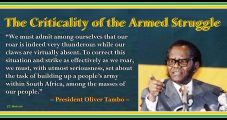
The orders were very clear to all the patriotic forces in the country, that as “Fellow Combatants … we have it within our means to increase our capacity to hit back at the enemy, arms in hand. No one but ourselves will accomplish this task. We must all take it as a priority task to build up the popular armed forces, to transform the armed actions we have thus far carried out into a people’s war, by helping to root Umkhonto we Sizwe firmly among the people and actively drawing the masses into the prosecution of a people’s war.”
Furthermore, was the final order to “take big strides in further strengthening the organised underground structures of the ANC. Let us see greater mass political actions in all the provinces and districts of our country. Let it see us extend people’s war to all corners of our land. Let it see the fastest and furthest possible co-ordinated advance on all fronts towards the goal of people’s power. There is no going back. Forward Always is our battle cry!”
Castro Khwela
Good day fellow Compatriots!
Discover more from CASTRO KHWELA
Subscribe to get the latest posts sent to your email.

Your updates are always great and appreciated for the correct historical information about the glorious movement.👊🏾