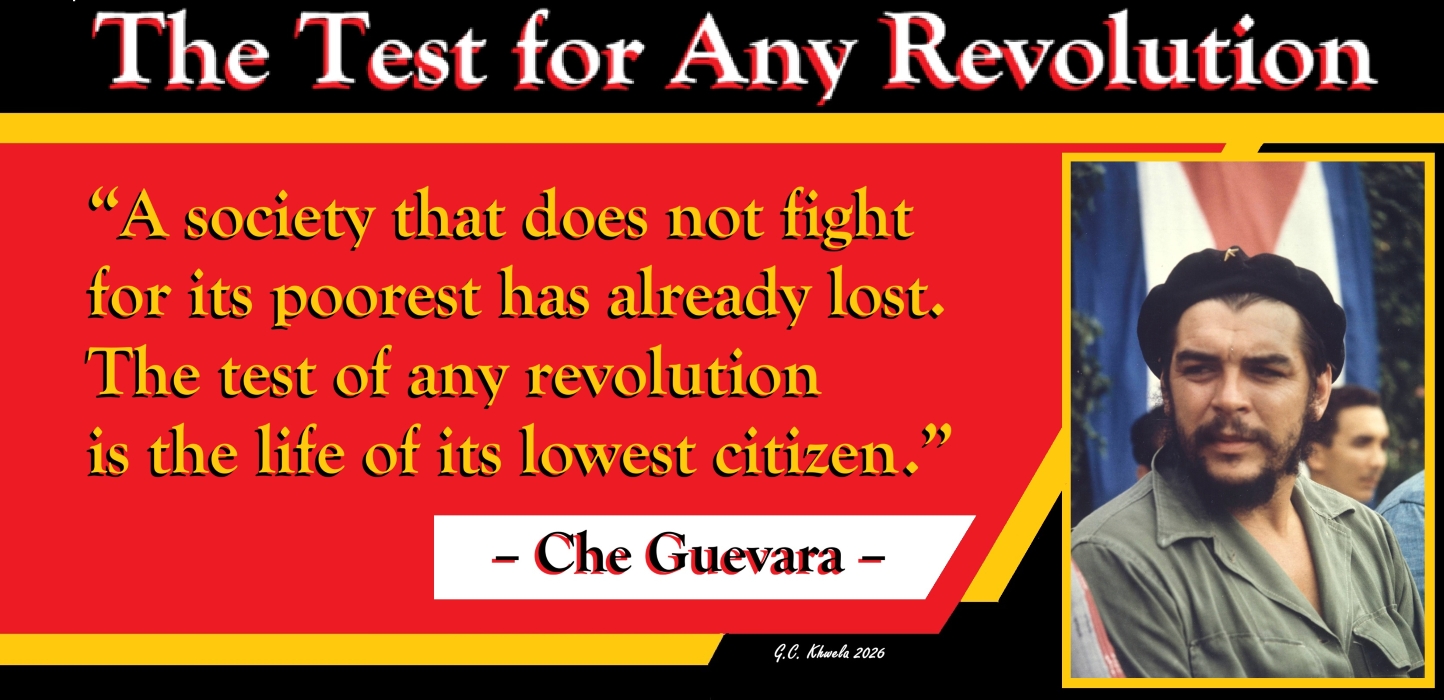
The Test for Any Revolution
The Revolutionary Focus of the “test” implies that any political or social shift – a revolution – is useless if it does not improve the material conditions of the marginalised. It highlights that a society’s humanity is reflected in how it cares for those who cannot care for themselves. The core idea is that a just society is not designed for the top, but rather, for the bottom, ensuring everyone has a dignified life.
This powerful sentiment emphasises that true societal progress and moral legitimacy are measured not by the wealth of the elite, but by the dignity and well-being of the most vulnerable. It suggests that a society that ignores its poorest members has already failed fundamentally. The argument here that poverty is not merely an economic issue, but a moral failing of the collective.
In the South African context, this philosophy highlights a deep tension between the nation’s constitutional promises and its economic reality. While the post-apartheid “revolution” was aimed to restore dignity to the majority, the “test” of the lowest citizen currently reveals a society grappling with some of the highest levels of extreme inequality in the world.
As of late 2025 and early 2026, Millions live below the Food Poverty Line of roughly R796 per month, meaning they cannot afford the minimum required daily energy intake. The “lowest citizens” are often young people. The official unemployment rate for those aged 15 – 24 years remains alarmingly high at 57% (Q4 2025), a figure that effectively excludes a generation from participating in the economy.
Essential costs like maize meal, cooking oil, and public transport have seen steep increases, disproportionately impacting the poor and forcing many households to skip meals. While social grants support millions of children and elderly, administrative failures and the lack of a permanent Basic Income Grant leave many unemployed adults without a reliable survival mechanism. Marginalised communities bear the brunt of poor local governance, often facing unreliable access to water, sanitation, and electricity.
Many analysts argue that South Africa’s democratic project is at a crossroads where the failure to meaningfully include its poorest citizens is causing a decline in public trust in democratic institutions. Accordingly, is our pursuit of a National Democratic Revolution a pipedream under these circumstances, since it has failed the “test”?
THE PEOPLE WILL TRIUMPH!
Our Battle Cry is and Will Continue to be: VICTORY OR DEATH WE SHALL WIN!
Castro Khwela
Good morning fellow Compatriots!🙏🏾✊🏾👊🏾
Discover more from CASTRO KHWELA
Subscribe to get the latest posts sent to your email.