
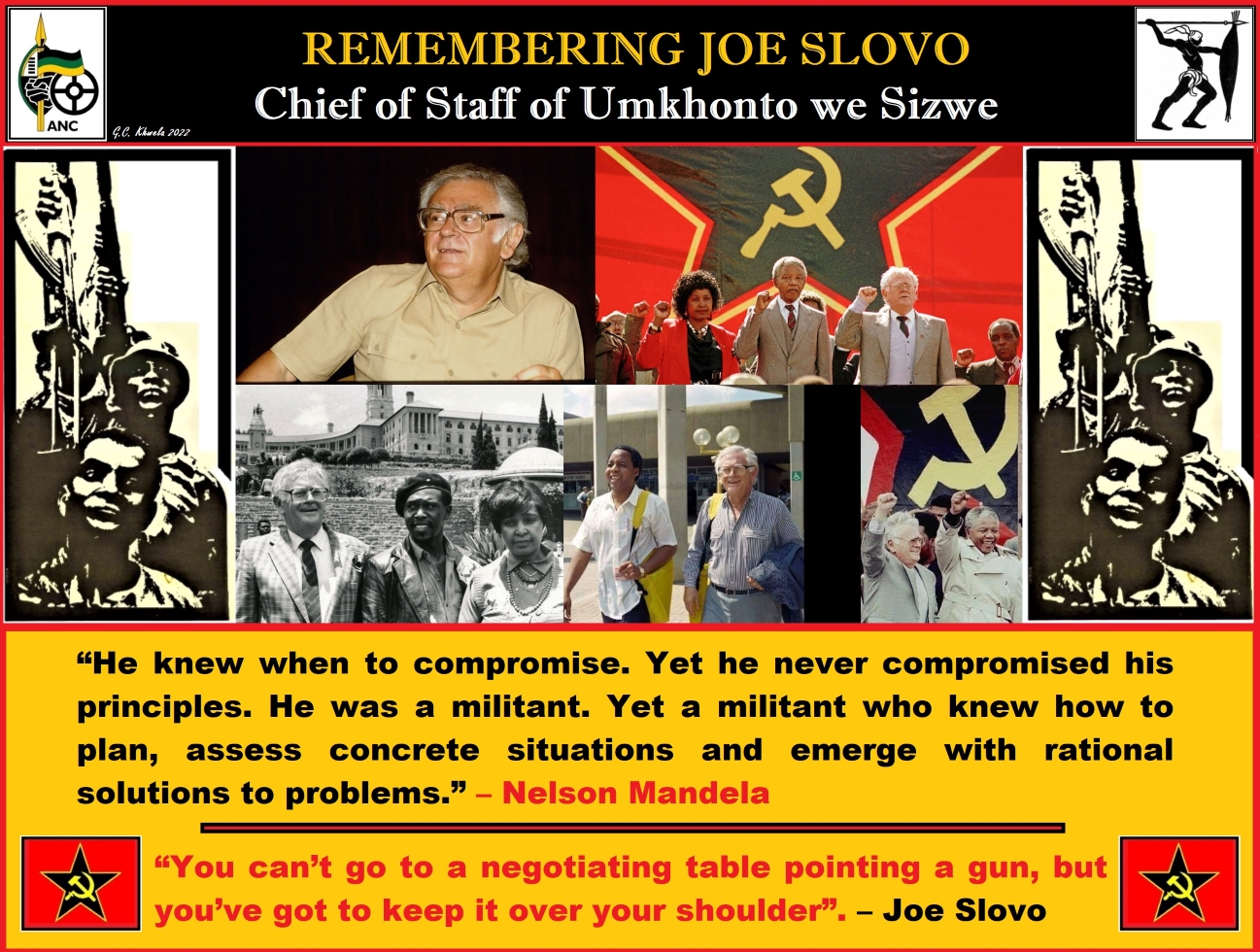
On 6 January 1995, Joe Slovo, the communist intellectual widely credited with being one of the masterminds of South Africa’s revolutionary struggle and national reconciliation, died after a long battle with cancer of the bone marrow. He was buried in Avalon Cemetery, Soweto, unheard of, for a white South African.
Slovo was widely admired across southern Africa, and was described as “a liberation war hero” and “African patriot completely immersed in the struggle for black freedom”.
Joe Slovo was born Yossel Mashel Slovo on 23 May 1926 in Obeliai, Lithuania, to a Jewish family that emigrated to the Union of South Africa when he was eight. His father worked as a truck driver in Johannesburg. Although his family were religious, he became an atheist who retained respect for the positive aspects of Jewish culture.
Slovo was educated at King Edward VII School and left school in 1941 and found work as a dispatch clerk. He joined the National Union of Distributive Workers and, as a shop steward, was involved in organising a strike. He then joined the Communist Party of South Africa (CPSA) in 1942.
Inspired by the Red Army’s battles against the Nazis on the Eastern Front of World War II, Slovo volunteered to fight in the war. He served as a Signaler in combat operations for the South African forces in North Africa and Italy, and on his return to South Africa he joined the Springbok Legion, a multiracial radical ex-servicemen’s organisation.
Between 1946 and 1950 Slovo completed a law degree at Wits University and was a student activist. He was in the same class as Nelson Mandela and Harry Schwarz. In 1949 he married Ruth First, another prominent Jewish anti-apartheid activist and the daughter of CPSA treasurer Julius First.
Slovo and Ruth had three daughters, Shawn, Gillian and Robyn. In 1950, the CPSA was banned and both First and Slovo were listed as communists under the Suppression of Communism Act and could not be quoted or attend public gatherings in South Africa. Slovo became active in the South African Congress of Democrats and was a delegate to the June 1955 Congress of the People organised by the African National Congress (ANC) and the the Congress Alliance organisations at Kliptown near Johannesburg, that drew up the Freedom Charter.
He was arrested and detained for two months during the Treason Trial of 1956. Charges against him were dropped in 1958. He was later arrested for six months during the State of Emergency declared after the Sharpeville massacre in 1960.
In 1961, Slovo became a co-founder member of the military wing of the ANC, Umkhonto we Sizwe (MK), with Nelson Mandela, and regularly attended meetings of its High Command at Lilliesleaf Farm, Rivonia. Following the need to establish MK as a guerrilla army, Joe Slovo went into exile in 1963 and lived in Britain, Angola, Mozambique and Zambia.
In his capacity as Chief of Staff of MK he co-determined its activities, such as the Special Operations Unit, which carried out dazzling operations against the apartheid infrastructure and military forces. In 1982, his wife Ruth First was assassinated in Maputo, by order of Craig Williamson, a Major in the Apartheid security police. Slovo was forced to leave Mozambique in 1984 in terms of the Nkomati Accord that was signed between apartheid President PW Botha and Mozambican President Samora Machel.
In that same year, in 1984, he was elected as Chairperson of the South African Communist Party (SACP), following the death of Yusuf Dadoo in 1983. And in 1987, Joe Slovo succeeded the late Moses Mabhida (who had passed on in 1986) as General Secretary of the SACP.
Slovo was also a leading theoretician in both the SACP and the ANC and wrote influential essays, including “South Africa: No Middle Road” and “Has Socialism Failed?”, in which he argued for a “justified confidence in the future of socialism and its inherent moral superiority”, while at the same time exposing the failures of capitalism.
In 1990, he returned to the country to participate in the early “talks about talks” between the government and the ANC. With regards to negotiations, Slovo argued that “You can’t go to a negotiating table pointing a gun, but you’ve got to keep it over your shoulder”. Ailing, he stood down as SACP General Secretary in 1991 and was given the titular position of SACP Chairperson. Slovo was succeeded by Chris Hani, who was assassinated two years later by a white right-winger.
Slovo was a long-demonised figure in white racist South African society, widely misrepresented as a “KGB Colonel” or “Russian secret agent”, and attracted a great deal of press after his return. After the elections of 1994, Slovo became Minister for Housing until his death in 1995.
According to then ANC President Nelson Mandela, with whom they co-founded the People’s Army, Umkhonto we Sizwe (MK), Slovo “knew when to compromise. Yet he never compromised his principles. He was a militant. Yet a militant who knew how to plan, assess concrete situations and emerge with rational solutions to problems.”
Castro Khwela
Good day fellow Compatriots!
Discover more from CASTRO KHWELA
Subscribe to get the latest posts sent to your email.


Yossel Mashel Joe Slovo aka Joe Slovo was instrumental in the formation of SACP together with Mandela.
His legacy with the blek natives will live forever in their lives. He sacrificed his life for the freedom of the blek native.
We will forever be indebted to him for his selflessness in giving up.his life in order to serve the masses.
Long Live the spirit of Joe Slovo, Long Live.