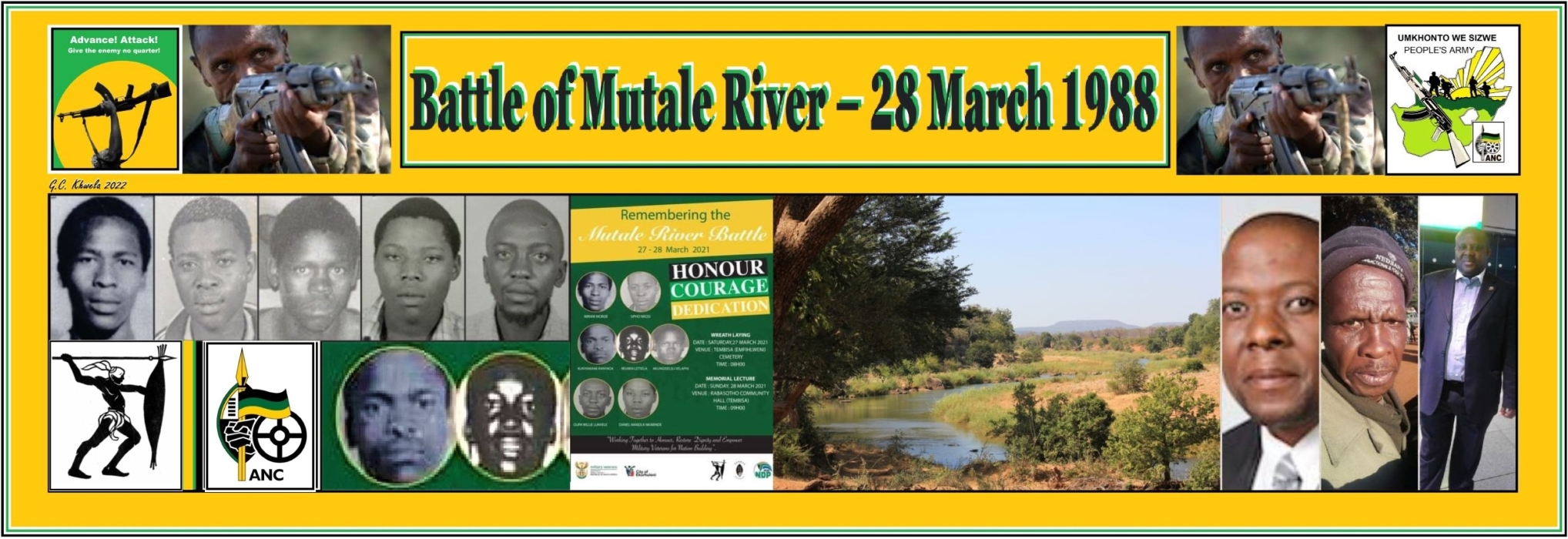
Battle of Mutale River – 28 March 1988
On 28 March 1988, nine Umkhonto we Sizwe (MK) Soldiers, aged between 19 and 21 years were surprised by heavy enemy fire from the apartheid South African Defence Force (SADF) and the then Bantustan Venda Defence Force (VDF), in what came to be known as “The Battle of Mutale River”. The MK Unit was tasked with infiltrating the rural areas of the then Venda Bantustan homeland in the Northern Transvaal (now Limpopo), and they crossed from Zimbabwe into South Africa on 25 March 1988.
Looking for a place to rest, the unit took refuge on an island on the Mutale River. On the morning of 28 March 1988, while on a small island on the Mutale River, they were spotted by members of the Venda Defence Force (VDF), after being reported by residents of Ha-Mutele village who identified their tracks near the river. Following being spotted by members of the Venda Defence Force, a battle ensued that lasted the whole day between the “Bantu homeland VDF” and the nine person MK unit in the vicinity of Ha-Mutele village, near Tshikondeni mine. The VDF called for reinforcements from the apartheid SADF, and helicopter gunships were deployed which ended in the demise of five of the nine MK guerrillas.
When reinforcements were brought in, one of the guerrillas that survived the confrontation, James Sekgale, said that a helicopter gunship began circling and firing at them. They tried to shoot down the helicopter but were outgunned, even when they tried using machine guns as an anti-aircraft weapon when their more effective portable shoulder launched surface-to-air missile (SAM-7) malfunctioned. Sekgale had to watch his comrades fall one by one, which included Daniel Nkabinde (Vusi Mthembu ), Oupa Lukhele (Dan Mabaso), Mlungiseleli Velaphi (Mzimkhulu Goduka), Sipho Nkosi (Peter Molotsi) and Ruben Lentsela (Benard Zondi).
Some of the notable heroic acts by the group included crawling under the enemy fire, enduring the napalm bombs thrown at them, as well as crossing the overflooded strong current river in their boots and backpacks. Indeed, these heroic acts by the brave young guerrillas gave their enemies a run for their money. Unfortunately, Sekgale was captured, but three members of the unit escaped and crossed back into Zimbabwe. These were Duma Mlambo, Ntwasihaye “Gabs” Magebhula and Thabo “Pele the Great” Dube.
Sekgale later escaped from prison in Venda and made his way back to Zimbabwe, but the bodies of his three fallen comrades disappeared. Recalling that fateful day, where they matched fire with fire, Sekgale said: “We were special forces. They sent us to Cuba for training … We were united, determined and hungry for action to liberate our people, and fear for death did not arise to us.” One of the guerrillas, who managed to escape during the firefight, Abram Moroe, was tracked down to a nearby village and was shot dead on 18 April 1988.
In 1998, the Truth and Reconciliation Commission (TRC) gave the families of the three guerrillas their exhumed remains. Sipho Sombane, a relative of Oupa Willie Lukhele (aka “Dan Mabaso”), said the following at the reburial, “At first we didn’t suspect it, until a member of the special branch came and told us that he had died”. But trauma followed when it was discovered these were not the remains of the families’ loved ones.
Years later, through studying police dockets and mortuary records, the National Prosecuting Authority’s (NPA) Missing Persons Task Team (MPTT) was able to correctly identify the five, who had been buried in the Mbaleni or Tshokota Cemetery in Makhado, Thohoyandou, in the Northern Transvaal (now Limpopo Province).
In his message of support, the General Secretary of the South African Communist Party (SACP), Solly Mapaila, representing the ANC-led Tripartite Alliance, said that “these young men were not hired assassins. They were not a gang of ‘tsotsis’ (gangsters). They had no expectations of material gains, but freedom of our people was in their hearts. Some of them sacrificed their youthful bodies to cushion the everlasting bed, all in the name of freedom.”
The Battle of Mutale constituted one of the many heroic battles that MK fought against the apartheid forces during its 32-year history of armed struggle. It was a gun running battle of a guerrilla formation against fully equipped regular defence forces that lasted for 48 hours, reflecting the calibre of highly trained and disciplined cadres who had done their rural guerilla warfare training in Cuba. No direct operations had previously been carried out against military personnel except for a number of skirmishes between MK cadres and the security forces, usually in the remote border areas.
Cadres were taught to maintain the moral high ground occupied by the liberation movement, owing to the justness of their cause, in the actual theatre of battle. At the height of the fog of battle, even after seeing their colleagues lying dead and others injured while administering first aid on them, they kept on encouraging each other saying, “we can’t die without fighting”. And they continued fighting a good fight worth being remembered. They truly reflected the courage and bravery of their forebears who fought valiantly against the invading colonial forces.
Sources:
South African History Online (SAHO).
Shaun Smillie, “Closure for Family of MK Soldiers”, The Star, 24 June 2013.
Department of Military Veterans (DMV), “Commemoration of the 34th Anniversary of the Battle of Mutale River”, Department of Military Veterans (DMV), 24 March 2022.
Gaudence Milanzi, “Liberation Struggles: Why Tanzania’s Legacy Lives on in South Africa”, Daily News, 28 September 2023.
Kenny Mathivha, “Limpopo Commemorates Fallen Military Veterans”, Department of Sport, Arts and Culture (Limpopo), 26 June 2023.
Gunners Association, “MK Names Added to Gunners’ Memorial”, DefenceWeb, 18 April 2019.
Zoutnet, “Mutale River MK Heroes Honoured”, Zoutnet, 9 April 2022.
Muifha Tshifhiwa, “Remembering Battles of Limpopo Mutale and Limpopo River Valley”, Limpopo Department of Agriculture and Rural Development (LDARD), 28 July 2023.
Nakedi Kekana, “Speaking Notes During the Battles of Mutale and Limpopo Valley Commemoration by the Acting Premier, Nakedi Kekana”, Limpopo Department of Sport, Arts and Culture, 30 June 2023.
Castro Khwela
Good day fellow Compatriots!
Discover more from CASTRO KHWELA
Subscribe to get the latest posts sent to your email.