Apartheid’s ‘Total Strategy’: Arming the Racist State – Part 1
Introduction
On 31 March 1977, the apartheid government released a Defence Force White Paper in the House of Assembly, which called for a “total national strategy” for defence, because South Africa was at war “whether we wish to accept it or not”. The document mentioned Soviet and Cuban intervention in Angola, which it cited as a “clear indication of Soviet imperialism which will confront Africa in the future”.
According to the White Paper, “One can justifiably say that there is a Soviet shadow over parts of Africa … The relative proximity of Soviet influence and its military aid has had its effect on terrorist activities against the northern states of South West Africa and on the internal situation of our country. The general trend of the events following the coup in Portugal in 1974 has led to a state of decreased stability in areas to the north of South Africa.” According to the apartheid regime, “it was obvious that the Angolan Civil War, and particularly the foreign intervention that it had generated, had brought the liberation struggle in southern Africa into the global Cold War”.
Since the 1967/68 historic military confrontation between ANC/ZAPU (African National Congress/Zimbabwe African People’s Union) guerrillas and the forces of racism in the Wankie and Sipolilo Campaigns in Zimbabwe – events which were followed by the liberation of Mozambique and Angola – and the development of armed struggle in Zimbabwe and Namibia; the heroic uprisings begun by the youth of Soweto, Gugulethu and other places and the uncheckable growth and advance of Umkhonto we Sizwe, the military wing of the ANC, the racist regime of South Africa had rapidly built up its military forces.
From the time the liberation movement was banned in 1960 until 1978, state expenditure on defence had multiplied 35 times from R44 million to over R1 500 million. In the same period the total number of troops available to the regime had been increased from 60 000 in 1960 to 560 000 in 1978. Successive ‘Defence White Papers’ of the ten years prior to 1979 exhibited the growing hysteria and escalating panic of the regime.
The ‘Defence White Paper’ of 1969 spoke glibly of the “ever increasing threat from the outside”. Four years later, in the ‘White Paper’ of 1973, P.W. Botha, then Minister of Defence confessed: “I do not wish to spread alarm, but I must state that for a long time already we have been engaged in a war of low intensity and that this situation will probably continue for some considerable time to come”. And he threatened: “We are fully aware of the fact that passive defence alone is inadequate and we are therefore obliged to maintain a significant retaliatory and interdictory capacity”.
In 1975, with Mozambique and Angola on the brink of independence, the regime’s defence department became more specific about the military threat, which it described as finding expression “in the existence of armed elements of banned political organisations accommodated in neighbouring states. They attempt to infiltrate the R.S.A. for the purposes of terrorism, sabotage and subversion with a view to overthrowing the existing order.”
In the ‘Defence White Paper’ of 1977, with the racist army having been kicked out of Angola a year earlier, the regime admitted that: “The occurrences in Africa and elsewhere have led to an increase in the tempo of developments and this has brought the threats nearer in time”.
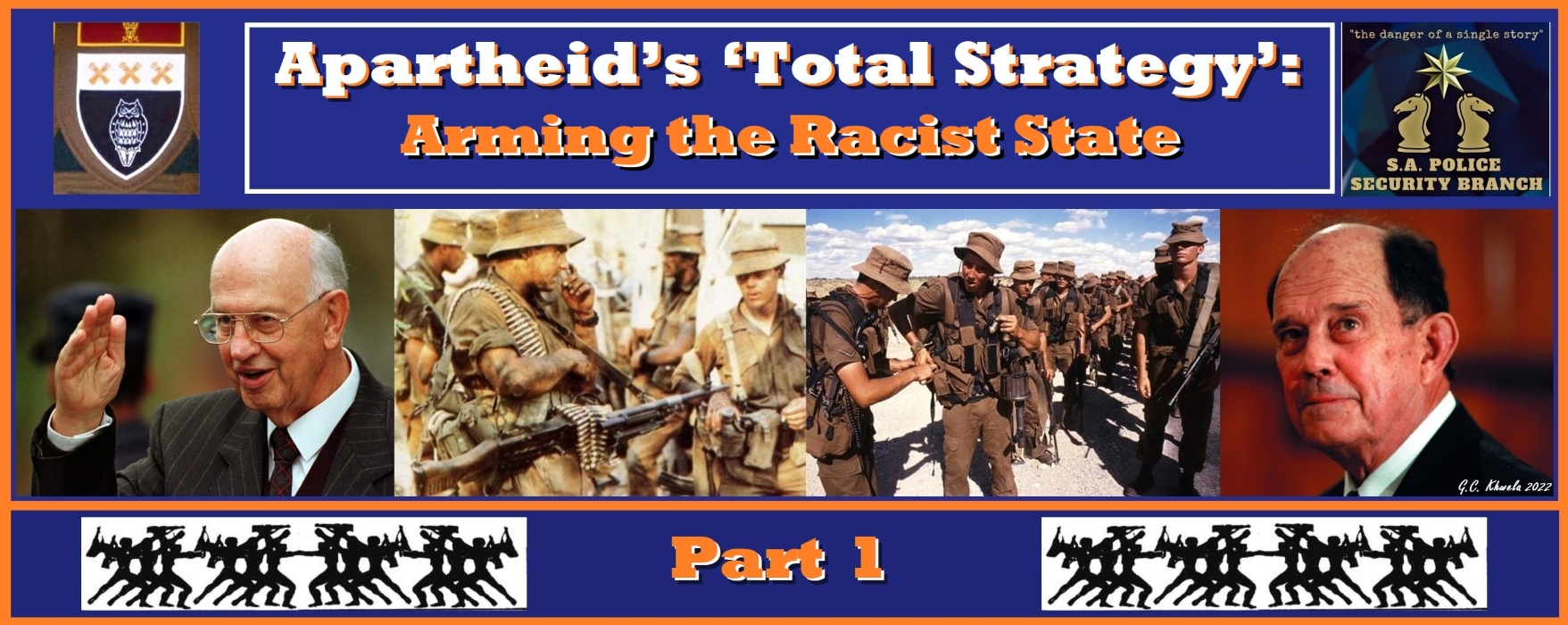
The coming to power of P.W. Botha on 9 October 1978, as Prime Minister and Minister of Defence, was the coming into force of his policy – total strategy. “Total Strategy” maintained that the 1977 ‘White Paper’ involved “interdependent and co-ordinated action in all fields – military, psychological, economic, political, sociological, technological, diplomatic, ideological, cultural”. In other words, the gearing of the whole of the South African state and social machinery towards the armed repression of the aspirations of the vast majority of the South African people.
Once again – as they did over a century ago when facing the heroic resistance of our people to encroaching colonialism – the racists had built themselves into a laager. Lately the laager was being protected not only with military might, but with propaganda, legislation, indoctrination, economic coercion and brutal repression. All arms of the state were being used to put the ‘total military strategy’ into action – parliament, the media, the schools, the churches, provincial and local authorities, the Bantustans, the intelligence services, the police, security police, navy, army, air force, commandos, civil defence units, etc.
Towards 1979, the white parliament had passed act after act giving more and more power to the state to crush armed resistance. The Defence Amendment Act of 1976 redefined South Africa as “Africa south of the Equator”, giving the racists the self-claimed right to attack neighbouring states with impunity.
Scrutinising “Total Strategy”
The theory of Total Strategy’s origins could be traced to the Cold War convictions in the West that the Soviet Union was out to use every possible means in its power to achieve world domination. For instance, the triumph of the Communist Party of China under the leadership of Mao Tse Tung in 1949 and the revolutionary attempts that occurred in Greece and Malaya, as well as their successes in Korea and Indo-China, led to the American doctrine of “containment”.
Military strategists within the apartheid establishment drew parallels between these events and the emergence of Marxist-oriented governments in Mozambique and Angola, in particular as an umbrella ideology designed to build crucial “white” popular support for the survival of the white racist state while dominating the surrounding region by military and economic pressure.
Various Defence White Papers described the onslaught in the language of an overall Marxist, indirect strategy designed to achieve the downfall of South Africa by a combination of international boycotts and embargoes, insurgencies and divisive domestic actions. This somewhat imperfect analysis fed upon historic Afrikaner traditions and racist views. Much of the theory required military inputs, both in formulation of policy and execution of its strategy.
The strategy was first outlined in the 1977 Defence White Paper and later expanded in Botha’s August 1979 speech to the National Party Congress, which laid out a 12-point plan for survival. It was basically a comprehensive plan to utilise “all means available to the state … in order to achieve the national aims within the framework of the specified policies … applicable to all levels and to all functions of the state structure”. It was also designed to mobilise the society behind the government and, by definition, to give the military a major role in policy making. The 1979 White Paper added that South Africa was being increasingly threatened and being thrown on its own resources to insure survival.
During a debate on 17 April 1978, Botha, informed the House of Assembly that: “It is a psychological struggle as well as an economic one. It is a diplomatic and military struggle. Therefore, it is a total struggle. For that reason I have quite correctly advocated that we develop a total strategy. A total strategy presupposes that the State, private enterprise and the citizenry should be clear about their aims.” This became the official view and approach to national security during this period, and which was considered to be a total strategy in terms of the mobilisation and coordination of political, economic, diplomatic and military means in defence of the principle of the perpetuation of minority rule.
Total strategy in this context was a state of affairs wherein all the elements of the elite – politicians, bureaucrats, businessmen, the press, and state security apparatus – had their activities tied down to a single overriding objective of defeating the total onslaught “directed from Moscow”. It was highly centrally planned in order for South Africa’s myriad administrative, intelligence and military structures to be united behind a focused leadership.
Beaufre and the “Total Onslaught” Theory
Contrary to what many people believed that it was P.W. Botha who came up with the concepts of the “Total Onslaught” and its antidote, “Total Strategy”, it was actually developed by the French military strategist, General André Beaufre in the 1950s, based on his counter-insurgency experiences in the French Indochina (Vietnamese) war and the Algerian war of independence. In 1952, Colonel Beaufre was the leader of the group for NATO’s (North Atlantic Treaty Organisation) tactical studies in French Indochina (Vietnam) and thereafter became a General in the Algerian War, as a leader of the Iron Division.
In the French Indochina (Vietnamese) war, on the one hand, French efforts were hampered by the limited usefulness of tanks in a forested environment, the lack of a strong air force, and reliance on soldiers from French colonies. On the other hand, the Vietnamese liberation forces used novel and efficient tactics, including direct artillery fire, convoy ambushes, and anti-aircraft weaponry to impede land and air resupplies together with a strategy based on recruiting a sizable regular army facilitated by large popular support.
Most importantly, the Vietnamese revolutionary forces used popular support in a home-based guerrilla warfare doctrine and instructions developed from the Chinese, which used war material provided by the Soviet Union. This combination proved fatal for the French bases, culminating in a decisive French defeat at the Battle of Dien Bien Phu. The ultimate result was the Paris government resigning and the new Prime Minister, Pierre Mendès France, supporting French withdrawal from Indochina.
With the Algerian war of independence, France, which had just lost French Indochina, was determined not to lose the next colonial war, particularly its oldest and nearest major colony. While the French were militarily dominant in the entire Algerian war, they lost the war and had to admit defeat since, according to Beaufre, they were unable to win the loyalty of the Algerian population. They were unable to convince the Algerians that they could provide a better future than the one promised by the Algerian National Liberation Front (FLN), as they regarded Algeria as a part of Metropolitan France (rather than a colony), by French law.
Instead of maintaining a strong military presence against the revolutionary movement, Beaufre maintained that the approach that the French should have adopted was that of understanding the liberation war as a “total onslaught” on all aspects of life, including the aim to take over the country, and was to be counteracted by a “total strategy”. The aim of total strategy, according to Beaufre, was “to fulfil the objectives laid down by policy, making the best use of resources”. As such, national strategy had to be viewed as the art of mobilising and directing the total resources of a nation in order to safeguard and promote its interests against its enemies. Acceptance of the strategy as consisting of ends, ways and means, led to the notion that national security strategy has to do with the achievement of those national security objectives as set out by government and fulfilled through the utilisation of the requisite methods and appropriate resources.
Beaufre was invited to visit South Africa in 1974 where he delivered lectures to the military establishment and made a lasting impact on the then Chief of the apartheid South African Defence Force (SADF), General Magnus Malan, who began to apply Beaufre’s theories to the South African situation. Theories espoused by Beaufre resonated well with the Nationalist government’s obsession with the issue of security, since their accession to power in 1948, they had perceived threats to Afrikanerdom as equivalent to threats to South Africa, and vice versa.
However, because the “threats” to South Africa, and thus to Afrikanerdom, had increased “both in intensity and scope”, this induced apartheid policymakers to conclude that the country was the subject of a “total onslaught masterminded by the Soviet Union”. This perception, in turn, induced a great deal of thought amongst the top policymakers of the racist regime about how this “onslaught” ought to be “countered”.
It was some time after P.W. Botha became Prime Minister before he committed himself openly to the “Total Onslaught/Strategy Doctrine”, perhaps at the insistence of his military advisors. He accepted that a “total national strategy” had to be created in order to meet the “total onslaught”. This “total national strategy” had an internal and a sub-regional dimension, wherein they had to deal with re-organising the state to meet an internal revolutionary challenge to the status quo, while a distinct but complementary strategy was directed towards neutralising the challenges posed by the Front-Line States and the challenge they, or their guests, the ANC, could pose from without.
The phenomenon of the total onslaught was used chiefly as a means of persuading whites generally and the political and economic establishment, in particular, that a restructuring of the central government decision-making structures was vital to ensure continued white domination. It had also been used as a mechanism to effect a considerable militarisation of South African society, even while the actual numbers (and percentage of the population) of the SADF remained small.
Critically, however, the acceptance of the “total national strategy” had two important effects – it changed the organisational structures, and it changed the way in which policy, particularly security policy, was made. (To be continued).
Castro Khwela
Good evening fellow Compatriots!
Discover more from CASTRO KHWELA
Subscribe to get the latest posts sent to your email.