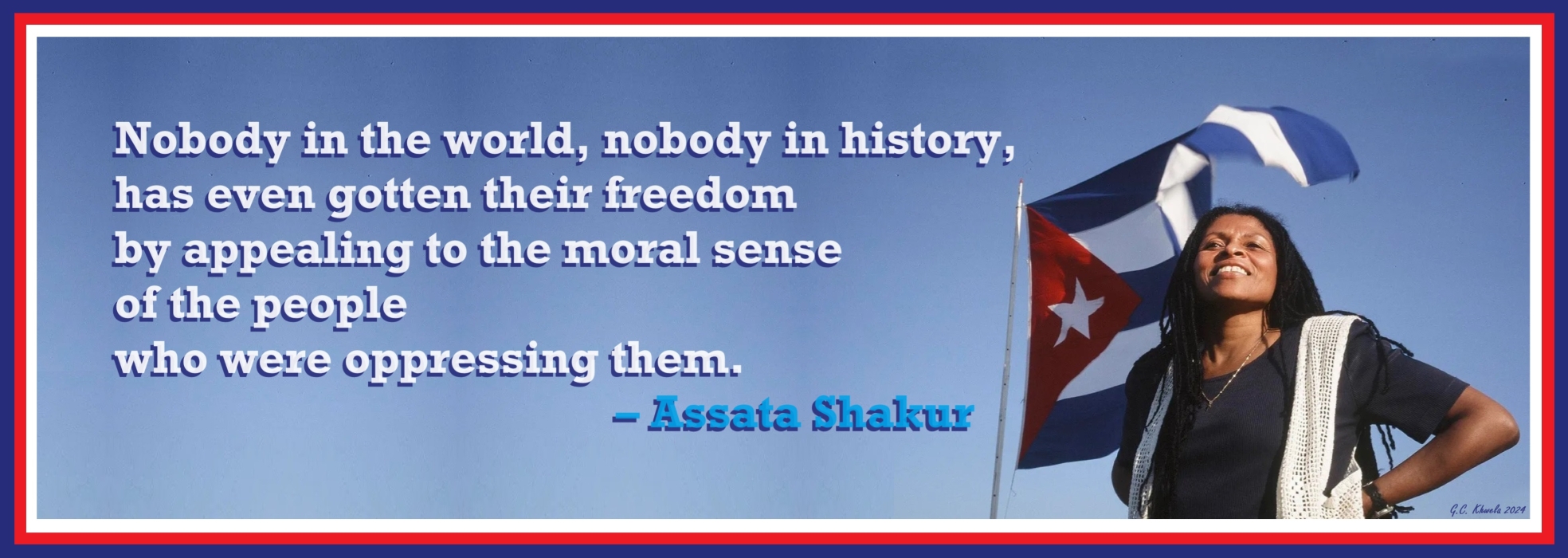
Belated Tribute to Assata Shakur
On 25 September 2025, former Black Panther Party member Assata Shakur died at the age of 78 in Havana, Cuba, where she had lived in political exile since 1985. The Cuban Ministry of Foreign Affairs announced her death the following day. Assata Shakur was a political activist in the United States in the 1960s and 1970s. As a member of the Black Panther Party, she was targeted by the Federal Bureau of Investigations (FBI) under its counter-intelligence programme, COINTELPRO. She was framed for the murder of a New Jersey State Trooper and sentenced to life imprisonment. In 1979 she escaped from prison and since 1985 has been in political exile in Cuba.
Assata Olugbala Shakur, also known as Joanne Chesimard, an activist with the Black Liberation Army, was exiled in Cuba for four decades, died of unspecified health conditions and “advanced age”, in Havana, aged 78. Shakur had been on the FBI’s Most Wanted Terrorists list for years after she escaped in 1979 from a New Jersey women’s prison, where she was serving a life sentence following her murder conviction in a shoot-out that killed a New Jersey state trooper and a fellow activist. Shakur maintained her innocence and in 1984 reappeared in Cuba, where she was granted asylum by former President Fidel Castro.
Shakur was born JoAnne Deborah Byron on 16 July 1947 in New York City and was raised between the city and Wilmington, North Carolina. She was the step-aunt and godmother of the late rapper Tupac Shakur. She became involved in political activism for black Americans while in college, first with the Black Panther Party, a group that favoured radical resistance to racism in the United States and developed schools and other social services for black people. The movement was under heavy surveillance by the United States’ FBI, which considered it a threat to the US. Shakur also joined the more radical Black Liberation Army (BLA), whose membership consisted of former Black Panthers.
Shakur was travelling with fellow activists in 1973 when their car was stopped by New Jersey officers. A shoot-out ensued in which state trooper Werner Foerster and fellow activist Zayd Malik Shakur were killed. Foerster was killed “execution-style” at point-blank range, while his colleague was injured, according to the FBI. Assata Shakur was also injured in the shootout. She was arrested and tried for Foerster’s death but denied shooting him and said her trial in front of an all-white jury was unfair. One of Shakur’s fellow BLA companions died in the shootout, while the third, Sundiata Acoli, served almost 50 years in prison before being granted parole in 2022. Shakur was found guilty in 1977 of first-degree murder, four years after the shootout and always protested her innocence, saying she had her hands in the air during the altercation.
In early November 1979, Shakur’s comrades from the BLA, which was a Marxist-Leninist organisation that separated from the Black Panther Party, posed as visitors and broke her out of Clinton Correctional Facility for women. She escaped the United States’ prison in 1979, and after disappearing, she emerged in 1984 in Cuba, where the then-leader Fidel Castro granted her asylum. Shakur’s work later became a rallying cry during the Black Lives Matter movement. However, she was criticised by some for being influenced by Marxist and communist ideology. The case of Shakur, who was close with the family of the late rapper Tupac Shakur, caused difficulties in the already tense relationship between the US and Cuba. During US President Donald Trump’s first term, he demanded that Shakur be returned from Cuba to face justice
According to Assata, “Cuba is not perfect. Cuba is not fantasy-land, but it’s a place where people are committed to making a better life for everybody, which is different to most of the rest of the world. Most governments right now are committed to a more selfish agenda, making rich people richer, a more racist agenda, a more sexist agenda.”
She continued to say, “When human beings become divorced from their creativity and their inventiveness, they stagnate and die a little. A revolutionary process is the same; it has to be creative, dynamic and loving. When you feel good in a place, even if you don’t have a lot of material wealth, you have a lot of spiritual and human wealth, and you are not as interested in trying to buy all those little trinkets and gadgets. The way we can conceive of building a socialist society has to be more on the human level, rather than on the material aspects. I’m not saying material aspects are not important but that when it comes to building socialism both are important and in order to build an enduring socialism you have to go way, way beneath the surface to the human psyche and the human heart.”
The former Black Liberation Army (BLA) member, who was a symbol of resistance for many activists, told NBC News in a 1998 interview filmed in Havana that she escaped because she was afraid for her life and that she “would never receive justice” in the US. Her exile in Cuba was among the many thorny issues between the communist-run island and the US. Shakur was the first woman to be added to the FBI’s Most Wanted Terrorists list. The agency and New Jersey each offered a $2million (R35 million) reward for information leading to her arrest. Shakur’s life became a focal point in debates over race and justice in the United States. She faced multiple charges over the years, including robbery and kidnapping, but many cases ended in acquittals, dismissals or hung juries. Supporters say she was frequently targeted by law enforcement due to her activism.
“It is our duty to fight for our freedom. It is our duty to win,” Shakur wrote in her autobiography in 1988. “We must love each other and support each other. We have nothing to lose but our chains.” After her death was announced, Black Lives Matter Grassroots Inc, a group of American racial justice activists, paid tribute to her in a statement on Instagram. “May our work be righteous and brave as we fight in her honor and memory,” it said. She was celebrated in music, with her name featuring in songs such as 1998’s “Rebel Without a Pause” by hip-hop group Public Enemy and “A Song for Assata” by the rapper Common. Shakur is survived by her daughter Kakuya Shakur, who wrote on Facebook: “Words cannot describe the depth of loss that I am feeling at this time”.
Assata’s political work with the Black Panthers and the BLA specifically identified American police and prisons as racist and oppressive forces that must be eliminated. Her offerings of steadfastness remind us to continue to fight for and honour those still inside and those who have been martyred by the colonial prison system. Living in exile in Cuba under the protection of the socialist Cuban government only further expanded Assata’s analysis of anti-imperialism and the interconnectedness of global struggles for liberation. Assata was a true internationalist in every sense of the word, describing Cuba as “One of the Largest, Most Resistant and Most Courageous Palenques (Maroon Camps) That has ever existed on the Face of this Planet.”
“You cannot wipe out racism or sexism unless you have some kind of system that guarantees basic human rights, and food and shelter, and is humanistic. Because in a dog-eat-dog society, with a dog-eat-dog philosophy, you have a dog-eat-dog way that people interact and right now in the United States you have a system with a high level of technical sophistication, a high level of technology, of industrial capacity, and you have some very barbarian- thinking people. It’s like cavemen with computers. The only way you can completely eradicate racism or sexism is to have a society which is very well-founded in social justice” Assata Shakur (1998).
“A revolutionary freedom fighter, a political prisoner, a mother, a woman in exile – Assata Shakur’s lifelong practice of militancy and sacrifice will continue to be aspirational to all who wish to see the day that imperialism receives its final blow” (Samidoun Madrid – 3 October 2025).
Sources:
Wikipedia.
David Yaffe, “Interview with Assata Shakur (1947-2025) in Cuba (1998)”, FRFI (Fight Racism! Fight Imperialism!), 131, June/July 1996.
Ahjamu Umi, “When I Actually Got to Hang out with Assata Shakur”, Hood Communist, 4 November 2021.
Kwasi Gyamfi Asiedu, “Assata Shakur Black Liberation Activist Exiled in Cuba Dies at 78”, BBC News, 26 September 2025.
Rory Sullivan, “Assata Shakur, US Black Liberation Activist Exiled in Cuba, Dies at 78”, Al Jazeera, 26 September 2025.
Aaron Katersky and Mark Crudele, “Assata Shakur Wanted Black Liberation Army Member Dies at 78 in Cuba”, ABC News, 27 September 2025.
Reuters, “Assata Shakur, Fugitive and Prominent Black activist, Dies in Cuba at 78”, Reuters, 27 September 2025.
Samidoun Madrid, “Long Live Assata Shakur, 1947-2025”, Palestinian Prisoner Solidarity Network, 3 October 2025.
Castro Khwela
Good day fellow Compatriots!
Discover more from CASTRO KHWELA
Subscribe to get the latest posts sent to your email.