Birth of Alex La Guma
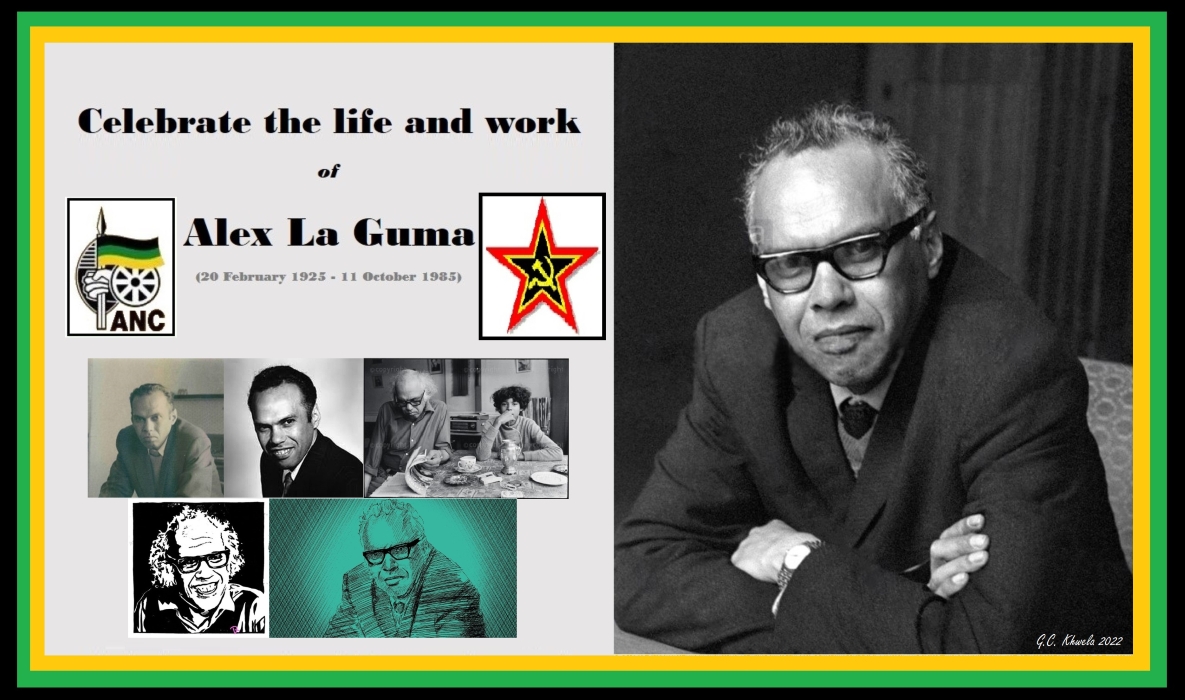
On this day, 20 February 1924, Alex La Guma, was born in District Six, Cape Town, South Africa. La Guma was a South African novelist, leader of the South African Coloured People’s Organisation (SACPO), the South African Communist Party (SACP) and a defendant in the Treason Trial, whose works helped characterise the movement against the apartheid era in South Africa. La Guma’s vivid style, distinctive dialogue, and realistic, sympathetic portrayal of oppressed groups had made him one of the most notable South African writers of the 20th century.
La Guma was the son of James La Guma, who was of Cuban descent and was a leading figure in both the Industrial and Commercial Workers’ Union (ICU), the Communist Party of South Africa (CPSA), the African National Congress (ANC) and the chief architect of the ‘Black Republic’ thesis, which was based on Lenin’s 1920 thesis on “The National and Colonial Question”. James La Guma stood against the leader of the African People’s Organisation (APO), Dr Abdullah Abdurahman, for a seat on the City Council in September 1939, but was beaten by 1083 votes to 263.
Alex la Guma’s early exposure to class politics and the national liberation struggle, as well as an acute experience of oppression growing up in District Six in Cape Town, would have a major effect on his own socialist politics and the ‘revolutionary aesthetics’ of his writing. La Guma attended Trafalgar High School in District Six. After graduating from a technical school in 1945, he worked as a clerk, bookkeeper, factory hand and journalist. It was these humble working-class beginnings that shaped his writing and made him create memorable characters that are at once believed and immensely moving.
He became an active member of the Plant Workers Union of the Metal Box Company. He was fired after organising a strike, and he became active in politics, joining the Young Communists League in 1947 and the CPSA in 1948. In order to oppose the disenfranchisement of the so-called Coloured people, Alex joined the Franchise Action Council, which also became part of the Joint Planning Council for the 1952 Defiance Campaign.
In January 1952, under the leadership of President‐General Dr Moroka and Secretary‐General Walter Sisulu, the Joint Planning Council wrote to Prime Minister Malan calling for the repeal of six ‘unjust laws’ by 29 February 1951, which included the Pass Laws, Stock Limitation, the Group Areas Act, the Suppression of Communism Act, the Coloured Voters Act and the Bantu Authorities Act – laws that were keystones of the apartheid state being set up by the Nationalist government.
In 1956 he helped organise the South Africa representatives who drew up the Freedom Charter, and consequently he was one of the 156 accused at the Treason Trials that same year. He published his first short story, “Nocturn”, in 1957. In 1960 he began writing for New Age, a progressive newspaper, and in 1962 he was placed under house arrest. Before his five-year sentence could elapse, A No Trial Act was passed, and he and his wife, Blanche, were put into solitary confinement. On their release from prison, they returned to house arrest.
During this period of restriction orders, la Guma had the chance to properly pursue creative writing. It was the time in which he produced most of his fiction. His first novella “A Walk in the Night” was completed in 1962, followed by multiple short stories, the novel “And a Threefold Cord” in 1964, and “The Stone Country” after his release from prison. Interestingly, the restrictions imposed on him provided the time to exploit his writing skills and in a way contributed towards exposing the brutality and cruelty of the apartheid regime.
The shantytowns and ghettoes of the Western Cape, such as District Six, Elsies River, Nyanga and Windermere, became the focus of his writings, portraying them so vividly such that they provided a picture of how life was under colonialism and the apartheid state. La Guma’s next work was “The Fog of Season’s End”, which was a novel about ordinary people’s underground struggle against racial capitalism. It depicted life in the underground movement, as well as the torture and death experienced at the mercy of the apartheid security police.
La Guma, along with his wife Blanche and their two children, in 1966 went into exile in London under instruction of the ANC. He continued his political activities while also writing a series of detective stories ‘based on a fictitious African detective named Captain Zondie’. After three years in London, he became the first person to receive the prestigious Lotus Prize for literature by the Afro-Asian Writers’ Association in 1969.
In 1967 he attended the African-Scandinavian writer’s conference in Stockholm, followed by the Fourth Congress of the Union of Soviet Writers in Moscow. In 1984 he was appointed Officer of Arts and Letters by the French Ministry of Culture. La Guma was Chief Representative of the ANC in Cuba and the Caribbean, the General-Secretary of the Afro-Asian Writers Association, and a leading member in the South African Communist Party at the time of his death from a heart attack in Havana, Cuba, on 11 October 1985. AIex la Guma had shown in action what it means to be a revolutionary committed to internationalism.
During his funeral in Havana, Cuba, on 20 October 1985, the ANC was officially represented by the Secretary General, Alfred Nzo, and the eulogy was delivered by Jesus Montand, an alternate member of the Cuban Political Bureau. It was always emphasised that “Very few, if any, have described the lives of the ghetto dwellers so vividly and starkly as he has done. And, since the people who live mainly in the areas which he describes so graphically are Coloured, it can truly be said that his is the authentic voice of this oppressed section” (Obituary: Sechaba).
In a letter to his wife, Blanche, the South African Communist Party (SACP) wrote that Alex “devoted his life to the fight for the liberation of the South African people and the advance to socialism, contributing not only through his writings, but also in his everyday political work inside South African and after being forced to leave the country. Alex was in every sense a worthy ambassador of our people, …an internationalist and fighter for peace… The SACP dips its red banner in honour of this loyal and dedicated son of the people” (Z. Nkosi: The African Communist).
La Guma was a self-aware social realist invested in the ideological implications of his writing. He wrote that “when I portray South Africa I wish to show it as it actually is”. For him, the revolutionary potential of his work was embedded in the fact that “life is the stimulation of artistic endeavour”. When he received the President Denis Sassou Nguesso Prize for African Literature in Brazzaville, in August 1985, Alex la Guma maintained that he could not have written what he had without the inspiration derived from the struggle of the South African people.
According to La Guma, “Whatever I have produced in the literacy field came out of the stirring influence of our people engaged in the battle to survive the ravages of apartheid to overthrow the racist regime and to establish a democratic South Africa. If literature is linked to life, then the life of our heroic people should inspire all writers in our country” (Obituary: Rixaka).
Sources:
Wikipedia
South African History Online (SAHO).
“Obituary”, Rixaka: Cultural Journal of the African National Congress, No. 2, 1986.
Sadtu, “June 26 th: South Africa Freedom Day”, South African Democratic Teachers Union, https://sadtu.org.za› uploads › 2023/09.
Z. Nkosi, “Death of Alex La Guma – Writer and Freedom Fighter”, The African Communist, No. 104, First Quarter 1986.
“Obituary”, Sechaba, January 1986.
Castro Khwela
Good day fellow Compatriots!
Discover more from CASTRO KHWELA
Subscribe to get the latest posts sent to your email.