
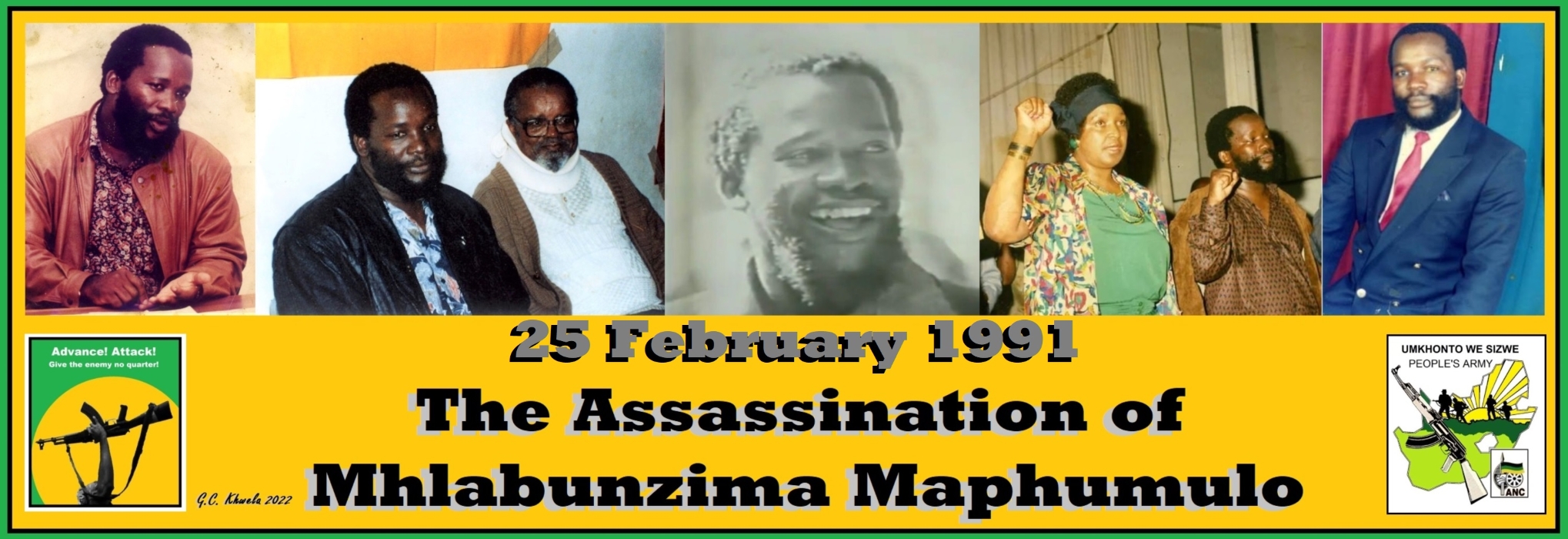
Chief Mhlabunzima Maphumulo Gunned Down
On 25 February 1991, the president of the traditional leaders’ organisation, the Congress of Traditional Leaders of South Africa (CONTRALESA) and African National Congress (ANC) stalwart, Chief Mhlabunzima Maphumulo, was gunned down in the driveway of his home in Pietermaritzburg. Maphumulo was a chief from Maqongqo/Table Mountain area, east of Pietermaritzburg. He had survived a previous attempt on his life when his house was burnt down.
An alleged “hit-squad” operative claimed that the murder had been planned by the Pietermaritzburg police, and that the assassins were paid R5000 each. Judge N.S. Page found in his judicial inquest the testimony of this witness and another alleged “hit-squad” witness “unreliable”, “appalling” and “even worse”. A subsequent probe by the Truth and Reconciliation Commission (TRC), paying no attention to the conflicting judicial ruling, nevertheless found that Chief Maphumulo had been targeted for attack in a planned hit-squad operation.
Mhlabunzima Maphumulo was born on 6th September 1949 at the Maqongqo district of KwaZulu-Natal. At the age of 24, Maphumulo inherited the role of Chief of the Maphumulo tribe from his father. The territory which his chieftaincy encompasses contained 35, 000 people at the time. He matriculated at Bhekuzulu College for the sons of chiefs in 1971. Since his installation in 1973, he carried out the duties of the chieftaincy within the structures of the Chief Mangosuthu Gatsha Buthelezi-led KwaZulu Bantustan, which was the ultimate level of the three-tiered system of governance designed by the apartheid regime to ensure segregation on both racial and ethnic lines.
The region that Maphumulo governed, was built on the so-called tribal authorities that became the foundation of the Bantustan system. Based on the “tribal authority” system, he was considered an ex-officio member of the KwaZulu legislative assembly. Subsequently, he joined Zulu King Goodwill Zwelithini and others in forming the Inala party in 1975 that was in opposition to Chief Mangosuthu Buthelezi’s Inkatha Movement. Buthelezi used threatening tactics to force the Inala Party to dissolve, denouncing Maphumulo as someone bent on destroying Zulu unity.
In 1979, a court order thwarted Buthelezi’s attempt to unseat Maphumulo as a chief, but the Inkatha leader was unrelenting in trying to quell all challenges to his dominance. In 1983, Inkatha Youth Brigade members beat Maphumulo unconscious in the Bantustan’s Legislative Assembly buildings in Ulundi. The attack was led by MP Simon Chonco and Inkosi Khawula where he was beaten unconscious in front of members of the KwaZulu Police and a massive crowd, allegedly for his renewed refusal to join Inkatha and the affront to Chonco. In the KwaZulu Legislative Assembly, Buthelezi again accused Maphumulo of being an agent of the National Intelligence Service (NIS) and of unleashing violence against Inkatha during the elections canvassing in Mpumalanga.
Maphumulo believed that chiefs and other traditional authorities were being pushed aside within national politics, and he sought to counteract it. One of his priorities was to provide land to his subjects during a time when territorial segregation constrained black South Africans’ access to land. The contested strip of land that he vigorously pursued, which split his territory, became a difficult exercise, since, according to apartheid-defined territorial boundaries, the land did not belong to his chiefdom or to that of a neighbouring chief.
In 1986, as tensions rose in the region because of various apartheid measures and as conflict affected most of the Natal midlands’ region, his territory enjoyed relative peace. Violence continued to rise, and by 1989, 10,000 refugees from the other regions could be found in Maphumulo’s territory. He was considered to be a peacekeeper and a negotiator in these events and this was best exemplified by his activism which led to the creation of a Judicial Commission of Enquiry pertaining to the problems and the violence of the region. He became the first President of CONTRALESA and he led the organisation to align itself with the ANC. He was a very strong believer in a unified South Africa and believed that if a chief chose to side with CONTRALESA, the people would follow that chief.
Some believed that this was an admirable move by him, but others (who believed in the independence of the various chieftaincies and kingdoms from the State of South Africa and who supported the ideas of Chief Buthelezi) disagreed strongly with this position and threatened Maphumulo with violence if he did not rescind his support for the ANC. His tribal home ended up being burned down because of this disagreement and he and his family were forced to flee for survival. In 1990, an assassination attempt was made against him, when a motorcade, which should have been transporting him, was attacked and ambushed at gunpoint resulting in many deaths and injuries. Yet, he continued to fight for the rights of traditional leaders under the umbrella of a unified South Africa.
In the late 1980s and early 1990s, more than 11 600 people died as a result of conflict in what is today, KwaZulu-Natal; thousands more were injured and made homeless. The common explanation about the violence holds that the conflict was rooted in the struggle for power between Inkatha and the African National Congress (ANC), United Democratic Front (UDF), Congress of South African Trade Unions (COSATU) alliance.
On 25 February 1991, Maphumulo’s house was attacked, and he was assassinated by an apartheid hit squad at gunpoint. Maphumulo had moved to the city centre to avoid attack at the Table Mountain Area but was gunned down in his car as he pulled into the driveway. The possibility of hit squad involvement and community reaction to his death illustrate, among other things, the continued struggle over his leadership and authority. A day after Maphumulo’s assassination, Buthelezi released a memorandum that points to the significance of land, Maphumulo’s politics, and his leadership in gaining a more complex understanding of the factors driving the local violence.
In the months following Maphumulo’s assassination, the ANC contended that the assassination was the work of apartheid death squads. In April 1991, Sipho Madlala, a former member of the apartheid SADF military police and a Security Branch police informer, confessed to the assassination of Maphumulo, but nothing came of the investigations. He claimed to be part of hit squad recruited by the apartheid Security Branch to kill Maphumulo and other chiefs. This admission and the subsequent inquest into Maphumulo’s assassination further complicate the contestation over this his leadership.
In 19 August 1989 Maphumulo led a Contralesa delegation to Lusaka in Zambia — a meeting which resulted in a joint memorandum which recognised the role of traditional leadership in resisting apartheid. After the meeting an Umkhonto we Sizwe (MK) bodyguard was assigned to protect him after he had received numerous death threats. Evidence from the Truth and Reconciliation Commission linked his assassination to state-sponsored hit squads under Caprivi Death Squad Commander Daluxolo Luthuli, a veteran of the Wankie campaign, a joint initiative of MK and the Zimbabwe People’s Revolutionary Army (ZIPRA).
In a joint communique issued by the Congress of Traditional Chiefs (Contralesa) and the ANC, said: “The future of our motherland lies in the hands of the people, the victims of oppression and dispossession, and the courageous fighters against this evil system. Among these multitudes are hundreds of patriotic chiefs: deposed, harassed and even killed, but forever unbowed. We salute these brave patriots, deserved heirs of the glorious tradition of no surrender shown by our forebears in the wars of resistance of past centuries” (ANC).
In 2018, Inkosi Mhlabunzima Maphumulo was posthumously awarded by the South African Presidency the Order of Luthuli in Gold for “his exceptional selfless contribution to conflict resolution, and his resistance against injustice and oppression. He paid the ultimate price for our freedom and hard-won democracy.”
Sources:
Wikipedia.
South African History Online (SAHO).
Bongani Mthethwa, “Order of Luthuli award for assassinated tribal ‘peace chief’”, Times Live, 11 April 2018.
Jill E. Kelly, “The “Peace Chief” Mhlabunzima Maphumulo: Conflict over Land and Authority in Mbambangalo during the Udlame”, PhD Candidate, Department of History, Michigan State University, 25 May 2011.
TRC, “Final Report”, Truth and Reconciliation Commission (TRC), Vol. 3, Chapter 3, Subsection 50.
ANC, “Congress of Traditional Chiefs and the ANC’s appeal to all Traditional Leaders of South Africa”, African National Congress, (http://www.anc.org.za/show.php?id=3843), 19 August 1989.
Castro Khwela
Good day fellow Compatriots!
Discover more from CASTRO KHWELA
Subscribe to get the latest posts sent to your email.


Thanks for valuable information. It teaches us a lot about our struggle stalwarts
This is a very informative platform .