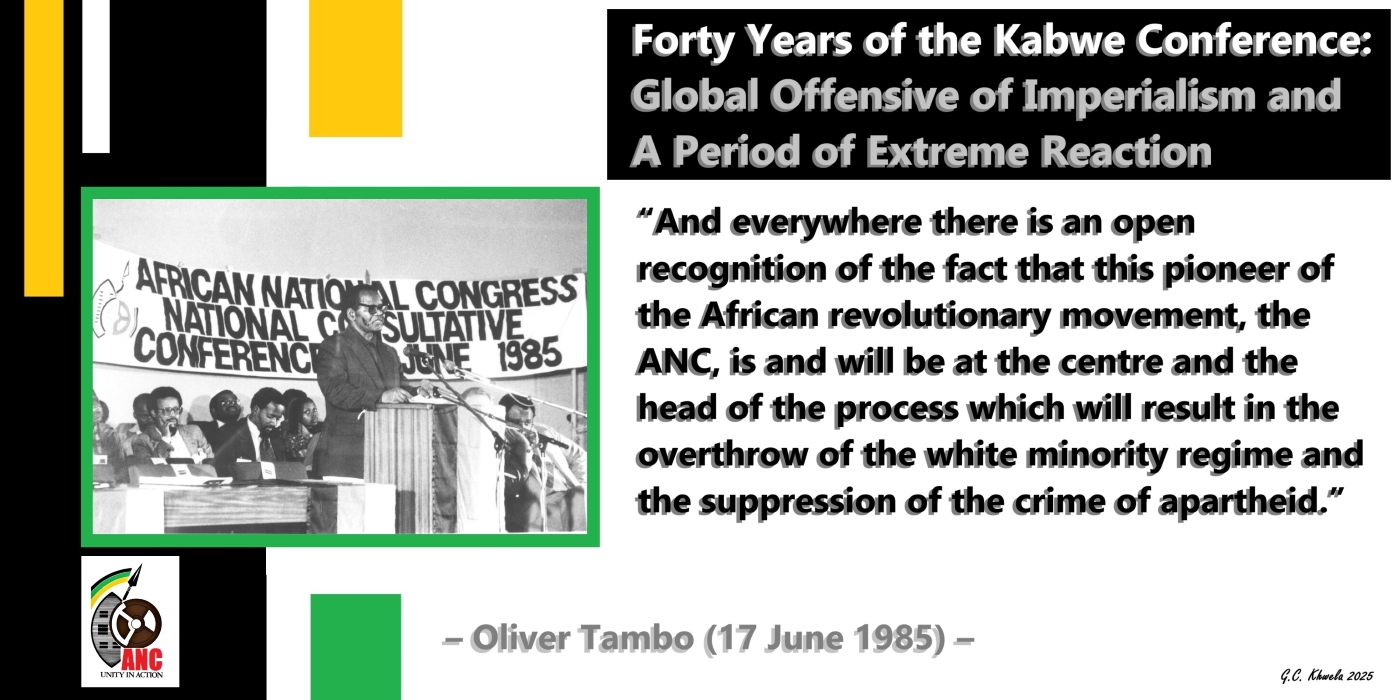
Forty Years of the Kabwe Conference: Global Offensive of Imperialism and A Period of Extreme Reaction
(Portions of the Political Report of the National Executive Committee to the National Consultative Conference, which was presented by the President of the African National Congress, Oliver Tambo, 17 June 1985, Kabwe, Zambia)
Comrade Chairman,
Comrades, Delegates,
“This day, the opening of the National Consultative Conference of the ANC, is a great and moving moment in the history of our struggle for national liberation. The days we will spend here will live forever in the records of that struggle as marking a turning point in the history of all the people of South Africa. Our Conference itself will be remembered by our people as a council-of-war that planned the seizure of power by these masses, the penultimate convention that gave the order for us to take our country through the terrible but cleansing fires of revolutionary war to a condition of peace, democracy and the fulfilment of our people who have already suffered far too much and far too long.
“The eyes of our people and the rest of the world, both friend and foe, are focussed on this Conference. That is so because the crime of apartheid has persisted for too long. Almost everywhere, at home and abroad, the peoples are saying that the beginning of the end of the apartheid system has commenced. And everywhere there is an open recognition of the fact that this pioneer of the African revolutionary movement, the ANC, is and will be at the centre and the head of the process which will result in the overthrow of the white minority regime and the suppression of the crime of apartheid.”
Global Offensive of Imperialism
The apartheid regime has survived for 37 years now. Born three years after the destruction of its fascist and Nazi progenitor, this regime was a historical anachronism from the very first day of its existence, a remnant of an epoch that was passing away. That it continues to exist to this day is a measure of the tenacity of the forces of imperialism and reaction which, in the last four decades, have sought to reverse the results of the Second World War and to stop the process of the democratic transformation of our planet to which the defeat of Nazism gave a new and added impetus.
It was because of this global offensive of imperialism that as we met in Morogoro in 1969, a war of liberation was raging in Vietnam and the rest of Indo-China. The Arab peoples were rebuilding their forces in preparation of a renewed offensive to annul the gains that Zionist Israel had made during the six-day war of 1967. At the same time, we were still experiencing the influx into our country of a new wave of European immigrants. These were the so-called freedom fighters from Czechoslovakia who fled to apartheid South Africa, there to be received by the Pretoria fascist regime with what it considered well-deserved accolades.
Portugal and Spain still suffered under the yoke of fascist dictatorships. For two years, the Greek people had been living under the tyranny of a military junta that had been sponsored by United States imperialism. At the same time, the United States was engaged in feverish efforts to stop Salvador Allende’s election as President of Chile the following year, a campaign that led to his assassination in 1973 and the victory of the counter-revolution.
As we met in Morogoro to confer about our own struggle, the peoples of Guinea-Bissau, Angola, Mozambique and Sao Tome and Principe, as well as those in East Timor, still suffered under the yoke of Portuguese colonial domination. Zimbabwe was ruled by the white minority Smith regime whose illegal unilateral declaration of independence was a scant four years old.
“Indeed, so confident was the counter-revolution of its strength in southern Africa that the United States Government of the day could accept, in 1969, the so-called ‘National Security Study Memorandum 39’. Among other things, this official document said: ‘For the foreseeable future South Africa will be able to maintain internal stability and effectively counter insurgent activity. The whites are here to stay and the only way that constructive change can come about is through them. There is no hope for the Blacks to gain the political rights they seek through violence, which will only lead to chaos and increased opportunities for the communists …’
“This infamous document went on: ‘We can, through selective relaxation of our stance towards the white regimes, encourage some modifications of their current racial and colonial policies… At the same time, we would take diplomatic steps to convince the black States of the area that their current liberation and majority rule aspirations in the south are not attainable by violence and that their only hope for a peaceful and prosperous future lies in closer relations with the white-dominated States.’ The memorandum dismissed the liberation movements of southern Africa as ineffectual and not ‘realistic or supportable’ alternatives to continued colonial rule. It ruled out any possibility of victory by these movements and questioned ‘the depth and permanence of black resolve’.
Period of Extreme Reaction
“Within our country, the Vorster regime was at the pinnacle of its power. It felt that the period of extreme reaction which the racists had unleashed when it banned the ANC, with Vorster as the general officer commanding the campaign of repression, had succeeded to smash the revolutionary movement. The Pretoria regime also thought that it had further secured itself by helping to suppress the armed liberation struggle in Zimbabwe, in which units and cadres of the Luthuli Detachment of Umkhonto we Sizwe had participated with outstanding heroism and skill.
“Despite the fact that the United Nations General Assembly had terminated South Africa’s mandate over Namibia – a decision which Vorster dismissed as ‘ridiculous and impracticable’ – the apartheid regime felt that it could continue its domination of Namibia for as long as it wished. In opinion polls, white South Africa hailed Vorster as an ‘excellent’ Prime Minister and helped him in 1970 to defeat the Herstigte Nasionale Party in the white general elections held that year.” (To be continued)
– Oliver Tambo (17 June 1985) –
Source:
Oliver Tambo, “The Eyes of Our People are Focussed on this Conference”, Sechaba, October 1985, pp. 2 – 9.
Castro Khwela
Good morning fellow Compatriots!🙏🏾✊🏾👊🏾
Discover more from CASTRO KHWELA
Subscribe to get the latest posts sent to your email.