Johannesburg Bar Opposes the Suppression of Communism Bill
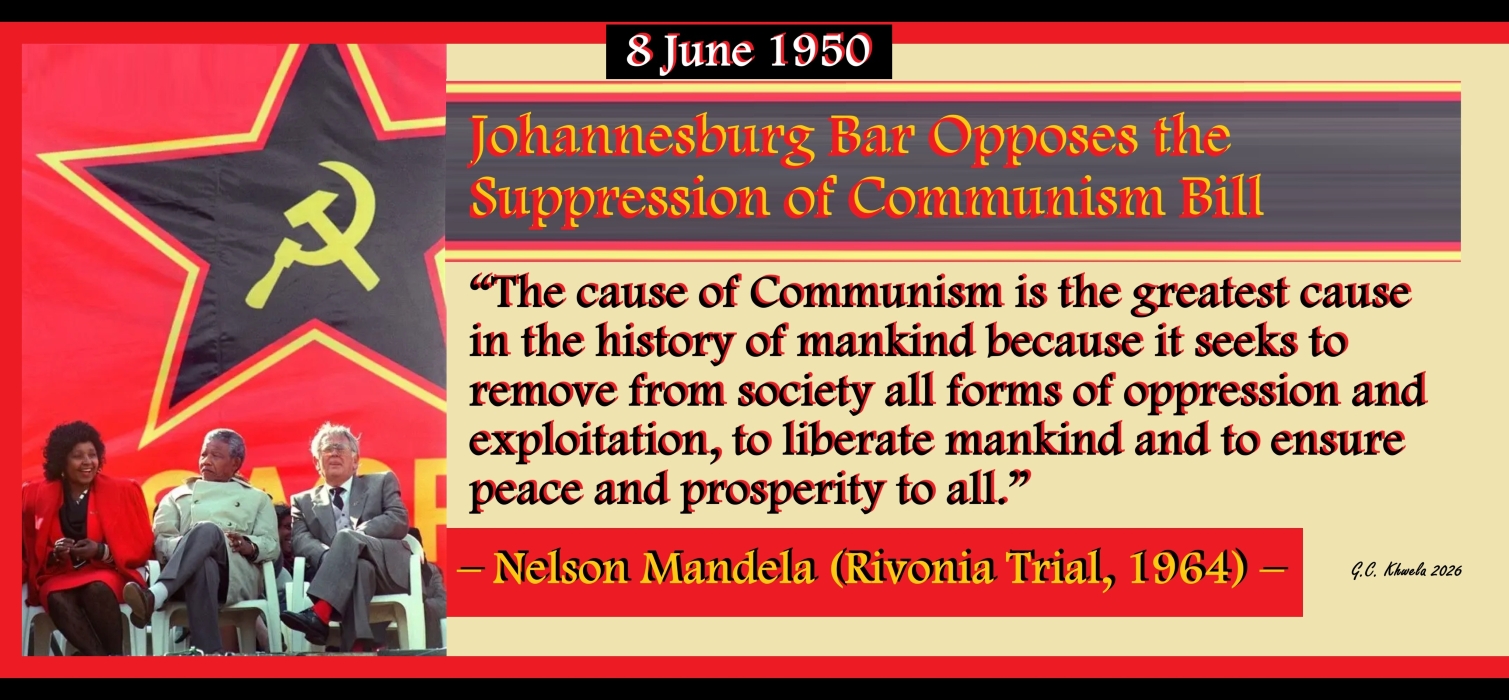
On 8 June 1950, the Johannesburg Bar declared that if the Suppression of Communism Bill was passed, the freedom of people in South Africa would be in jeopardy. The Bill was established by the Johannesburg Bar to contain an overly broad, unreviewable definition of communism that allowed the government to criminalise almost any form of political opposition. The Bar made this point with reference to a speech in parliament by apartheid Justice Minister C.R. Swart, wherein he stated that the Communist Party of South Africa (CPSA) would be outlawed should the Bill be passed. Under the Bill, not only was the CPSA to be outlawed, but it was to become a crime, punishable by ten years’ imprisonment, to propagate or further the aims of communism.
The Johannesburg Bar, which was officially known as the “Johannesburg Society of Advocates”, was composed of referral advocates (barristers) practicing within the jurisdiction of the Johannesburg High Court. Unlike attorneys, who deal directly with the public, members of the Bar were referral practitioners, meaning that they had to be briefed by an attorney to argue cases in court. The Society was (and still is) a voluntary professional association governed by an elected executive body known as the Bar Council which enforced ethical rules, oversaw the rigorous training of new advocates (pupillage), and managed the Bar’s affairs.
During the era when the Bar took its stand against the Suppression of Communism Bill, its composition looked starkly different than it does today. Due to the discriminatory legal and social framework of the era, the Bar’s membership was entirely white. The first woman had been admitted in 1926, but the profession remained heavily male-dominated. It was not until 1956 that the Johannesburg Bar admitted its first Black African member, Duma Nokwe, who faced immense systemic obstacles under apartheid laws (like the Group Areas Act) but was famously allowed to share chambers with legendary human rights advocate George Bizos.
The Johannesburg Bar during this period included prominent legal minds who routinely took up the defence of political activists, such as Abram (Bram) Fischer QC (who later led the defence at the Rivonia Trial) and Sydney Kentridge, who dedicated decades to defending political defendants targeted by the National Party regime.
The legal association (Johannesburg Bar) raised severe concerns regarding the several mechanisms built into the Suppression of Communism legislation. For instance, the Bill defined communism so broadly that it included any scheme aimed at bringing about political, social, economic or industrial change via “disorder” or by promoting “hostility between European and non-European races”. The Bar recognised that this crude wording could easily trap liberals and non-communist activists who were simply fighting against racial segregation. The Minister of Justice was granted unilateral power to “deem” any individual a communist based on arbitrary alignment with those broad aims.
The Bill prescribed that after a nominal two-week window, the state’s designation of an individual as a communist became an unreviewable matter of fact. This effectively stripped citizens of their right to appeal to the courts, thus bypassing due processes. Anyone designated or found propagating the broadly defined aims under the Bill faced up to ten years of imprisonment, strict bans from public participation, severe restrictions on movement (banning orders), and the silencing of their publications. Ultimately, the Johannesburg Bar foresaw that the National Party government was using anti-communist rhetoric during the Cold War as a legal weapon to dismantle basic human rights, to target liberation movements like the African National Congress (ANC) and to cement the framework of apartheid.
The introduction of the Bill and its subsequent passage into the Suppression of Communism Act (No. 44 of 1950) on 26 June 1950, officially came into force and commenced nearly three weeks later, on 17 July 1950. The Act functioned as a foundational turning point in South African history. It provided the legal foundation for the National Party regime to dismantle civil liberties and forcefully suppress all organised opposition to apartheid. The Act had deep, cascading impacts on both the Communist Party and the broader national liberation movement.
For the Communist Party of South Africa (CPSA), the immediate effect was legal extinction, forcing a total structural transformation. Anticipating the exact terms of the Act and hoping to shield its members from immediate asset forfeiture, the CPSA formally voted to dissolve itself on 4 May 1950. By June 1950, when the law took effect, the public-facing party ceased to exist. The dissolution was however temporary, since in 1953, former members clandestinely reconstituted the party as the South African Communist Party (SACP). It operated entirely underground for the next four decades, utilising highly secretive cells to avoid police detection.
The state used its new powers to target left-wing politicians. In 1952, public figures who had been “named” as communists – such as Member of Parliament Sam Kahn and Cape Provincial Councillor Fred Carneson – were formally expelled from public office. The 1952 expulsions effectively eradicated parliamentary representation for Black South Africans and signalled the start of sweeping state suppression of anti-apartheid dissent. Sam Kahn’s expulsion, for instance, eliminated one of the few platforms where the grievances of Black South Africans were voiced in the white-minority Parliament. While the movement briefly continued to contest these seats, subsequent representatives like Brian Bunting were similarly ejected.
The establishment of the South African Congress of Democrats (COD) in 1953, did not enable left-wing activists to permanently overcome or bypass the legal and operational challenges of the Suppression of Communism Act. While the COD served as a highly energetic, public-facing proxy that kept radical ideas alive for nearly a decade, the apartheid state ultimately used the exact provisions of the Act to completely destroy the organisation. The balance sheet of how the COD interacted with the challenges of the Act revealed both its tactical successes and its ultimate vulnerabilities.
Following the 1950 banning of the CPSA, left-wing activists desperately needed a legal platform. Because the COD was established as a non-communist, radical-liberal/left organisation for white South Africans, it allowed former CPSA members and newly formed underground SACP members to continue operating openly without violating the law on paper. However, the COD remained a tiny organisation with a very small, predominantly middle-class white membership.
It lacked a deep, mass-based constituency within the broader white electorate, making it easy for the state to isolate it. Because the state equated radical white dissent with high treason and “communism”, the regime aggressively used the Act to target COD’s leadership with continuous banning orders, house arrests, and restrictions rapidly decapitating the organisation’s operating capacity.
The ANC operated as an exclusively Black organisation during this era. By creating the COD as a white parallel organisation, the liberation movement successfully formed the non-racial Congress Alliance (comprising the ANC, COD, SA Indian Congress, and SACTU). This legally blunted the state’s propaganda that the anti-apartheid struggle was purely a racial war between Black and white South Africans. Despite police surveillance and the threat of statutory communism charges, the COD played an instrumental role in organising the Congress of the People in Kliptown, where the Freedom Charter was adopted. This proved that the Act could not entirely halt the movement’s ideological and organisational momentum in the mid-1950s.
Despite its creative manoeuvring, the COD remained a small organisation – never exceeding 700 members – making it highly susceptible to the state’s legislative onslaught. The state weaponised the Act to dismantle it through several methods. In the first instance, the Minister of Justice utilised the broad powers of the Act to systematically serve individual banning notices on virtually all key COD leaders. Prominent members like Ruth First, Helen Joseph and Rusty Bernstein were forbidden from attending meetings, writing for publications or communicating with one another. This left the COD with a severely depleted “second string” of leadership.
In 1956, the state used the Act to arrest the core leadership of the Congress Alliance, including many COD members, charging them with a communist plot to overthrow the state. Though the activists were eventually acquitted, the multi-year trial tied up the COD’s resources and paralysed its organisational capacity. Because the COD tried to maintain an open, legal presence, it was vulnerable to state espionage. Underground police agents, most notably Gerard Ludi, successfully infiltrated the COD. Ludi gathered internal information that the state later used to prosecute figures like Nelson Mandela and SACP leader Bram Fischer.
The state closed the legal loophole entirely, using the powers granted by the Suppression of Communism Act, which was amended and reinforced by the Unlawful Organisations Act. In September 1962, the apartheid government officially banned the COD, making membership a criminal offense. Nevertheless, the establishment of the COD delayed the total suppression of left-wing activism and successfully allowed white radicals to integrate into the broader liberation struggle. However, it could not outrun the absolute executive authority of the Suppression of Communism Act. By 1962, the COD was forced to follow the SACP and the ANC into the underground, proving that legalistic resistance alone was no longer viable against the apartheid state.
Because the Act’s legal definition of “communism” was exceptionally broad, the state used it as an omnibus weapon to crush non-communist organisations like the ANC and other partners in the Congress Alliance. The state routinely charged activists who had no alignment with Marxist ideology with “statutory communism”, which was a sweeping, legally manufactured category used to convict and punish anyone who opposed the government’s racial policies or advocated for radical social change, regardless of whether they were actually members of a communist party.
During a 1952 trial of ANC leaders, presiding Justice Frans Rumpff famously observed that the legal offenses the activists were charged with under the Act often had “nothing to do with communism as it is commonly known”. Between 1950 and the mid-1980s, the government used the Act to serve severe banning notices on over 1,400 to 1,600 activists. These orders effectively paralysed the liberation movement’s leadership by confining activists to specific magisterial districts or placing them under house arrest.
These orders forbade them from entering factories, universities or trade union offices and banning them from attending any social or political gatherings, often defined as more than two people. In addition, the orders made it a criminal offense for the media to quote or publish anything they said. Worse of all, the state used the legislation to construct massive, multi-year legal battles to drain the liberation movement’s resources. When the Congress Alliance drafted the Freedom Charter in 1955, the government declared it a communist document. This culminated in the Treason Trial that lasted from 1956 to 1961, where 156 leaders of the liberation movement were arrested and tried.
Ironically, in retrospect, the National Party’s attempt to isolate communists backfired. Instead of separating the left-wing from the nationalist movement, the Suppression of Communism Act pushed the ANC and the SACP into an inseparable alliance. Barred from open organisation, SACP members poured their energy into building up the ANC, the South African Congress of Trade Unions (SACTU), and the broader Congress Alliance. By 1960, when the state officially banned both the ANC and the Pan Africanist Congress (PAC) following the Sharpeville Massacre, peaceful, legal avenues of protest were totally eliminated, the experiences of the underground SACP became valuable.
When Nelson Mandela and other leaders formed the armed wing, Umkhonto we Sizwe (MK), in 1961, they actively relied on the underground networks and international connections of the Communist Party to secure financial aid, military training and weapons from Soviet-bloc countries. Ultimately, what began as a legal tool designed to isolate left-wing ideology ended up cementing a deep, decades-long cross-pollination between the national liberation struggle and the revolutionary Marxist underground structures.
Sources:
Wikipedia.
South African History Online (SAHO).
N. Numade, “Marxism and African Liberation”, The African Communist, Number Two, April 1960.
A. Lerumo, “After 40 Years: An Important Anniversary”, The African Communist, Number Seven, September 1961.
A. Lerumo, “50 Years of the Communist Party – 3: From ‘Fusion’ to Fascism”, The African Communist, No.46, Third Quarter 1971.
A. Lerumo, “50 Years of the Communist Party – 4: Apartheid, Resistance and Armed Struggle”, The African Communist, No.47, Fourth Quarter 1971.
Brian Bunting, “Moses Kotane, South African Revolutionary, A Political Biography”, Inkululeko Publications, 1975.
Padraig O’Malley, “1950. Suppression of Communism Act No 44”, The Heart of Hope, https://omalley.nelsonmandela.org/index.php/site/q/03lv01538/04lv01828/05lv01829/06lv01840.htm
Digital Innovation South Africa (DISA), “The Internal Security Act (Suppression of Communism Act), Act No 44 of 1950”, South African History Archives (SAHA), 2026.
Castro Khwela
Good morning fellow Compatriots!🙏🏾✊🏾👊🏾
Discover more from CASTRO KHWELA
Subscribe to get the latest posts sent to your email.