Tiro’s ‘Turfloop Testimony’ Speech Raises Vorster’s Ire
On 6 June 1972, the Johannesburg newspaper, the Rand Daily Mail, wrote the following in its first page, “… we have policemen who … may well have to believe that every baton blow they strike is a blow against communism.” This was in reaction to the banning of public meetings and demonstrations through a proclamation issued by the apartheid Prime Minister B.J. Vorster following students’ protests in universities throughout the country.
Vorster characteristically used the Nazi big lie and ascribed the student unrest to “foreign agitators”, “Communist agitators”, while the Principal of the University of Durban-Westville attributed the students’ unrests there to “extraneous forces” – the Natal Indian Congress (NIC) and the South African Students Organisation (SASO).
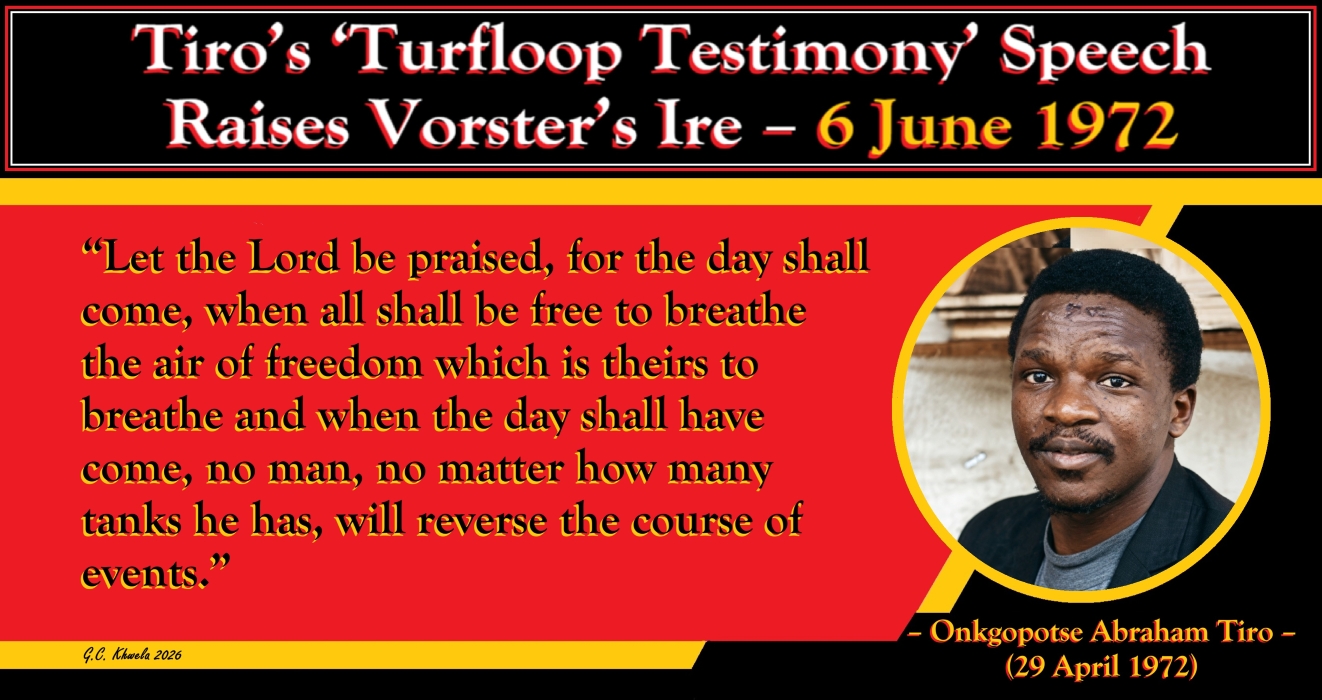
This whole episode began on 29 April 1972, during a graduation ceremony at the University of the North (now University of Limpopo), which is conversationally known as Turfloop. The then President of the Students’ Representative Council (SRC), Onkgopotse Abraham Tiro, made a critical speech of the apartheid tertiary education system that resulted in widespread demonstrations and strikes at all Black universities and some White campuses as well.
Much publicity was given to police brutality, and rightly so. But what was significant was the root causes of the unrests, which gave a correct perspective of the students’ struggle in South Africa. Onkgopotse Tiro’s speech at the graduation ceremony in Turfloop fundamentally exposed the fraudulent concept of separate development and apartheid. More crucial and noteworthy, the speech revealed the close identity of interests, aspiration and demand of the Black students had with the mass of the oppressed people.
Beginning by quoting Prime Minister Vorster, who when speaking at a meeting of the Afrikaans Students Society (A.S.B.) Congress in June 1971, had said: “No Black man has landed in trouble for fighting for what is legally his”. Tiro then said, “Although I don’t know how this is true, I make this statement my launch pad. R.D. Briensmead, an American lay preacher says, ‘He who withholds the truth or debars men from motives of its expediency, is either a coward, a criminal or both.’ Therefore, Mr Chancellor I will try as much as possible to say nothing else but the truth. And to me ‘truth’ means ‘practical reality’.”
Tiro then continued, “Addressing on the occasion of the formal opening of this university, Mr Phatudi, a Lebowa Territorial officer said that in as much as there is American education there had to be Bantu Education. I am conscientiously bound to differ with him: In America there is nothing like Negro education, Red Indian education and White American education. But in South Africa we have Bantu education, Indian education, Coloured education and European education. We do not have a system of education common to all South Africans. What is there in European education which is not good for Africans?”
According to Tiro, “We want a system of education common to all South Africans … In conclusion Mr Chancellor I say: Let the Lord be praised, for the day shall come, when all shall be free to breathe the air of freedom which is theirs to breathe and when the day shall have come, no man, no matter how many tanks he has, will reverse the course of events.”
Onkgopotse Tiro’s speech, which later became known as the “Turfloop Testimony”, shattered the submissive traditions of apartheid-era graduation ceremonies and weaponised the growing Black Consciousness philosophy among the youth. It caused a massive commotion as his summary expulsion by white university authorities sparked a national chain reaction of solidarity strikes, class boycotts, and campus closures across South Africa’s black universities. Tiro, serving as the SRC President, was expected to give a standard, polite valedictory address. Instead, he delivered a scathing, public indictment of the apartheid regime.
He attacked the hypocrisy of an ostensibly “black” university being run entirely by white administrators and faculty and noted that campus vacation jobs and food supply contracts were given to white individuals while poor black students struggled. Tiro pointed directly to the back of the hall, noting that black parents who had travelled long distances were locked out or forced to watch through sliding doors, while the front seats were reserved for white dignitaries who would not even cheer the graduates. Ultimately, he openly called on all black graduates to work toward the complete destruction of the Bantu Education Act of 1953 and the broader apartheid system.
The all-white university council and rector, deeply embarrassed and outraged by this challenge to their authority, immediately expelled Tiro and banned all activities of the South African Students Organisation (SASO) on campus. This heavy-handed retaliation backfired drastically: The student body revolted, initiating a total class boycott until Tiro was reinstated. In response, the university shut down the entire campus and terminated the registrations of all its students. Breaking away from their white colleagues, the university’s black academic staff walked out in protest and formed the Black Academic Staff Association.
Because Tiro’s message perfectly captured the shared, systemic degradation felt by black students nationwide, his individual punishment turned into a national rallying cry. Mobilised by the SASO leadership, solidarity strikes erupted at nearly every black tertiary institution in May and June 1972. Students at the University of Fort Hare, the University of Zululand, the University of the Western Cape, and the University of Durban-Westville launched mass sympathy boycotts. The unrest spilled over into white, liberal English-speaking campuses, leading to solidarity demonstrations by the National Union of South African Students (NUSAS) at institutions like the University of Cape Town.
Scores of White students who participated were arrested after the police had baton-charged their demonstrations, at least one of which was held on the premises of St George’s Cathedral, on 2 June 1972. The brutal attack on peaceful demonstrators was condemned by many, but the Prime Minister and his Minister of Police fully supported the actions of their Gestapo police. Vorster stated that he would have been disappointed if the police had not acted in the manner they did.
The confrontation between the authorities and students was not a new development in the Black educational institutions of South Africa. Resentment against injustices went back to the 1950s and before. The conflict had sharpened since the introduction of Bantu Education and the establishment of tribal colleges and universities. The main ingredient of student unrest and sense of grievance was their disapproval of the apartheid ideology in all its manifestations. What, however, had horrified the international community and some sections of the South African public was the brutality perpetrated by the police in dealing with a peaceful demonstration by White students. historically speaking, this was the treatment that had been meted out to Blacks, irrespective of whether they were students or not.
As a result of the student protests, public meetings and demonstrations were banned in South Africa by apartheid government proclamation. Vorster threatened action against foreign students studying in South African universities and proposed the introduction of legislation to screen foreign students coming to study in South Africa. The apartheid government and its police demonstrated to the white population that they were not going to tolerate dissent and were prepared to use force to consolidate the status quo. Fascist laws that were designated for Blacks could and were applied with indiscriminate vehemence against Whites also, and segments of the white population began realising that physical violence that was inflicted on them was exposing the inherent violence of the apartheid system.
Tiro became deeply feared by the apartheid regime, which viewed his ability to mobilise the youth as a profound existential threat to the state’s control. The regime’s intense fear of his influence was clearly demonstrated by how relentlessly they pursued him, culminating in his assassination. Following his expulsion from Turfloop, the security police placed him under constant, intense monitoring.
Tiro took a teaching post at Morris Isaacson High School in Soweto, where he radicalised a younger generation of pupils – including student leader Tsietsi Mashinini. The state quickly intervened, fearing his power to radicalise high school pupils, the apartheid government pressured the principal to fire him after just six months. This direct line of influence is why historians view the 1972 commotion as the foundational catalyst that directly birthed the Soweto Students Uprisings of June 16, 1976.
Responding to these events, the South African national liberation movement, in the Editorial of its official journal, Sechaba, said, “We of the African National Congress, have said that ‘there is no easy walk to freedom’. The polarisation of forces is sharpening, emphasizes the indispensable revolutionary role and leadership that the oppressed people must give in the South African revolution. As was shown in the growth of opposition by white students; it is only a united Black opposition which will force the whites to come out their laager.”
“He who withholds the truth or debars men from motives of its expediency, is either a coward, a criminal or both” – Onkgopotse Tiro, 29 April 1972.
Sources:
Wikipedia.
SAHO, “Graduation Speech by Onkgopotse Tiro at the University of the North, 29 April 1972”, South African History Online (SAHO), 1 June 2012.
Editorial, “Inside South Africa: Spotlight on Apartheid – National Strike by Students”, Sechaba, Vol. 6, No. 8, August 1972.
Rodney Warwick, “Cape Town June 2 1972”, Politicsweb, 11 June 2012.
Anne Heffernan, “Black Consciousness’ Lost Leader: Abraham Tiro, the University of the North, and the Seeds of South Africa’s Student Movement in the 1970s”, Journal of Southern African Studies, Vol. 41, No. 1, January 2015.
Anne Heffernan, “A Speech with a Galvanizing Effect”, Mail & Guardian, 18 April 2019.
Castro Khwela
Good evening fellow Compatriots!🙏🏾✊🏾👊🏾
Discover more from CASTRO KHWELA
Subscribe to get the latest posts sent to your email.