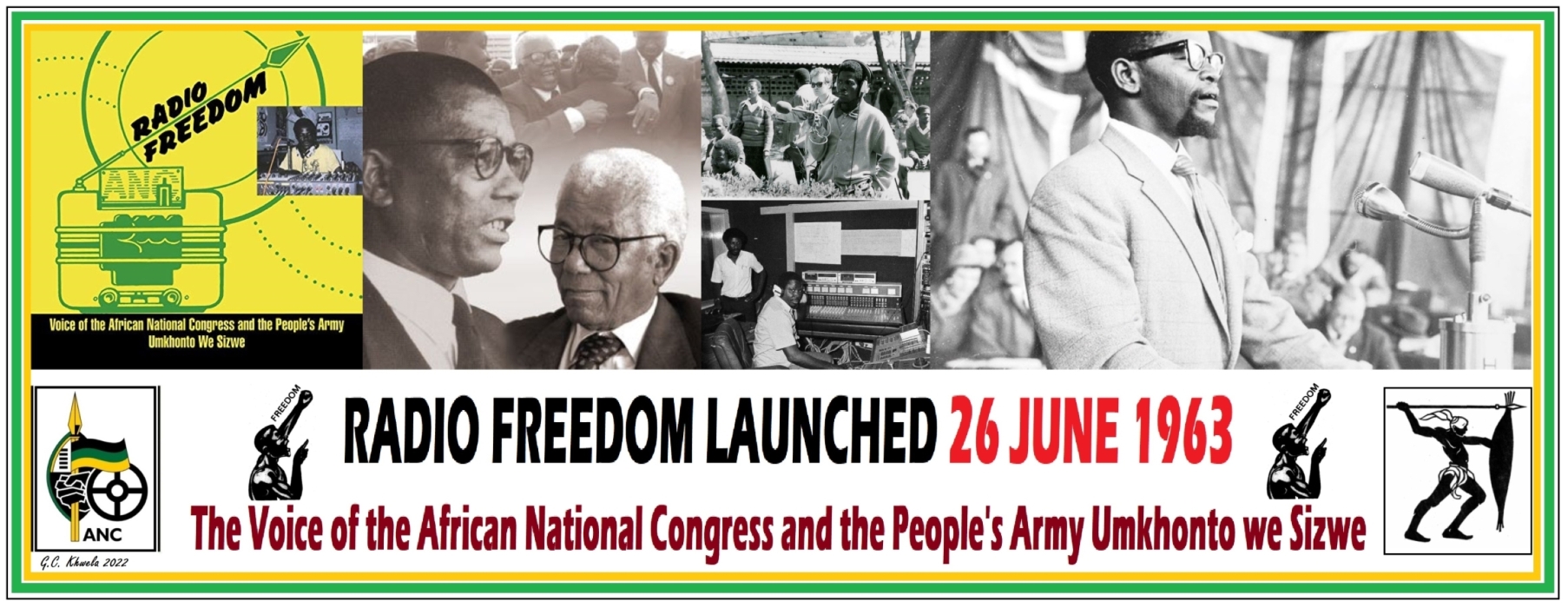
Launching Radio Freedom – 26 June 1963
On 26 June 1963, a broadcast was heard over large stretches of Johannesburg, which said “This is Radio Liberation! This is the Radio of the African National Congress! Our radio talks to you for the first time today, June 26, but not for the last time. There will be more broadcasts.” On this day Radio Freedom was born, as the station’s first transmission went out from the armed wing’s, Umkhonto we Sizwe’s (MK), hideout in Liliesleaf, a farm in Rivonia, north of Johannesburg, with Lionel Gay, Denis Goldberg, Cyril Jones and Ivan Schermbrucker handling the technical aspects of the broadcast.
The radio made mention of the house-arrest order placed on Walter Sisulu and it said: “We could not accept this. We are not afraid of jail or even death in the struggle. Even in jail the struggle goes on, but those in jail are there as captives of the government. Our Congress decided that Walter Sisulu should leave his home. His house was being used by Vorster to imprison him. Today he continues to lead our organisation and the people. He leads from underground. Here from underground is Walter Sisulu to speak to you.”
Sisulu then began speaking: “Friends, Comrades, Sons and Daughters of Africa, I am speaking to you from somewhere in South Africa. I have not left the country.” He continued to say that by order of “my organisation, the African National Congress, I am resuming my position of Secretary-General that I relinquished in 1954. Those who succeeded me have now been allocated other duties overseas.”
His final words were: “We warn the government that drastic laws will not stop our struggle for liberation. Throughout the ages men have sacrificed – they have given their lives for their ideals. And we are also determined to surrender our lives for our freedom. In the face of violence, men struggling for freedom have had to meet violence with violence. How can it be otherwise in South Africa? Changes must come, changes for the better, but not without sacrifice … We face tremendous odds. We know that. But our unity, our determination, our sacrifice, our organisation are our weapons. We must succeed. We will succeed! AMANDLA!”
Following the tragedy of the arrests of the leadership at the Liliesleaf farm in Rivonia on 11 July 1963, Radio Liberation also became a victim. It was until 1969, following a resolution adopted by the African National Congress (ANC) at its first national consultative conference, the Morogoro Conference, in Tanzania, that Radio Liberation was revived as “Radio Freedom”. The decision of the conference was to establish a broadcast division to enable the movement to communicate with the people inside the country. The first broadcast occurred through Radio Tanzania Dar es Salaam in July 1969, leading to other platforms being established through Radio Zambia’s External Service in May 1973, Radio Nacional de Angola in June 1977, the External Service of Radio Madagascar in 1979 and Radio Ethiopia in October 1981.
Radio Freedom became a critical tool that disseminated the African National Congress’ (ANC’s) and Umkhonto we Sizwe’s (MK’s) revolutionary culture and heritage. It became the station that linked exiled revolutionaries and activists inside the country at a time when communication was virtually impossible. It shaped the consciousness and style of struggle of a whole generation of militant youth as it provided inspiration with the truth that was absent from most of the legal media in apartheid South Africa.
By the mid-1970s, having been exiled, Radio Freedom was broadcasting on radio stations in five different countries including Tanzania, Zambia, Angola, Ethiopia and Madagascar. In 1983, South African soldiers targeted and destroyed Radio Freedom’s Madagascar facility, halting its operation for a short time. The apartheid state, meanwhile, did its best to jam the transmissions, but at least some of the broadcast always got through.
Listening to Radio Freedom in apartheid-era South Africa was a crime carrying a penalty of up to eight years in prison. Over the years, the message spread. Clandestine networks of tape traders recorded the broadcasts – especially ANC President Oliver Tambo’s annual address to the nation on January 8, the Movement’s anniversary statement – and distributed them throughout the country.
By the mid-1980s the townships were in open revolt, and nobody was worried about being arrested for listening to a radio show. The ANC, still in Lusaka, did its best to manage the revolutionary struggle and uprisings from afar. Like other guerrilla stations, Radio Freedom shared news, interviews, poetry and commentary from the movement that ran counter to the highly censored media reports from within South Africa. The broadcast began with machine-gun fire, followed by spoken words such as “This is Radio Freedom, the voice of the African National Congress and the People’s Army, Umkhonto we Sizwe!”
Sources:
Hugh Macmillan “The African National Congress of South Africa in Zambia: The Culture of Exile and the Changing Relationship with Home, 1964–1990”, Journal of Southern African Studies, Vol. 35 No. 2, 2009.
Raymond Suttner, “The ANC Underground in South Africa, 1950 – 1976”, First Forum, 2009.
Gcwelumusa Chrysostomus “Castro” Khwela, “Preserving and Advocating MK’s Cultural Heritage: The Revolutionary Character for National Liberation”, Paper Presented at the All-inclusive Ex-MK Conference, East London ICC, 28 – 30 April 2022.
Howard Barrell, “Conscripts to Their Age: African National Congress Operational Strategy, 1976-1986”, D.Phil. thesis in Politics, Faculty of Social Studies, University of Oxford, Trinity Term, 1993.
Thula Simpson, “Umkhonto we Sizwe: The ANC’s Armed Struggle”, Penguin, 2016.
Clarence Kwinana, “Helping Hands for Radio Freedom”, in Ronnie Kasrils, Muff Anderson and Oscar Marleyn, “International Brigade Against Apartheid: Secrets of the People’s War that Liberated South Africa”, Jacana, 2021.
Castro Khwela
Good evening fellow Compatriots!
Discover more from CASTRO KHWELA
Subscribe to get the latest posts sent to your email.