Lessons of Our People’s War: The Political and Military Relationship
(An adaptation of the Part 2 and 3 of the articles penned by Khumalo Migwe – Jabulani “Mzala” Nxumalo – on the on-going debate regarding the focus of Umkhonto we Sizwe on driving the armed struggle towards a completely developed people’s war, February 1982).
Since by definition guerilla warfare is that form of warfare adopted by the strategically weaker side to give it the capability of taking the tactical offensive at chosen times and places, it generally stands to reason that, from the point of view of military science it can never be decisive on itself, but is the initial phase developing towards mobile and positional conventional warfare. Practical experience, however, has demonstrated that given certain political factors, guerilla warfare can of itself, without developing into higher stages of military deployment, bring down an oppressive state.
It is this political dimension, that is, this popular will as the key to military strategy, which renders it possible to overthrow even the most economically and militarily powerful government by means of guerilla tactics alone.
RELATIONSHIP BETWEEN THE POLITICAL AND THE MILITARY
The history of all hitherto guerilla struggles indicates that their successes or failures depended very much (but not solely) on the relationship that is created between the political and the military; nevertheless, this question needs to be understood even much more deeper, and so we must discuss it further. Facts, unlike coins, do not wear off through constant handling.
It would not be correct to mechanically say that only those who have maintained the primacy of the political to the military have necessarily succeeded, in as much as on the other hand, history yet knows not of successes of guerilla war in those situations where the political was ignored. Striking the necessary balance, depending on the concrete situation of a given country, constitutes the art of guerilla warfare – and art cannot be reduced to scientific formula.
Success has been guaranteed by the artful combination of the two, with the proportions dictated by the concrete historical reality of the country concerned, and at times by the level of the development of the struggle towards armed insurrection. What, however, has been irrefutably proved, is that in those conditions where the primacy of politics was maintained both in principle and actuality, victory was guaranteed. The contrary has never bore fruit.
The primacy of politics is fundamental because all the revolutionary tactics, and this includes military tactics as well, are aimed basically at ‘conquering’ the hearts and minds of the people and at the same time destroying the spiritual fibre of the ruling class. This is the political power that causes the trigger-finger of the enemy troops to hesitate to shoot; this is the force that produced, for example in Mozambique, “a general crisis and a situation of neuropsychological exhaustion” (to quote General Spinola) and the possibility of the transfer of political power to the people while the enemy soldiers still retain their weapons and ammunition in abundance.
When we talk of revolutionary armed struggle we are talking of political struggle by means which include the use of military force. It becomes important to emphasize this because of the danger of the guerillas developing what Basil Davidson refer to as “military commandism” which is always manifested by militarism, a cow-boy approach to armed struggle that seem to make a cult out of the bullet. The ever present debate in South Africa on the overemphasis of this or that aspect (political or military) arises from the fact that it is not easy to determine the point at which concrete political preparation has been sufficiently carried out to give our combat detachments the maximum chances of survival and growth within any given area. There is no instrument for measuring this. The only guarantee against blunders is to move the debate from the academic seminars to the actual political situation.
The other danger here exists in the creation of a strict dichotomy between the political and the military. In theory this question presents no problems, but in actual practice it creates a group of political revolutionaries and a separate group of military revolutionaries, that is, those who do the shooting and destroying. The armed combatants thus develop a negative attitude to political education, tending to view it as a mere verbal necessity forced on them by the political leadership (“because all talks”, says one slogan, “end in Geneva”). If this is not checked early enough, it finally results, with the development of the struggle, in the competition for power between the so-called military and the so-called political.
Che Guevara described a guerilla as a social reformer who takes up arms in reply to the cry of his people. In an article printed in “Granma” (English edition), Havana, December 3, 1977, he said: “The guerilla is a liberation fighter par excellence: elected of the people, vanguard combatant in their struggle for liberation”.
In other words, each guerilla must be a political activist with a weapon in hand. Here there is division of tasks, it must relate only to the specific duties and assignments but not to designation. A guerilla that is void of political content will lack creativity and initiative – he will wait for a distant command for the situation he is supposed to appraise and command. A conscious drive should ever be directed towards co-ordinating political and military leadership until eventually it is integrated.
ARMED STRUGGLE – NOT A SUBSTITUTE FOR OTHER TACTICS
It would be appropriate to quote at this stage from the Report of the Eighth National Congress of the Popular Socialist Party of Cuba (PSP) which was given by Bias Roca, a Member of the Politburo:
“Even though armed struggle was a decisive means for achieving the overthrow of the tyranny and the triumph of the revolution, we should not underestimate the role played by other forms of struggle, which co-operated in achieving these ends. The constant struggles, large and small, which were carried on in the cities and fields, outside of the field of military operations, kept the repressive forces of the government in check, prevented them from concentrating against the guerillas, politically influenced many members of the army and the police, disorganising these forces and tending to paralyse them. The actions and mobilisations of every type, in city and country, co-operated effectively in helping the Rebel Army to defeat the offensives of the army of tyranny and finally to win the battle for revolutionary power.”
If the people in struggle were to be represented by the stormy sea, then the armed combatants are the waves – remove the sea or lower its tide, then you are tempering with the very existence or tide of the waves. It would be an error to think of armed struggle as a dichotomy separate from the other forms of struggle waged by the people. Armed combatants are given rise to by the people in mass action, and in turn their armed actions further stimulate more mass actions. The two exist in dialectical unity, to think otherwise would be tantamount to being metaphysical, philosophically speaking.
Nelson Mandela had this very truth in mind when he said that between the anvil of mass action and the hammer of armed struggle, we shall crush the racist system. This is our formula for victory.
The prominence of armed struggle in liberation movements in many countries should not obscure the fact that independence from imperialist rule have been gained in a large number of African countries by other means, including general strikes, mass demonstrations, etc. If these tactics by themselves are capable of rendering imperialism under certain conditions weak , for what reason should they be ignored once the armed tactics are applied?
In the case of South Africa, for instance, strategists of varying political persuasions have maintained that given the degree to which the South African economy is dependent on the labour of the oppressed black population, a nationwide general strike for a period of only two weeks by at least four-fifths of black workers, could of itself overthrow the Pretoria boers. This therefore means that a significant amount of energy should be directed towards the organisation of the working class.
What, however, should also be guarded against in this regard, is to approach this mobilisation in divorce from the development of armed struggle. In fact, what the above-mentioned strategists fail to grasp in the South African reality, is that without accompanying manpower as well as economic installations, such nationwide general strike leading to the overthrow of the Boer regime is only a pipe dream.
When we study the lessons of the Malayan as well as Philippines liberation struggles, and particularly the cause of their failures, we note that here the forms of struggle were not diversified and developed to bring all sections of the population, including sections of the national bourgeoisie, into the liberation movement, and “insufficient masses of the people were led by their- own struggle experiences to acceptance of the armed struggle as the only logical alternative. In short, Marxist-Leninist principles of revolutionary situations and their development were not closely observed”, wrote William Pomeroy (“Guerrilla Warfare and Marxism”, London 1969, p.34).
Looking back over the whole process of development of the Vietnamese revolution, one again sees how the Vietnamese constantly relied on the all-round employment of all revolutionary tactics, with the proportions being dictated by the concrete situation and the stage of the development of the struggle towards mass insurrection.
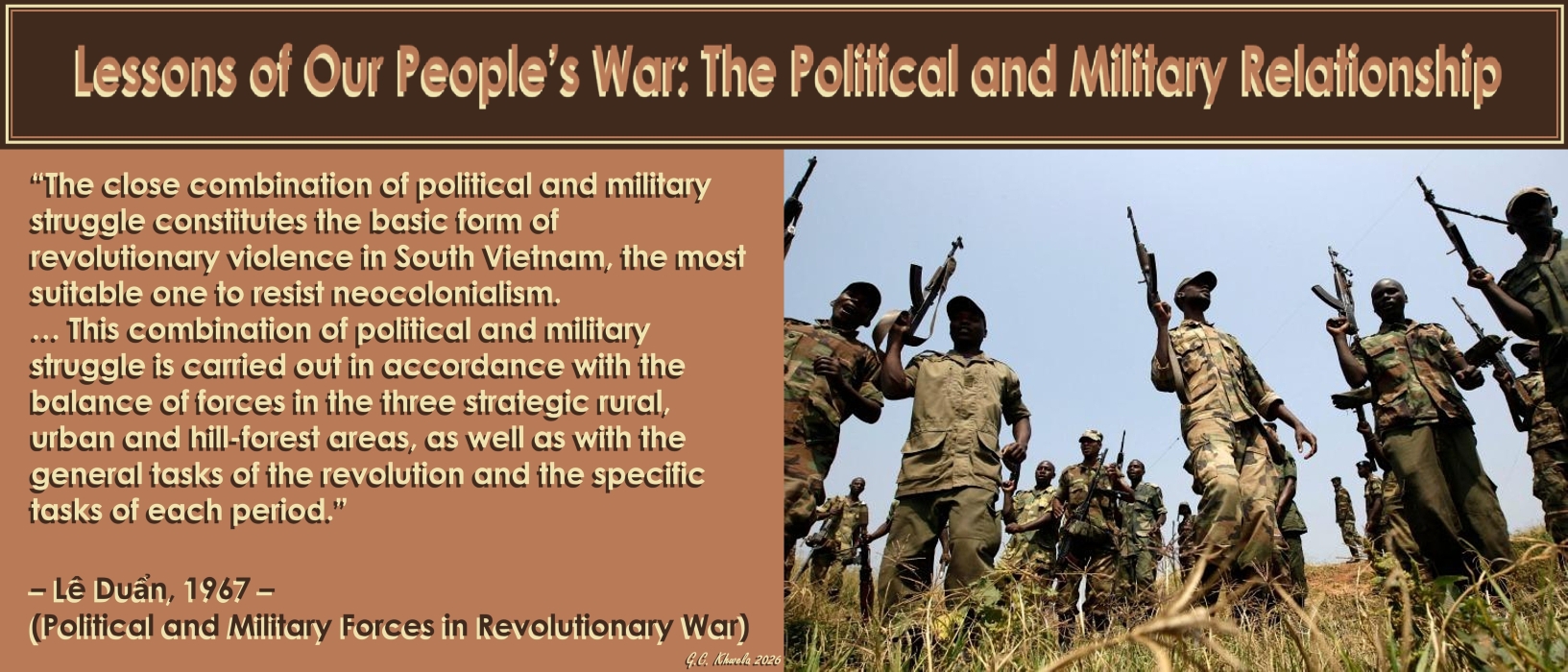
“Military struggle, coupled with political struggle is the fundamental form of revolutionary violence in the South”, said Le Duan, “and the combination of the two is the fundamental rule of revolutionary methods”. Mass uprisings combined with revolutionary warfare in close co-ordination! They enlarged the people’s field of action – conversely, the more the revolutionary war developed, the more favourable conditions it created for the outbreak and spreading of uprisings.
The combat activities of Umkhonto We Sizwe therefore aim not only at wiping out the enemy’s military forces, but also at boosting the political struggle, and in particular at helping the insurrectionary masses of South Africa break up all forms of enemy control and oppression, win sovereignty and set up revolutionary power. This means the elimination of informers and administrative stooges as well as government representative organs and institutions in our midst. It means to arm ourselves with modern war equipment and to adopt an offensive strategy against our racist tormentors.
To quote General Giap, “It means to fight the enemy in our fields and orchards, villages and hamlets, forest clearings and streets. It means to cling to and be masters of the land, to control the administration in varying degrees, to be masters of the situation.”
“Our aim is a war fought by the entire people, not only in strikes and demonstrations but precisely in the field of armed struggle. In other words, the role of the masses as the combat forces is growing, and their political education is a principal task which will facilitate unity inaction involving the black masses and democratic forces of our country.” (Unity in Action – A History of the. African National Congress 1912-1982, Page 71).
Sources:
Khumalo Migwe, “Lessons of Our People’s War”, Dawn – Monthly Journal of Umkhonto we Sizwe, Vol. 6, No. 4, April 1982.
Lê Duẩn, “Political and Military Forces in Revolutionary War, 1967”, Revolutionary Thought in the 20th Century, Zed Press, 1980.
Castro Khwela
Good morning fellow Compatriots!
Discover more from CASTRO KHWELA
Subscribe to get the latest posts sent to your email.