MK Special Ops Apartheid-Shattering Church Street Bombing
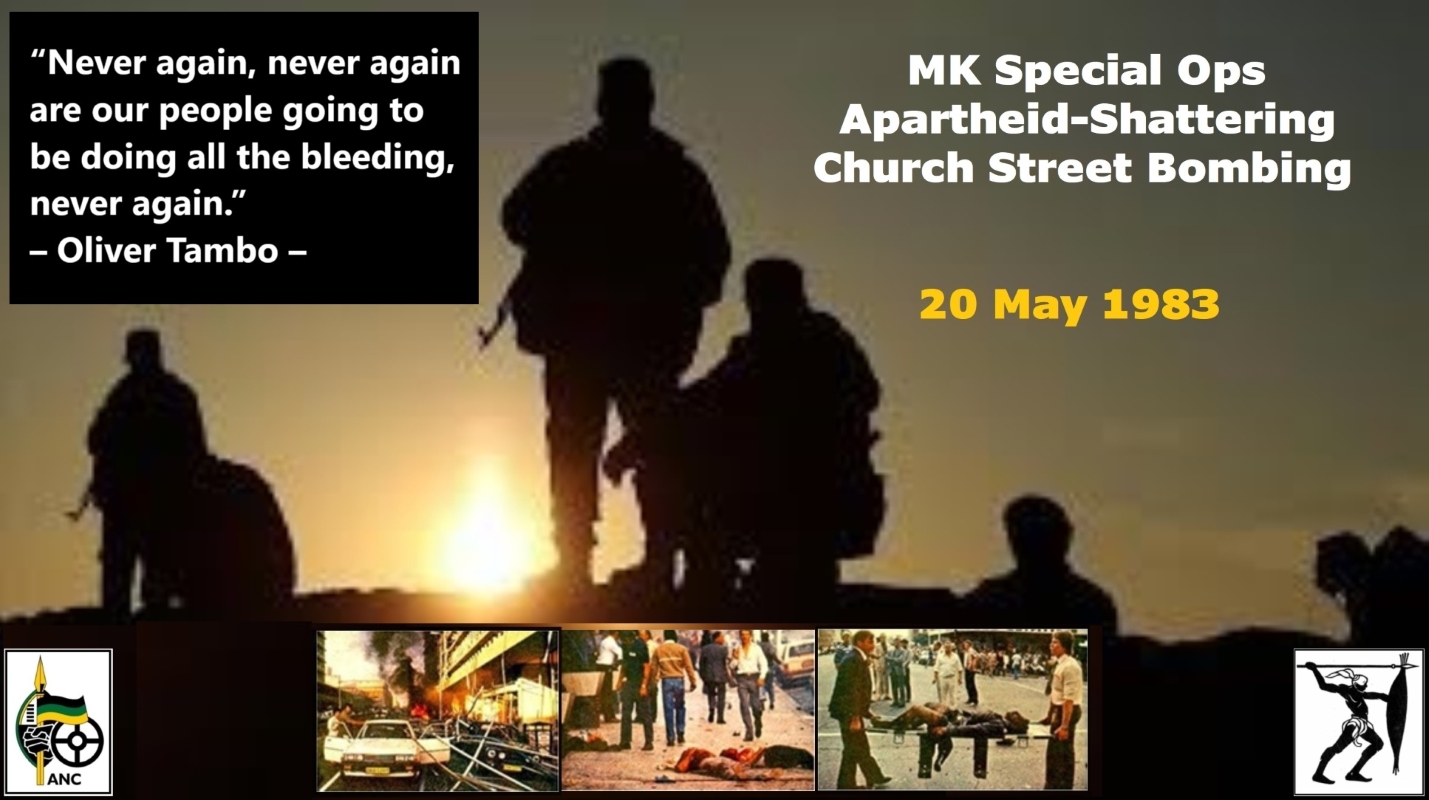
On Friday, 20 May 1983, at approximately 16:28, a huge blast on Church Street made a black plume of smoke to emanate from a car outside the Nedbank Square Building, which housed the South African Air Force Headquarters. The bomb had made a huge crater in the ground. When the bomb exploded prematurely, Umkhonto we Sizwe (MK) Operative, Freddie Shongwe’s body was hurled some distance from a Colt Gallant and was crushed against a lamp post. His Comrade, Ezekial Maseko suffered critical injuries to the lower half of his body and was taken to hospital only to be pronounced dead upon arrival.
On the other side of the street was the Poynton Building, which housed the apartheid South African Defence Force (SADF) Directorate of Military Intelligence. Almost all the shops on both sides of the street were destroyed, as were three floors of the Nedbank Building. Worst hit, was the Golden Egg Restaurant on the ground floor of the Nedbank Building. Crushed bodies were lying in the street and in the restaurant, a young soldier’s face was charred and his eyes were blinded by the explosion. The smoke created an unnerving haze around Church Street, while a nauseating smell was accompanied by cries from people trapped inside the Golden Egg Restaurant.
Where did it all begin? It was in December 1982 that Aboobaker Ismail (aka “Rashid”) and Joe Slovo began discussing the Umkhonto we Sizwe (MK) Special Operations Unit’s next major project, and they decided they wanted it to be a direct attack on apartheid South African security forces personnel. Following on from this discussion, Rashid met Johannes Mnisi and Freddie Shongwe in Swaziland, where he told Shongwe to go with Ezekial Maseko and reconnoitre targets within South Africa.
Shongwe identified Vootrekkerhoogte as a target that Special Operations (Special Ops) would like to hit again, but at the same time he mentioned other possible targets like the South African Air Force’s (SAAF) headquarters in Church Street. Rashid then showed Shongwe the weapon that they would like to use for the operations, which was a forty-kilogram explosive device with a trigger mechanism activated by radio.,
On 19 May 1983, Ms Hélène Passtoors, who was a Belgian activist, employed in the linguistics department of Maputo’s Eduardo Mondlane University, drove out of Swaziland in a cream-coloured Colt Gallant. When she entered South Africa she headed to Mamelodi, a township outside of Pretoria, where she parked the car behind the house belonging to Ezekial Maseko. Hélène was recruited by MK Chief of Staff Joe Slovo into the armed struggle in 1981, where he managed to place her talents and skills to the benefit of the revolution. She worked closely with “Rashid” and Slovo had groomed her to become a pivotal figure in the MK Special Ops Unit, wherein she exploited her natural endowments as a white woman and a foreigner to carry out extensive reconnaissance missions without being detected.
The following day, on 20 May 1983, Ezekial Maseko and Freddie Shongwe began working with a grinder under the bonnet of the Colt Gallant, and shortly after 15:00, they departed in two cars, with Shongwe driving the Gallant and Maseko a Combi. When they arrived at the Pretoria Central Business District, Ezekial Maseko parked the Combi in the vicinity of Schubart Street and proceeded on foot to the northern kerb of Church Street, where he took up a position.
The Colt Gallant was parked on the opposite side of the road in front of the Nedbank Plaza, with Freddie Shongwe still inside it, and within minutes a huge explosion occurred. Unfortunately, for some unknown reason, the explosives were detonated prematurely and exploded ten minutes earlier than planned, killing the two MK Operatives, along with 17 other people. Ultimately, twenty-one people were killed, and 219 others were injured in the attack. Eleven of the dead were SAAF employees. Evidence revealed that up to 84 of the injured had been SAAF employees.
On 21 May 1983, at the press conference in Nairobi, Kenya, ANC President Oliver Tambo mentioned that “Never again, never again are our people going to be doing all the bleeding, never again.” The Church Street bombing took place subsequent to the December 1982 SADF raid into Maseru in which a number of African National Congress (ANC) supporters and Lesotho civilians were killed and the assassination of Ruth First in Maputo, as well as a parliamentary debate on the Government’s attempts to introduce a Tri-cameral Constitution. The ANC was strongly opposed to this step, which was considered to be purely cosmetic.
In the January 8 Statement, 1984, Tambo emphasised that “Everywhere in the country, our people and youth have courageously confronted the regime in numerous encounters, whether against rent-increases, forced removals or in military actions among them, the attack on the Air Force Headquarters at Pretoria by Umkhonto we Sizwe. … But the challenge confronting Umkhonto we Sizwe, in the face of current developments in Southern Africa, has never been greater. Therefore, in commending its units and commanders on the sustained offensive of the past year, we charge them, and call upon our people, to carry the struggle to new heights, and sue for victory tomorrow rather than the day after tomorrow.”
“To this end”, Tambo added, “Umkhonto we Sizwe must deepen its roots and grow inextricably among the popular masses: among us – the workers, the peasants, the youth, the women; we, the unemployed, the landless, the homeless, and the starving millions. Umkhonto we Sizwe must grow in size, in the spread and quality of its operations, and in the weight of every blow delivered. The armed struggle must grow. We shall achieve victory through a combination of mass political action and organised revolutionary violence.”
Sources:
Peter Stiff, “The Silent War: South African Recce Operations, 1969 – 1994”, Galago, 1999.
Ebrahim Ebrahim, “Beyond Fear: Reflections of a Freedom Fighter”, Jacana, 2022.
Hugh Macmillan, “The Lusaka Years: The ANC in Exile in Zambia, 1963 to 1994”, Jacana, 2013.
Stephen Ellis, “External Mission: The ANC in Exile”, Jonathan Ball, 2012.
Vladimir Shubin, “ANC: A View from Moscow”, Jacana, 2008.
Castro Khwela
Good day fellow Compatriots!
Discover more from CASTRO KHWELA
Subscribe to get the latest posts sent to your email.