The George Hodges Hijacking Incident
On the morning of 19 May 1989, a contingent of 174 Umkhonto we Sizwe (MK) cadres, who had been withdrawn from Angola as part of the 22 December 1988 Tripartite regional peace agreement between South Africa, Angola and Cuba towards the independence of Namibia, arrived in Dakawa, Tanzania. An estimated 7,000 African National Congress (ANC) guerrillas in Angola were supposed to be moved to bases in Tanzania and Uganda as a result of the peace accord.
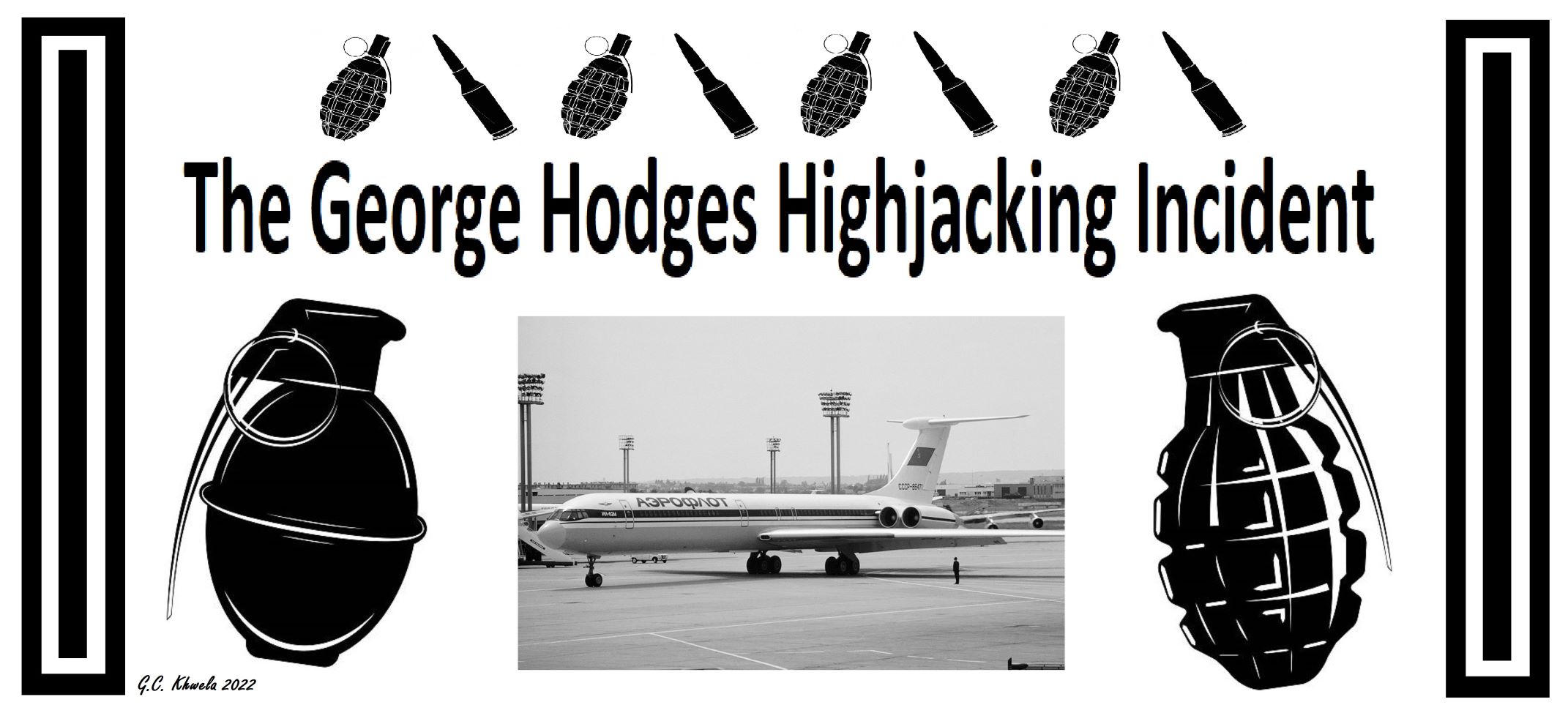
The 174 guerrilla fighters were traumatised by what had occurred the previous day, 18 May 1989, in a Soviet Iluyshin 62 Aeroflot aircraft from Luanda to Dar es Salaam. As the plane entered the Tanzanian airspace, four men (one white, one so-called Coloured and two black), stood up in the aisles. The white man, Bradley Richard Stacey (aka “George Hodges”), brandished what he said was a hand grenade and ordered that the flight be diverted to Johannesburg, South Africa, because one of the passengers on board was “a Russian communist wanted in South Africa”.
George Hodges approached the cockpit of the plane waving a hand grenade, but was shot in the chest by a Soviet security officer, wounding him seriously, and the other would-be hijackers surrendered. The Tanzanian Police said they believed Hodges was an undercover agent working for the apartheid South African government.
At 14:46 local time, the plane landed at the end of the runway of the old Dar es Salaam airport, with soldiers and policemen waiting for it. Witnesses on the tarmac saw George Hodges being taken from the plane by stretcher and was flown by military helicopter to Muhimbili Medical Centre in Dar es Salaam, being placed under heavy armed guard. The other would-be hijackers, who said were disillusioned with the ANC, were arrested by the Tanzanian Police.
George Hodges, who was in his late twenties, had left South Africa in March 1986 with the police seeking him in connection with an act of arson at the University of Natal, where he was a student. The arson attack on the campus in 1986 had resulted in the lifework of Prof. Lawrence Schlemmer being destroyed. Hodges then became part of the MK Young Lion Detachment, which trained in Quibaxe Camp 13 in 1986 to early 1987. With the beginnings of the Northern Front against UNITA (The National Union for the Total Independence of Angola) in late 1987, George Hodges was deployed to the Outpost Unit in protecting the route into the Camp from Quibaxe town.
When he was questioned about why he wanted to hijack the Soviet aircraft and divert it to Johannesburg, Hodges maintained that he became disillusioned with the ANC because of its involvement in the Angolan Civil War, and particularly the approximately eighty lives lost by MK during the 1987 – 1988 Northern Front campaign against UNITA. He had been trained in Camp 13, which was approximately 12 kilometres from Quibaxe, a town in the north of Luanda. After training, he was deployed in Camp 13 until the withdrawal of MK from the North to Luanda.
The ANC however, maintained that Hodges was a South African police agent planted by the police to sow disunity in the organisation following a call by the Minister of Police, Adrian Vlok, to ANC members to renounce violence and return to South Africa. The latter’s call to ANC-Umkhonto cadres to denounce violence received extensive media coverage in Africa as well as on the BBC’s service.
On 1 June 1989, 30-year-old George Hodges was sentenced to two 15-year prison terms for carrying grenades and explosives on board a Soviet aircraft which he reportedly tried to hijack to Johannesburg. Another, as yet unidentified, South African in a Tanzanian military hospital faced similar charges and was to appear in court on 13 June 1989.
On 2 June 1989, the ANC issued a statement accusing the apartheid South African police of sending white undercover agents to try to hijack a Soviet airliner flying from Angola to Tanzania in May 1989 with 174 guerrillas on-board. A crew member was also reportedly injured and one hijacker wounded by gunfire in the struggle. The hijack failed and Stacey was subsequently sentenced to 15 years imprisonment in Tanzania.
If the alleged attempted hijacking had been successful, it would have resulted in the largest mass arrest of ANC guerrillas ever and would likely have provoked an international uproar and accusations of state-sponsored air piracy. On several occasions during the period, the ANC’s exile training bases had been infiltrated by white South African police agents posing as anti-apartheid activists. Some of them had been sent to the Soviet Union and to Eastern Bloc countries for guerrilla training and had resurfaced in South Africa as senior security police officers.
Sources:
Cornelius Johannes Brink le Roux, “Umkhonto we Sizwe: Its Role in the ANC’s Onslaught Against White Domination in South Africa, 1961 – 1988”, PhD Thesis, University of Pretoria, 1992.
UPI Correspondent, “ANC Hijack Man Gets 15 Years”, United Press International, 2 June 1989.
William Claiborne, “South Africa Accused in Attempted Air Hijacking”, The Washington Post, 3 June 1989.
Correspondent, “ANC HQ Moving to Tanzania”, Bulletin of Tanzanian Affairs, No. 34, September 1989.
Thula Simpson, “Umkhonto we Sizwe: The ANC’s Armed Struggle”, Penguin, 2016.
Castro Khwela
Good day fellow Compatriots!
Discover more from CASTRO KHWELA
Subscribe to get the latest posts sent to your email.