Bantustan Leaders Jointly Reject the Mandela-De Klerk “Record of Understanding”
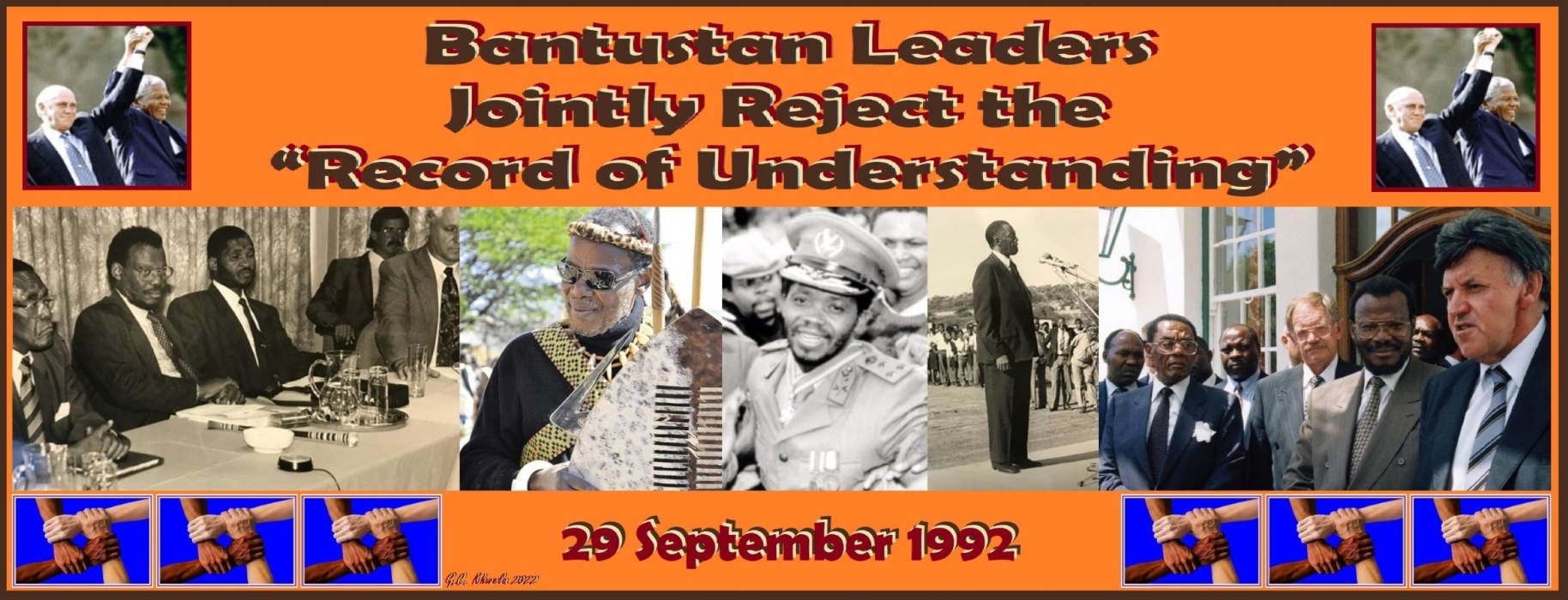
On 29 September 1992, following the signing of a “Record of Understanding” by the leader of the African National Congress (ANC), Nelson Mandela, and the apartheid South African President, F.W. de Klerk, three prominent leaders of the Bantustans that were opposed to the domination of the negotiations by the ANC and the apartheid government, issued a joint statement after a trilateral meeting in Mmabatho, the capital of the then Bophuthatswana Bantustan.
In the statement issued by Chief Mangosuthu Gatsha Buthelezi of KwaZulu, Lucas Mangope of Bophuthatswana and Brigadier Oupa Gqozo of the Ciskei, they maintained that they rejected the “Record of Understanding” and charged that De Klerk and Mandela had taken decisions affecting their interests without involving them. For the three Bantustan leaders, they considered this as a sign that the apartheid government was pursuing a bilateral agreement or agenda with the ANC over their heads. Furthermore, Buthelezi went on to warn that the deals struck between the ANC and the apartheid government were “illegitimate” and “unimplementable”.
On 26 September 1992, during a summit between the apartheid South African government and the African National Congress (ANC), both parties agreed to a conclude a Record of Understanding, which was to set up a timetable for establishing a Constitutional Assembly, an Interim Government and dealing with political prisoners, amongst others. The apartheid government and the ANC agreed that all political prisoners, whose release could make a contribution to reconciliation, should be released as soon as possible. The agreement was that the release of prisoners who had committed offences with a political motive on or before 8 October 1990 shall be carried out in stages. However, the deadline for that process was 15 November 1992.
The signing of the Record of Understanding between the two parties came shortly after the funeral of victims of the Bisho Massacre, where scores of people were killed by the Ciskei Defence Force on 7 September 1992. In his statement, the ANC President, Nelson Mandela regarded the killings as nothing but an indictment on the apartheid government. Nonetheless, the two delegations agreed that the summit had laid a basis for the resumption of the negotiation process. To this end, the ANC delegation advised the South African Government that it would recommend to its National Executive Committee (NEC) that the process of negotiation be resumed and thereafter extensive bilateral discussions would be held.
Following a series of meetings that were held between Roelf Meyer, the apartheid Minister of Constitutional Development, and Cyril Ramaphosa, the Secretary General of the ANC since 21 August 1992, these meetings entailed discussions with a view to remove obstacles towards the resumption of negotiations and focused on the identification of steps to be taken to address issues raised in earlier memoranda. The discussions took note of various opposing viewpoints on the relevant issues and obstacles. It was decided then that these issues should not be dealt with exhaustively in the understanding.
Although it was observed that there were still other important matters that were going to receive attention during the process of negotiation, the Record of Understandings focused on the following issues and obstacles: the a need for a democratic constitutional assembly or constitution-making body, and that for such a body to be democratic, it had to be democratically elected; draft and adopt the new constitution, implying that it was to sit as a single chamber; be bound only by agreed constitutional principles; have a fixed time frame; have adequate deadlock breaking mechanisms; function democratically, meaning that it was to arrive at its decisions democratically with certain agreed to majorities; and to be elected within an agreed predetermined time period.
Within the framework of these principles, details were to be worked out during the negotiation process. Both parties also agreed that during the interim or transitional period there was to be constitutional continuity and no constitutional hiatus. In consideration of this principle, it was further agreed that the constitution-making body or constituent assembly was also to act as an interim or transitional Parliament.
Furthermore, that there was to be an interim or transitional Government of National Unity (GNU); the constituent assembly-cum-transitional Parliament and the GNU were to function within a transitional constitution which was to provide for national and regional government during the period of transition and was to incorporate guaranteed justiciable fundamental rights and freedoms. The transitional Parliament was to function as a one- or two-chambered body.
The Goldstone Commission had given further attention to hostels and brought out an urgent report on certain matters and developments, including the volatile atmosphere of violence, the public display and carrying of dangerous weapons, and the right of all parties and organisations to participate in peaceful mass action in accordance with the provisions of the National Peace Accord and the Goldstone Commission’s recommendations. As a reaction to these recommendations, at a meeting held in Ulundi, on 27 September 1992, Inkatha Freedom Party (IFP) leader Chief Mangosuthu Gatsha Buthelezi warned that the deals struck between the ANC and the government were “illegitimate” and “unimplementable”.
Referring specifically to the proposed ban on the carrying of cultural or traditional weapons in public, he said that Zulus would continue to carry their cultural weapons. The ban if adopted and implemented would have prevented IFP members from carrying Zulu “cultural weapons” during their marches. The intention of this ban was to curb growing violence resulting from the use of these weapons to attack bystanders caught in the way of IFP marchers. At the same day, Buthelezi suspended his own talks with the government, demanding that the Mandela-De Klerk Accord be approved by all parties in the constitutional talks.
Subsequently, Buthelezi held extensive meetings with right-wing white leaders and nominally independent black Bantustan leaders who shared his fear of ANC domination in a new government. “We charge that President De Klerk is doing deals with the ANC to write the rules of the negotiations game,” the Inkatha petition said. “We insist on the Zulu nation’s delegation being included in future negotiations if there is any serious quest for peace.” De Klerk strongly denied Buthelezi’s claims that the government was conducting negotiations only with the ANC and further denied Buthelezi’s claim that the government agreement to ban traditional weapons was aimed at the Zulu nation.
In a follow-up meeting, on 6 October 1992, Buthelezi, Ciskei military leader Oupa Gqozo, Bophuthatswana’s Lucas Mangope, the Conservative Party, its breakaway faction, the Afrikaner Volksunie (AVU), and the Afrikaner Freedom Foundation, met in a Conference for Concerned South Africans to respond to the Record of Understanding. The conference demanded that Umkhonto we Sizwe be disbanded and that the Record of Understanding be scrapped. This conference also gave birth to the Concerned South Africans Group (COSAG).
The remarkable aspect of COSAG was that it was the first formal alliance in South Africa between black and white right-wing organisations uniting around a common rejection of the Record of Understanding and fear of an ANC majority government. COSAG was opposed to both an interim government and the drafting of the final constitution by an elected constituent assembly. It was even opposed to the title ‘CODESA’ (the Convention for a Democratic South Africa), particularly, as an important issue for consideration, was the status of agreements previously reached at CODESA.
The position of the Inkatha Freedom Party (IFP) was that the multi-party conference should re-evaluate all agreements, including the Peace Accord, and the process of negotiations. Those parties which did not participate in CODESA should be enabled to confirm or reject it as they wished, which actually meant the replacement of CODESA by a more representative forum. Mangope also argued that they were not in COSAG because they were soul mates, but they were in COSAG because they didn’t accept the Record of Understanding which bound the Nationalist Party government to the ANC, although they differed when it came to their political philosophies.
Mangope maintained that “I would not accept a unitary state in South Africa where everything is controlled from the centre. That would be totally unacceptable to me. I may also, of course, say that I am unhappy with the South African government for the reasons I mentioned, the Record of Understanding, but also because in my understanding of their stand they have viewed what they call power sharing, for want of a better word, they have misled the public by giving the public to understand that by power sharing they mean federalism when as I see it in fact power sharing is a very narrow self-serving concept. They are only interested in sharing power with the ANC as a Nationalist Party.”
According to Mangope, “…the right have regrouped, if I may use the term, after the referendum because of what I said was the perception that the National Party government has capitulated to the ANC-Communist Party alliance as evidenced by the Record of Understanding. I think the Record of Understanding was extremely politically, extremely damaging to the Nationalist Party and I think it was the reason, the main reason, why the Nationalist Party has lost support.” COSAG desired a confederation of strong regions with a weak central government, and resisted the reincorporation of the Bantustans into South Africa.
Following this meeting between the Bantustan leaders and the Afrikaner right-wing organisations, on 17 October 1992, Mangosuthu Gatsha Buthelezi led more than 10 000 followers armed with spears on a defiant march through downtown Johannesburg to protest against the Record of Understanding between the ANC and the apartheid government. Many of the protesters, supporters of Buthelezi’s IFP, were clad in largely Zulu traditional regalia and some carried spears and sharpened sticks in open defiance of a police-ban on these weapons. Although a large contingent of police monitored the march, no protesters were arrested for carrying the weapons, which Buthelezi contended were “cultural weapons”. However, the authorities said they would consider filing charges against the march organisers.
The anti-government march, resembling many staged by the ANC over the previous years, was unprecedented for Inkatha, which had been a strong ally of President Frederik W. de Klerk and had in the past received financial aid from the white-minority government. Marchers walked peacefully past the downtown high-rises of the main business district, ending at the John Vorster Square police station, where Buthelezi presented a petition to the government. The petition accused De Klerk of reaching agreements with Nelson Mandela’s ANC “designed to side-line the Zulu nation”. Buthelezi said he and his party were the main political leaders of the country’s 7 million Zulus.
In reality, these figures were contested, since only about 2 million Zulus were members of Inkatha, and some had joined in order to secure jobs in schools, hospitals and other institutions that run by Buthelezi’s KwaZulu Bantustan government. Moreover, tens of thousands of Zulus were known to be supporters of the ANC, and were part of the supporters that had been at war Inkatha for nearly eight years in the predominantly Zulu province of Natal and in townships surrounding Johannesburg. Close to 8 000 blacks had been killed in township fighting since De Klerk took office in 1990.
Under that accord, the Record of Understanding, the ANC, the most powerful black opposition movement, agreed to return to the negotiating table after a three-month suspension of negotiations. In exchange, the government promised to ban the carrying of dangerous weapons and to fence off about two dozen migrant workers’ hostels identified as central to township violence. Most of those Johannesburg-area hostels were home to Zulu workers from Natal. Buthelezi regarded the agreements on hostels and dangerous weapons as unilateral attempts to weaken their (Bantustan and right-wing parties) bargaining position and ultimately to marginalise them from the negotiation process. In the following months, Buthelezi threatened secession but the move was met with intense diplomatic pressure that revealed his isolation.
Buthelezi had been angered by the Record of Understanding reached between De Klerk and Mandela, especially the apparent sidelining of the IFP implicit in the agreement, and as a result he, the Ciskei leader Oupa Gqozo, Bophuthatswana’s Lucas Mangope, the CP and its offshoot Afrikaner Volksunie (AVU), and the Afrikaner Freedom Foundation conferred as an opposing bloc and consequently formed the Concerned South Africans Group (COSAG). Buthelezi’s apparent alienation also exposed divisions within the National Party between those who supported a coalition with the IFP and the more reformist faction advocating a comprehensive settlement with the ANC.
The Record of Understanding and the implicit demotion within the National Party of Buthelezi as the party’s prime ally, however, signalled the prevailing of the reformist-minded faction within the National Party, which increasingly assumed the unprecedented predilection of an unconditional willingness to eschew the last vestiges of the political balance of power and reach a lasting agreement with the ANC. Thus, in an attempt to precipitate a settlement, delegations from the NP and the ANC convened several rounds of talks, which eventually culminated in a meeting in Cape Town from 10 to 12 February 1993. In these bilateral meetings concessions were made by both sides, as agreement was hastened by the increasing political (as opposed to only economic) collusion between the ANC and the NP after Joe Slovo’s ‘sunset clause.’
On 7 October 1993 the discordant groups involved with COSAG had reconstituted themselves as a coalition under the name of the Freedom Alliance. Nevertheless, despite concerns to get the Freedom Alliance aboard the transitional process during the first two weeks of November, the final areas of disagreement between the ANC, the NP, and other parties at the Multi-Party Negotiating Process were resolved. The final settlement was sealed, in fact, in a summit between Mandela and De Klerk, which was assisted by Cyril Ramaphosa and Roelf Meyer, on 16 November. During this meeting it was agreed that the power-sharing arrangement under the Government of National Unity (GNU) would continue for five years, and that a single ballot would be used in the April 1994 elections.
Actually, the process was initiated when Chris Hani – the leader of the SACP – was assassinated by White right-wing extremists on 10 April 1993. With a tremendously violent backlash to the assassination of the popular leader expected in the townships, Mandela proceeded to call for peace and restraint, and while clashes did occur throughout the country in response to Hani’s death, the assassination in the end accelerated the convergence when the negotiations resumed its proceedings on 26 April. Yet despite this persistent dissension and the political violence that continued to engulf South Africa, the negotiations continued and by early June the Multi-Party Negotiating Process had set a tentative election date of 27 April 1994, despite opposition from the COSAG/Freedom Alliance members.
Sources:
Wikipedia.
South African History Online (SAHO).
South African History Archives (SAHA).
SAHO, “Chapter 8 – Negotiating an End to the Deadlock”, South African History Online, 16 January 2012.
Institute for Justice and Reconciliation, “Turning Points in Transition: The Story of South Africa’s Road to Peace”, Institute for Justice and Reconciliation (IJR), 2011.
Mandy Gilder, “Memory of the World Register: Archives of the CODESA (Convention for a Democratic South Africa), 1991 – 1992 and Archives of the Multi-Party Negotiating Process, 1993”, The National Archives and Records Service of South Africa, 2012.
Botha W. Kruger, “Pre-negotiation in South Africa (1985 -1993): A Phaseological Analysis of the Transitional Negotiations”, Master of Arts: University of Stellenbosch, March 1998.
Barry Van Wyk, “The Balance of Power and the Transition to Democracy in South Africa”, Magister Hereditatus Culturaeque Scientiae: University of Pretoria, 2005.
Zwelethu Jolobe, “Getting To CODESA: An Analysis on Why Multiparty Negotiations in South Africa Began, 1984-1991”, Doctor of Philosophy: University of Cape Town, May 2014.
Stephanie Victor, “The Politics of Remembering and Commemorating Atrocity in South Africa: The Bhisho Massacre and its Aftermath, 1992–2012”, Journal of Southern African Studies, Vol. 41, No. 1, 2015.
Daniel L. Douek, “South Africa: The 1993 plot to kill Chris Hani”, ZAM Stories for Change, 02 November 2021.
Catherine Barnes (Ed.), “Accord – Owning the Process: Public Participation in Peacemaking”, Conciliation Resources, Issue 13, 2002.
Laura Evans, “The Bantustan State and the South African Transition: Militarisation, Patrimonialism and the Collapse of the Ciskei Regime, 1986-1994”, African Historical Review, Vol. 50, No.s 1-2, 2019.
Laura Evans, “The Mass Action Campaign of 1992: The Ciskei Crisis and the African National Congress in Transition”, South African Historical Journal, Vol. 75, No. 3, 2023.
Laura Evans, “The Bhisho March and Massacre of September 1992: The ‘Leipzig Option’ and the Meanings of Mass Action in the South African Transition”, South African Historical Journal, Vol. 75, No. 3, 2024.
FW de Klerk, “Reflections 30 Years on from the Start of CODESA – FW de Klerk”, PoliticsWeb, 05 February 2021.
Anthoni Van Nieuwkerk, “Transitional Politics in South Airica: From Confrontation to Democracy?”, The South African Institute of International Affairs, Occasional Paper, November 1992.
Hassen Ebrahim and Laurel E. Miller, “Creating the ‘Birth Certificate’ of a New South Africa: Constitution Making After Apartheid, in Laurel E. Miller and Louis Aucon (Ed.s), “Framing the State in Times of Transition: Case Studies in Constitution Making”, United States Institute of Peace, 2010.
Janet Smith and Beauregard Tromp, “Hani: A Life Too Short”, Jonathan Ball, 2009.
Thula Simpson, “Umkhonto we Sizwe: The ANC’s Armed Struggle”, Penguin, 2016.
Castro Khwela
Good evening fellow Compatriots!
Discover more from CASTRO KHWELA
Subscribe to get the latest posts sent to your email.