Oliver Tambo Reacts to the 1989 Apartheid Reforms
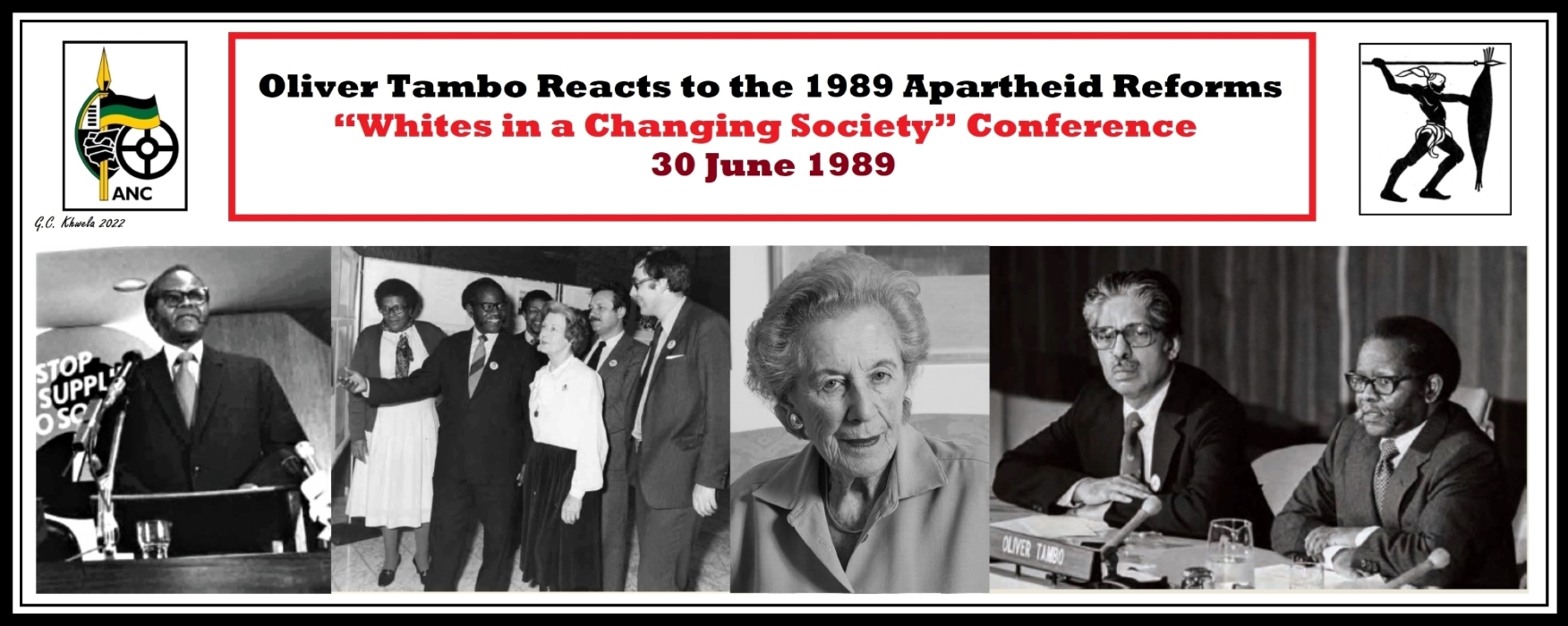
On 30 June 1989, while addressing a Conference attended by the 115 white South Africans belonging to a body called the Five Freedoms Forum, as well as 20 senior African National Congress (ANC) Officials, dubbed the “Whites in a Changing Society”, held at the Intercontinental Hotel, Lusaka, from June 29 to July 2, 1989, ANC President Oliver Tambo described the five-year reform programme by the apartheid National Party government as an “insult”, saying, “Tyranny, like hell, is not easily conquered”. Tambo held that “Apartheid must be destroyed now, not after five years”, as according to him the reform programme unveiled the day before was “unable to offer any meaningful alternatives”.
For Tambo, “The conclusion is inescapable: In South Africa peace and freedom have become inseparable. We shall never enjoy the former until we have achieved the latter. Unfortunately, it is not always possible to attain peace by peaceful methods only. Often, to activate peace you have to wage war and cause loss of life. This is exactly what happened and is happening to the ANC. While we decry the violence of the apartheid system and its regime, we must admit that, as a result of that violence, in order to stop it, we too have had to be violent.”
Oliver Tambo was reacting to a press conference made by apartheid Constitutional Development Deputy Minister, Stoffel van der Merwe, on 28 June 1989, that the National Party Congress in Pretoria that was to be held the following day was intending to adopt a platform for the forthcoming parliamentary elections envisioning a direct vote for blacks in national affairs within five years. The plan, which was to be formally adopted by the party’s highest policy-making body, the Federal Congress, described its objective as creation of “a new South Africa in which every South African can live in safety, prosperity and dignity, as an individual and within a group”.
According to Van der Merwe, the proposals were going to remain within the framework of the principle of “group rights” espoused by apartheid National Party leader FW de Klerk in February 1989. Under the platform, while the Group Areas Act was still to remain in the books, in cases where people were found living in a zone designated for another race, there would be a system of “assistance and negotiation to solve the problem without legal intervention”. There would also be a dual education system comprising of racially segregated “public schools” and multiracial “private schools”, both funded by the government.
The National Party’s emphasis was on the protection of the rights of groups to safeguard their interests and govern their own affairs. But the five-year plan was designed to shift the emphasis from racially defined groups to culturally defined ones. For political purposes there would be “a shift from the present race-defined groups to culturally defined groups”, and it would be for the people in the groups, and not the government, to decide who could join. The plan also called for creation of a new group under the Population Registration Act, which classified all South Africans by race at birth. Referred to as an “open group”, it would include members of any race who did not want to be categorised by ethnic origin and who wanted to live in desegregated “open areas”.
De Klerk repeatedly referred to “black minorities”, meaning tribal nations with their own languages and cultures, and the reform plan suggested with ambiguous rhetoric the possibility of tribal groups being represented as ethnic blocs in drafting a new constitution and governing the country. Furthermore, he promised that a Bill of Rights would be established and, finally, a new Constitution would be negotiated with “recognised leaders of all groups committed to the pursuit of peaceful solutions”. In order to prevent the white minority being dominated by the black majority, Van der Merwe added that government officials were contemplating the formation of a body like the United Nations Security Council, in which the major powers had a veto on some issues, but not all.
As a response to these bogus reforms, the Five Freedoms Forum (FFF) was one of the many extra-parliamentary organisations which came into existence, mainly as a direct reaction to the state of emergency. After informal meetings under the leadership of Zwelakhe Sisulu (the then Editor of the New Nation), Geoff Budlender (Legal Resources Centre), Dr Beyers Naudê, well-known anti-apartheid cleric and activist, and Sheena Duncan of the Black Sash, the FFF was established in 1987. After its inception, the FFF participated in a number of campaigns led by the United Democratic Front (UDF), despite the fact that it avoided any public liaison with this organisation. One of the best-known campaigns in which the FFF actively participated was the “One Country, One People” Campaign to propagate the notion of “one man, one vote”.
A variety of organisations fell under the banner of the Five Freedoms Forum. The most important were the National Union of South African Students (NUSAS), Black Sash, Young Christian Students (YCS), the Johannesburg Democratic Action Committee (JODAC), the Catholic Church Commission for Justice and Peace, Concerned Social Workers, Jews for Social Justice, and the Detainees’ Parents’ Support Committee (DPSC). The FFF, which supported the Freedom Charter, tried to canvass members via the so-called “white democratic” groups. It had branches in all the major South African centres, which were divided into sub-committees to explore the economy, education and other channels for mobilisation. It also had its own publication, called “Forum”.
President Tambo was scathing towards De Klerk’s insubstantial reforms, saying “It would appear that the National Party is dominated by a sense of contingency and, in matters of policy, has been reduced to a hand-to-mouth existence. The hollowness of De Klerk’s undertakings can be gauged by the myopic vision expressed in his master plan.”
According to Tambo, “There are many who sincerely believe that these institutions might still offer a measure of hope to effect substantive change. We would urge such to give more serious consideration to the political arena beyond and outside the apartheid parliaments. This, we are convinced, is the decisive terrain. The tricameral system, reformed or unchanged, is neither competent nor is it designed to bring about the fundamental changes that are essential to secure our country’s future. It is recognition of this hard reality that has already persuaded an increasing number of our white compatriots to seek out the ANC.”
He then directed his attention to the Five Freedoms Forum, saying “You have come to Lusaka because you refuse to be paralysed by uncertainty, fear and despondency. It is precisely this confidence in the future which we must jointly seek to spread amongst the ever-growing number of whites. We should proclaim as loudly and as often as we can that there is a future without apartheid; that future is democracy.”
Responding to Oliver Tambo’s reaction, Helen Suzman, a former leader of the Progressive Federal Party (PFP) and a member of the Forum, asked Tambo later, after the meeting, whether the ANC would suspend its armed struggle for a period of two years if Pretoria met its basic demands. In response Tambo replied that the ANC would be prepared to suspend its armed struggle if Pretoria met five basic conditions. These were: lifting the ban on the ANC and other political organisations; removing South African troops and armed police form the townships; scrapping the detention laws; releasing Nelson Mandela and other political prisoners; and lifting the state of emergency.
In a Joint Communiqué of the Five Freedoms Forum and the ANC issued after the Conference on 2 July 1989, “The Conference emphasised the possibility of pursuing different strategies to achieve a non-racial democracy. The extra-parliamentary struggle as a major vehicle for meaningful change was underlined. While there was general agreement that the present parliament is not representative of all South Africans, there was recognition that the white progressive opposition can play a role in mobilising public opinion. To this end the Conference stressed the need for white parliamentary forces to interact and consult with the extra-parliamentary movement.”
When saying farewells following the end of the conference, Helen Suzman’s final words to Umkhonto we Sizwe (MK) Political Commissar, Steve Tshwete, were: “No damn bombs between now and September!” – September 1989 was scheduled date for South Africa’s next election.
Sources:
Wikipedia.
South African History Online (SAHO).
William Claiborne, “S. African Ruling Party Discloses Reform Plan: Blacks Promised Democratic Participation”, The Washington Post, 28 June 1989.
Statements, “ANC-Five Freedom Forums Joint Communique”, Sechaba, September 1989.
African National Congress, “Opening Address to the Conference on “Whites in A Changing South Africa”, Convened by the Five Freedoms Forum and the ANC by O. R. Tambo, Lusaka, 1 July 1989.
Thula Simpson, “Umkhonto we Sizwe: The ANC’s Armed Struggle”, Penguin, 2016.
Castro Khwela
Good day fellow Compatriots!
Discover more from CASTRO KHWELA
Subscribe to get the latest posts sent to your email.