People’s Victory at Dien Bien Phu: 7 May 1954
From 13 March to 7 May 1954, the Battle of Dien Bien Phu occurred, resulting in a decisive victory for the Viet Minh and the People’s Army of Vietnam (PAVN) over French forces. Commanded by General Võ Nguyên Giáp, the PAVN used surprise artillery and tunnel tactics to overwhelm the French garrison, capturing strongpoints like Beatrice and Gabrielle, sealing the airfield, and forcing a surrender on 7 May.
From 13 to 15 March 1954 the battle began with a massive PAVN artillery bombardment on French strongpoint Beatrice, which fell within hours. By 15 March, the northern outpost Gabrielle also fell, heavily damaging French morale and exposing the airfield. Late March to April 1954, the PAVN implemented guerrilla tactics, digging extensive trenches to cut off the garrison. They successfully choked the French resupply efforts, making air drops difficult with their well-camouflaged anti-air guns.
On 7 May 1954, the central French positions, already compromised, fell after intense, close-quarters fighting. The battle ended when the French garrison, commanded by Christian de Castries, surrendered, effectively ending the French presence in Indochina and influencing the subsequent Geneva Conference on 12 July 1954. This battle became the climactic confrontation of the First Indochina War. The comprehensive victory showed the power of the Viet Minh and the PAVN against a conventional European army, ensuring victory for the revolutionary people of Vietnam.
General Võ Nguyên Giáp’s military philosophy, often referred to as People’s War, was built on foundational principles that prioritised political, ideological, and logistical factors over pure firepower. While Giáp did not always list any rigid factors in his military approach, his strategy against French and American forces was consistently defined by the following core components of revolutionary warfare:
Political Programming (The Political Factor): Giáp believed that “politics was more important than military affairs”. He emphasised that soldiers and the masses must understand why they are fighting, focusing on national independence, ideological commitment, and loyalty to the Party, transforming peasants and other related classes into motivated combatants.
Mobilising the People for People’s War: The war was designed to be fought by the people, not just by the army. This involved utilising local support, intelligence gathering by villagers, and engaging the entire population in logistical roles to sustain the fighting forces, making the battlefield a “people’s war”.
Guerrilla Tactics and Mobility: Especially in the early stages, Giáp emphasised small-scale, flexible guerrilla tactics – surprise attacks, traps, and avoiding pitched battles against a superior enemy until the right moment.
Logistics and Sustainability (The “Stomach” Factor): Giáp relied on unconventional, highly labour-intensive logistics, such as using bicycles and human porters to transport supplies over difficult terrain, to ensure his forces remained sustainable without traditional supply lines.
Strategic Patience and Time (Protracted War): Giáp’s strategy involved a “war of attrition”, or a protracted war, aimed at breaking the political will of the enemy over time rather than winning through quick, decisive battles. He focused on the approach to “strike steadily, advance steadily”.
The Viet Minh (PAVN) overwhelmed the French through a combination of logistical feats, secret artillery deployments, and a shift to “steady fight, steady advance” siege tactics. While the French had intended for Dien Bien Phu to be a strategic trap to lure the PAVN into an open battle, Giáp instead reshaped the battlefield into a siege the French could not win. Through superior intelligence, he understood beforehand what the French were anticipating, and thus misled them to believe that he was falling into their trap.
The French commander, General Henri Navarre, believed it was impossible to transport heavy artillery through the dense jungle and steep mountains surrounding the valley. However, tens of thousands of PAVN soldiers and civilians manually pulled 24х105mm howitzers and numerous anti-aircraft guns up 40-degree slopes. Artillery pieces anti-aircraft guns were placed in concealed casemates dug into the rear slopes of mountains, making them nearly impervious to French counter-battery fire or aerial observation.
The French defence relied entirely on aerial resupply since the base was isolated. In the opening days of the battle, from 13 to 15 March, PAVN artillery disabled the main airstrip, forcing the French to rely on parachute drops. Heavy anti-aircraft batteries positioned on the hills blocked air routes, shooting down 62 aircraft and forcing supply planes to fly at higher, less accurate altitudes. Consequently, many supplies fell into PAVN hands.
After suffering high casualties from early frontal assaults, Giáp shifted from a “fast strike” model to a deliberate “steady fight, steady advance” siege. The PAVN dug over 200 kilometres of trenches and tunnels that gradually tightened around French strongpoints. These allowed soldiers to approach French lines under cover from firepower. On the night of 6 May, PAVN engineers detonated a massive 960kg explosive charge under the vital French strongpoint Eliane 2, signalling the final general offensive.
The French were startled by the intensity and accuracy of the PAVN bombardment. Colonel Charles Piroth, the French artillery commander, committed suicide with a hand grenade just two days into the battle after realising that he was unable to silence the hidden PAVN guns. The early capture of the northern hills (Beatrice, Gabrielle and Anne-Marie), the PAVN exposed the central garrison and broke the French defensive “hedgehog” into isolated, vulnerable pockets.
General Giáp neutralised French advantages through a masterclass in asymmetrical innovation, specifically by turning the valley’s geography – which the French viewed as a “hedgehog” fortress – into a death trap. The French artillery commander, Colonel Piroth, was so confident in his superiority that he didn’t even dig in his guns, believing he could easily silence any PAVN batteries. Giáp dismantled this advantage using “reverse-slope positioning”, instead of placing guns on hilltops where they could be spotted, the PAVN manhandled heavy artillery up steep, jungle-covered slopes and positioned them on the “reverse slopes”.
Guns were placed in deep, hand-dug tunnels with only a small opening “porthole” for the barrel. Crews would roll the gun out, fire, and immediately pull it back into the safety of the mountain. While the French relied on complex indirect fire calculations, Giáp’s crews fired “point-blank” over open sights. They could see the French targets clearly from the high ground, making their fire devastatingly accurate. Giáp also used “dummy” artillery sites with small explosions to mimic muzzle flashes, tricking the French into wasting their limited ammunition on empty hillsides.
Naively, the French plan relied entirely on an aerial bridge for resupply and reinforcements, and Giáp shattered this using dozens of Soviet-supplied 37-mm anti-aircraft guns and 12.7-mm machine guns around the valley. These were well-camouflaged and highly effective, eventually forcing French transport planes to fly so high that their parachute drops became inaccurate and often landed in PAVN territory. Right from the start, PAVN artillery focused on the runway. By mid-March, it was so badly damaged that planes could no longer land, turning a “resupply by air” strategy into a desperate and failing “drop by air” mission.
Subtly, Giáp’s forces dug hundreds of kilometres of zigzag trenches toward the French lines. These allowed infantry units to move right up to the French bunkers, keeping them safe from French air strikes, which couldn’t hit the PAVN without hitting their own troops, which was called the “hug the enemy” tactic. As the battle progressed, General Giáp decided to switch from a “fast strike” to the “steady advance” approach, and it was exactly this tactical shift that ensured the total collapse of the French garrison.
The PAVN’s logistical triumph at Dien Bien Phu became one of the most extraordinary feats in military history. They successfully moved roughly 200 heavy artillery pieces and thousands of tons of supplies over 500 kilometres of dense, mountainous jungle – a task French intelligence deemed “logistically impossible”. Heavy 105-mm howitzers (each weighing about two tons) were moved through the jungle by hand, as there were no roads capable of supporting trucks for much of the journey. Thousands of soldiers used complex systems of ropes, levers, and pulleys to drag the guns up slopes as steep as 60 degrees.
To avoid French air detection, crews moved only at night, and it took an average of seven nights to move a single artillery piece over a mountain ridge. Soldiers acted as human chocks to prevent guns from sliding back down the muddy slopes. In one famous incident, a revolutionary and patriotic soldier, To Vinh Dien, threw himself under a runaway cannon to save it.
The mainstay of the supply line was the “steel horse” or “pack bicycle” (the “Xe đạp thồ”). The PAVN mobilised over 20,000 modified bicycles to ferry food and ammunition. These were not ridden but were pushed by porters walking alongside. By reinforcing the frames with wood and iron and adding bamboo “steering” poles, a single bike could carry 200 to 300 kilograms – ten times what a human could carry on their back. Unlike trucks, bicycles were silent, had no heat signature for French planes to track, and could navigate narrow “zigzag” jungle paths.
The sheer scale of the operation relied on a massive mobilisation of the Vietnamese population. Between 200,000 and 260,000 civilian porters, called the “Dan Cong”, were mobilised to support the 50,000 combat troops. The effort was so intense that for every kilogram of food that reached the front, several grams were consumed by the porters themselves during the trek. Beyond bicycles, they used 11,800 boats and rafts, 17,000 horses, and even some 600 Soviet-supplied Molotova trucks where roads allowed. By the time the battle began, this “ant-like” persistence had allowed Giáp to stockpile enough ammunition and food to sustain a two-month siege, completely surprising the French who believed the PAVN would run out of supplies in days.
The overwhelming victory of the Viet Minh and the PAVN at Dien Bien Phu fundamentally reshaped the global landscape, marking a pivotal shift in the Cold War and the collapse of European colonial power. The defeat forced France to end its nearly century-long rule in Southeast Asia. This was formalised by the 1954 Geneva Accords, which temporarily divided Vietnam at the 17th parallel and granted independence to Laos and Cambodia. For the first time a non-European colonial independence movement defeated a modern Western army in a conventional pitched battle. Dien Bien Phu became a symbol of hope for other liberation movements. It directly inspired the outbreak of the Algerian War of Independence just months later.
The vacuum left by France’s departure drew the United States deeper into Southeast Asian affairs to “contain” communism, eventually leading to direct American military involvement in the region. To prevent a “domino effect” of communist takeovers in Asia, the United States spearheaded the creation of the Southeast Asia Treaty Organization (SEATO) shortly after the battle.
The battle demonstrated that a well-organised, logistically innovative irregular force could overcome the technological and conventional superiority of a Western power. General Giáp’s success in moving heavy artillery through impossible terrain redefined asymmetric warfare. The “invincible” aura of Western military power was shattered. This loss of prestige weakened the French Fourth Republic, leading to severe domestic political instability and eventually a change in the French government. The victory solidified the role of China and the Soviet Union as major patrons for anti-colonial movements, shifting the strategic balance in Asia toward the communist bloc.
For the people of Vietnam and those living under European colonial rule, the victory at Dien Bien Phu was more than a military success. It was a psychological and political earthquake that shattered the myth of Western invincibility. It signalled the definitive end of nearly a century of French colonial rule. For the first time in the modern era, a colonised nation had successfully built a conventional army to defeat its “master” in a head-on battle. The victory solidified the prestige of the Viet Minh and Hồ Chí Minh. It transformed a fragmented resistance into a state-building force, though it also led to the bittersweet outcome of the Geneva Accords, which split the country in two. Primarily it vindicated the strategy of “People’s War”, proving that total national mobilisation could overcome superior Western technology.
Dien Bien Phu became a manual for revolution. Liberation movements across Africa and Asia realised that if a “peasant army” in Vietnam could defeat a global power like France, they could too. The most immediate impact was in French Algeria. Emboldened by the French defeat in Indochina, the National Liberation Front (FLN) launched its own war for independence just six months later in November 1954. Many Algerian soldiers who had been forced to fight for the French at Dien Bien Phu returned home with the training and motivation to fight against France.
It marked the beginning of the Twilight of the Empires: forcing European powers, especially Britain and France, to realise that maintaining overseas colonies through military force was no longer sustainable or affordable. The victory also helped fuel the Non-Aligned Movement (NAM), giving a voice to developing nations that sought to stay independent of both the United States and Soviet blocs during the Cold War. In short, Dien Bien Phu became the flagship for the 20th-century decolonisation movement, transforming the struggle for independence from a dream into an achievable reality.
The Americans were furious. They had given the French billions of dollars to carry on their colonial war and wanted them to continue fighting. John Foster Dulles, the U.S. Secretary of State, didn’t even want to attend the Geneva Conference and did his best to wreck it. He failed. President Eisenhower said, “The United States has not itself been a party to, or bound by, the decisions taken by the Conference”. All the same, international opinion was so strong that the United States government delegate at Geneva, Bedell Smith, had to make a promise that “The United States will refrain from the threat or the use of force to disturb the Agreements”. Nevertheless, it was a lying and hypocritical promise.
The French public’s reaction to the defeat at Dien Bien Phu acted as a massive psychological shock that effectively extinguished the metropolitan will to sustain old-style colonial empires through force. This shift in public sentiment accelerated the independence of other French colonies by destabilising the government and forcing a re-evaluation of its colonial policy. The defeat also brought a profound psychological shock to the French people. Before Dien Bien Phu, much of the public was indifferent to the “dirty war” being fought by professional and colonial troops. However, the news of an elite garrison surrendering to a “peasant army” humiliated the national psyche and made the cost of empire appear unsustainable.
The public outcry over the Indochinese drama led to the fall of Prime Minister Joseph Laniel’s government shortly after the surrender. He was replaced by Pierre Mendès France, who was swept into power on a specific promise to the French public that he would achieve a peace settlement in Indochina within 30 days or resign. This political mandate directly led to the signing of the 1954 Geneva Accords and the total withdrawal from Indochina.
The French public and military leadership initially hoped that exiting Indochina would allow them to focus all their resources on maintaining French Algeria, which was considered an integral part of France. However, the defeat had the opposite effect on the colonies: seeing the French public’s fatigue, independence movements in Morocco and Tunisia intensified their pressure. Realising they could not fight multiple fronts simultaneously with a war-weary public at home, France granted independence to both Morocco and Tunisia in 1956. The Algerian War of Independence began just months after the fall of Dien Bien Phu. While the French government initially tried to hold on, public support for French Algeria steadily dropped from nearly 50% in 1955 to a minority by 1957 as the human and economic costs became clear.
The domestic instability caused by colonial defeats eventually collapsed the French Fourth Republic in 1958. Charles de Gaulle returned to power with a mandate to end the turmoil. Recognising the public’s war-weariness and disinterest in colonial aggrandizement, he oversaw the rapid decolonisation of French West Africa and Equatorial Africa, with most of these nations gaining independence by 1960. In essence, the French public’s refusal to keep paying for lost causes after Dien Bien Phu forced French leaders to abandon the idea of military solutions for colonial unrest, paving the way for the wave of independence across the African continent.
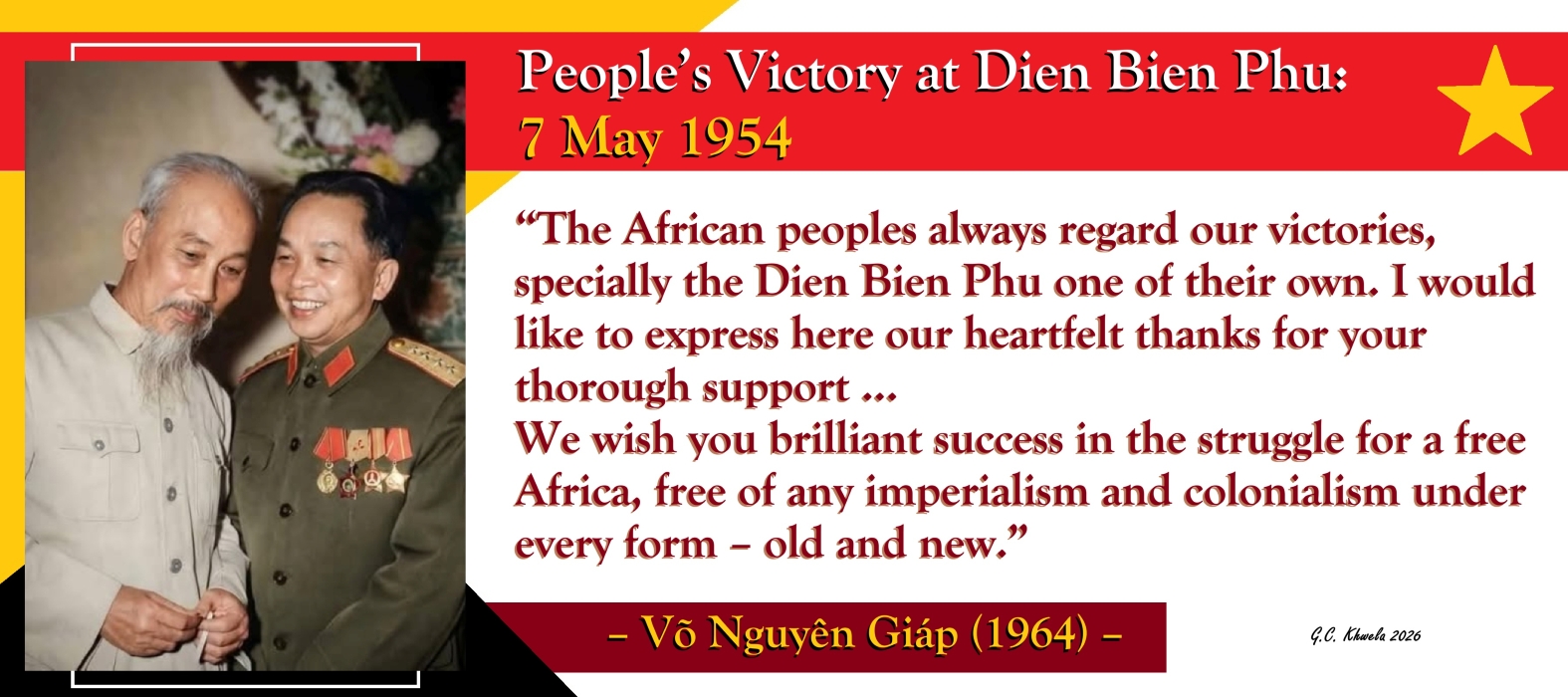
For General Giáp, Dien Bien Phu was not only “a great victory of the Vietnamese people but also a great victory of progressive mankind, of all small and weak nations fighting against colonialism under every form and for independence and freedom, of the forces of socialism, democracy and peace the world over. … The African peoples always regard our victories, specially the Dien Bien Phu one of their own. I would like to express here our heartfelt thanks for your thorough support, formerly during our patriotic resistance as today in the peaceful socialist building in the North and the emancipation struggle of our compatriots in the South. We wish you brilliant success in the struggle for a free Africa, free of any imperialism and colonialism under every form – old and new.”
According to the South African Communist Party (SACP), “The victory of Dien Bien Phu was not a victory for Vietnam alone. It showed the imperialists that they could not continue to rule Asia and Africa as before, in the old way. It was not the same old world; the colonial peoples were resisting foreign rule more vigorously and militantly; they had found powerful new allies in the anti-imperialist countries of the socialist camp.
“After their setback at Geneva”, the SACP averred, “the imperialist countries made haste to carry out a number of strategic retreats in Africa and Asia, ceding formal independence now at the price of retaining a number of economic and strategic strongpoints, rather than to be ignominiously thrown out later after a series of military defeats which would be as damaging to their economy as to their prestige, and from which they could hope to retain little or nothing in the way of influence.”
Moreover, the SACP maintained that “To those Africans who may ask: what has this faraway country of Vietnam got to do with us? We answer: these same Vietnamese peasants, ill-clad and hungry, bought with their lives the independence which so many of our African countries enjoy today. We owe them a debt that can never be repaid.”
ALL FOR THE FRONT! ALL FOR VICTORY!
Sources:
Wikipedia.
South African History Online (SAHO).
General Vo Nguyen Giap, “Dien Bien Phu”, Foreign Languages Publishing House, Hanoi, 1964.
Editorial Notes, “Vietnam and Us”, The African Communist, Number 25, Second Quarter 1966.
LTC Patrick W. Shull, “The Battle of Dien Bien Phu: Strategic, Operational, and Tactical Failure”, U.S. Army War College, 7 April 1999.
History.com Editors, “French Defeated at Dien Bien Phu”, History.com, 09 February 2010.
ADST, “The Fall of Dien Bien Phu and the Rise of US Involvement in Vietnam”, Association for Diplomatic Studies and Training”, March 2014.
Pham Xuan Nam, “Battle of Dien Bien Phu: Victory of Vietnam Culture”, Vietnam Social Sciences, No. 3 (161), 2014.
Bruno Philip, “Battle Against Oblivion: The Defeat That Ended French Colonial Rule in Vietnam”, The Guardian, 1 July 2014.
Greg Mills and Anthony Arnott, “Dien Bien Phu: Sixty Years On”, Daily Maverick, 3 October 2014.
Miles Maochun Yu, “The Lessons of Dien Bien Phu”, Hoover Institution, 22 December 2017.
Mike Hennelly, “The Fortress of Broken Dreams: Strategic Lessons of Dien Bien Phu”, WavellRoom, 10 September 2021.
J. Llewellyn et al, “Dien Bien Phu”, Alpha History 2018, accessed [06 May 2026], https://alphahistory.com/vietnamwar/dien-bien-phu/
Together We Served, “The First Indochina War – The Battle of Dien Bien Phu”, Together We Served, accessed [06 May 2026], https://blog.togetherweserved.com/the-battle-of-dien-bien-phu/
Castro Khwela
Good morning fellow Compatriots!🙏🏾✊🏾👊🏾
Discover more from CASTRO KHWELA
Subscribe to get the latest posts sent to your email.