PW Botha Resigns from the National Party
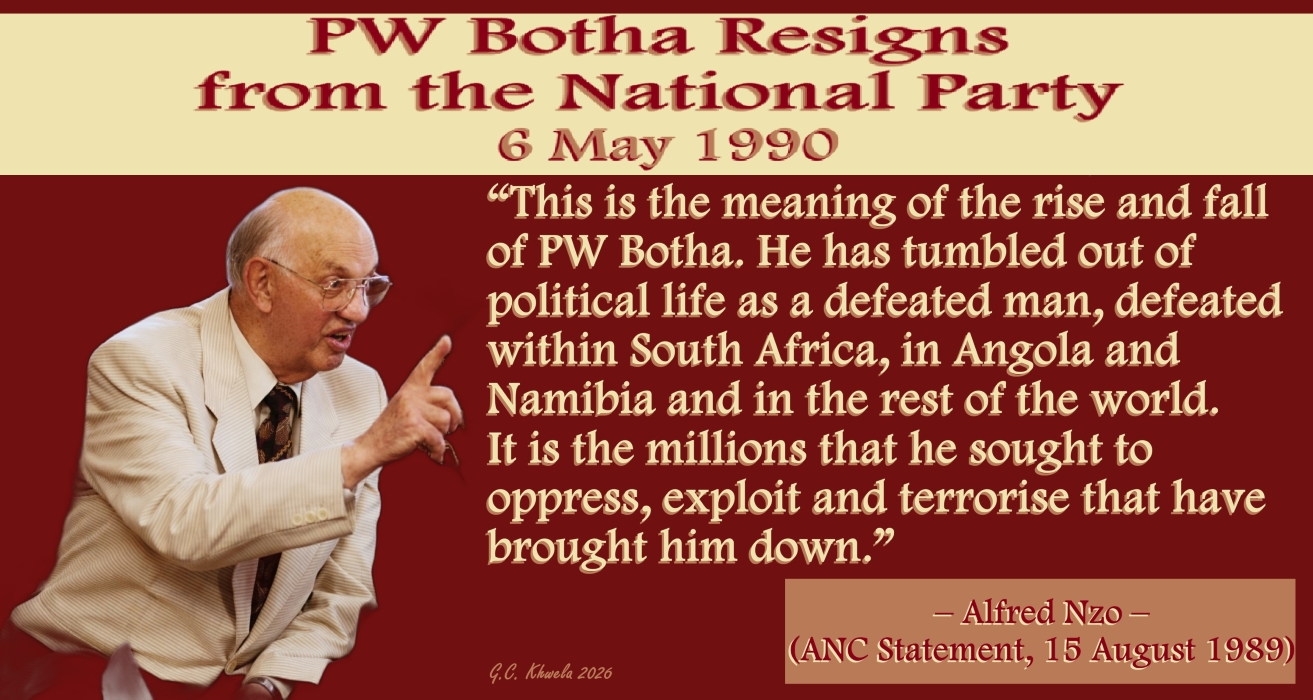
On 6 May 1990, former leader of the National Party (NP) and head of state, Pieter Willem Botha, resigned from the party in protest against President F.W. de Klerk’s reform proposals. On 2 – 4 May 1990, the Groote Schuur talks took place between the apartheid government and the African National Congress (ANC). An agreement was reached about conditions for full-scale negotiations on ending political conflict in South Africa. Following this agreement, on 6 May 1990, P.W. Botha resigned from the National Party in protest against the reform proposals.
Apartheid President Botha’s loss of influence can be directly attributed to the defeat of the apartheid South African Defence Force (SADF) in the Battle of Cuito Cuanavale in Angola on 23 March 1988 and the subsequent decisions taken at the summit between Ronald Reagan and Mikhail Gorbachev in Moscow, from 29 May to 1 June 1988, that paved the way to resolving the problem of Namibia. The issue of Namibia, according to apartheid Foreign Minister Pik Botha, was destabilising the region and “seriously complicating” the major issue which South Africa itself would shortly had to face.
Soviet military aid would cease and Cuban troops and Umkhonto we Sizwe (MK) guerrillas were to be withdrawn from Angola as soon as South Africa complied with United Nations (UN) Resolution 435 by relinquishing control of Namibia and allowing UN-supervised elections there. The Tripartite Agreement, which gave effect to the Reagan-Gorbachev summit decisions, was signed at UN Headquarters in New York on 22 December 1988 by representatives of Angola, Cuba and South Africa.
The South African state was, however in serious trouble. Economic sanctions were causing such severe damage that a political settlement could no longer be evaded. Urged on by astutely mobilised African American opinion, banks and corporations in the United States began to divest themselves of holdings in South Africa. This commercially motivated boycott was the undoing of apartheid, as the rand’s value collapsed. Botha was forced under United States pressure to concede independence to Namibia amid military setbacks in Angola and growing economic problems.
South Africa was finding it ever more difficult to roll over its foreign debt. At the same time the rapid increase of the black population made it imperative for government to find credible black partners that could assist in the administration of the country. Internal black leaders increasingly rejected negotiations unless the African National Congress (ANC) and other extra-parliamentary organisations were unbanned and were allowed to participate.
On 18 January 1989, Botha (then aged 73) suffered a mild stroke which prevented him from attending a meeting with Namibian political leaders on 20 January 1989. Botha’s place was taken by acting president J. C. (Chris) Heunis. On 2 February 1989, Botha resigned as leader of the National Party (NP), anticipating his nominee – Finance Minister Barend du Plessis – would succeed him. Instead, the NP’s parliamentary caucus selected as leader Education Minister F.W. de Klerk, who moved quickly to consolidate his position within the party as a reformist, while hardliners supported Botha.
The relationship of Botha and his ministers steadily deteriorated. A specialist who saw Botha as a patient after his stroke was of the opinion that Botha was undoubtedly not fit to continue in public life. But Botha stayed on and became enraged when ministers no longer asked his permission for official visits to other countries. They in fact had begun to treat him as if he was no longer president. He also became more and more concerned about the direction the NP was heading.
Botha said he had asked the Cabinet what reason he should give the public for abruptly leaving office. Some ministers stated that in calling for his resignation they were motivated by concerns about the President’s health and “They replied I could use my health as an excuse. To this, I replied that I am not prepared to leave on a lie.” Botha stated: “I am of sound health. Is anyone of you prepared to show me a medical certificate which states you are of sound health. How many of you are sitting here with pills in your pockets?”
Botha further scolded his cabinet, “I watch you on television and see how poorly you are preforming. You are apologetic and not willing to fight”. He continued to say, “It is evident to me that after all these years of my best efforts for the National Party and for the government of this country, as well as the security of our country, I am being ignored by ministers serving in my cabinet.” ‘Peevee’ Botha, the bald, bespectacled mandarin of the ultra-right Nationalist Party, whose trademark was a finger-wagging belligerence that earned him the nickname the “Groot Krokodil” (the “Great Crocodile”), was unyielding in his convictions as a crude Afrikaner.
In March 1989, the NP elected De Klerk as State President, but Botha refused to resign, saying that the constitution entitled him to remain in office until March 1990. Botha scoffed at the plea that he should retire. Turning to De Klerk he said: “You should have contested your seat in Vereeniging. You cannot act as if you are President while you are not yet President. He issued a dire warning, “A difficult time lies ahead of you. I pity you. The forces you have unleased will destroy you.”
Following a series of acrimonious meetings in Cape Town, and five days after UN Resolution 435 was implemented in Namibia on 1 April 1989, Botha and De Klerk reached a compromise: Botha would retire after the parliamentary elections in September, allowing de Klerk to take over as state president.
However, Botha abruptly resigned from the state presidency on 14 August 1989, complaining that he had not been consulted by De Klerk over his scheduled visit to see President Kenneth Kaunda of Zambia. Botha declared on nationwide television that “The ANC is enjoying the protection of President Kaunda and is planning insurgency activities against South Africa from Lusaka”.
Pieter Willem Botha was born on the farm Telegraaf in the Paul Roux district of Bethlehem in the Orange Free State, where his father, labelled as a “bitter-ender”, who had fought the British to the last gasp of the Boer war, was a horse farmer. PW Botha attended secondary school in Bethlehem before entering the University of the Orange Free State in Bloemfontein to study law. It was here that his political career began. Initially he helped organise the National Party (NP) during by-election campaigns and also became campus branch chairman.
The young PW, as he was usually known, inherited the sour, bullying, Anglophobic obduracy that became his trademark from his parents, especially since his mother was interned in one of Lord Kitchener’s concentration camps. He joined the pro-Nazi “Ossewabrandwag” (the Ox-wagon Guard) movement in 1939, but never over-burdened with moral courage, found it too risky and left after two years, avoiding internment. He was also a part-time reporter for ‘Die Volksblad’ newspaper and a member of the ‘Afrikaanse Nasionale Studentebond’ (National Afrikaans Student Association). At the age of twenty he delivered an address to Prime Minister D.F. Malan during his visit to the campus.
Malan was impressed and Botha was offered a post as party organiser in the Cape. He left the university before completing a degree in order to begin a full-time political career, a decision made when he was only 20 years old. He began working for the National Party as a political organiser in neighbouring Cape Province. Botha was already active in the Afrikaner National Party (NP) and became a politician all his adult life. He was Member of Parliament for the Cape Province constituency of George when the NP won power in the white electoral landslide of 1948.
During his early years as Defence Minister, Botha gained a reputation for toughness as well as for efficient administration. These qualities pushed him to the fore when Prime Minister B. J. Vorster unexpectedly resigned in 1978. At this time, Botha was also prominent as the Cape provincial leader of his party. Nevertheless, his elevation to the premiership on 28 September 1978, was to some degree unexpected and aided by a well-publicised scandal in the Department of Information. This fatally compromised the reputation of its minister, Connie Mulder, another serious contender for the position and then the National Party’s leader in the important Transvaal province.
Following a series of speeches, Botha seemed to try to direct the country into reformist paths and away from the racial Apartheid which had been an article of faith for the National Party since 1948. The new prime minister told his fellow Whites that they would have to “adapt or die”. Botha attempted to modify the Apartheid tenets of Afrikaner Nationalist ideology to introduce reforms, appearing to offer a better deal to the population. But he was contemplating the impossible by trying to find a way of sharing power without the White minority losing control.
He set in motion the dismantling of some Apartheid legislation, thereby irreversibly dividing National Party support. Furthermore, he did not award Coloured and Indian moderates with real partnership in the new Tricameral Parliament. The consequences were a changing and increasingly volatile South African society, which led to the civil insurrection of 1984 and its repercussions around the country. Botha’s response was the repression of activists and liberation movements under a state of emergency. The reform policy stagnated.
Apartheid’s policies drew increasing condemnation from the outside world, giving Botha little room to manoeuvre and less freedom to compromise. Apparently abandoning the idea of consensus, he took more and more power to himself in a style of government that came to be termed “imperial”. His uncompromising policies greatly polarised his own party’s views and eventually led to feuding within the National Party. In February 1989, he suffered a mild stroke and, caving in to cabinet pressure, resigned.
De Klerk was sworn in as acting state president on 14 August 1989 and a month later succeeded Botha in a five-year term as state president. De Klerk soon announced the removal of legislation against anti-apartheid groups – including the unbanning the ANC, the Pan Africanist Congress (PAC) and the Communist Party (SACP) – and the release of Nelson Mandela. De Klerk’s term saw the dismantling of the apartheid system and negotiations that eventually led to South Africa’s first racially inclusive democratic elections on 27 April 1994.
In retrospect, PW Botha’s resignation from the National Party (NP) on 6 May 1990 was a protest action against the rapid dismantling of apartheid by his successor, FW de Klerk. The protest was against De Klerk’s unbanning of the liberation movements and the move to release Nelson Mandela. His departure solidified the divide between the conservative elements and the so-called reformist wing of the National Party, thus marking a final, symbolic break between the old, hardline apartheid era and the new, reformist direction of the National Party.
Botha’s resignation – occurring months after he had already stepped down as State President – served as a symbolic and practical clearance of the path for the national liberation movement led by the ANC. While Botha had initiated the first secret talks with Nelson Mandela, his final break from the party removed the most prominent internal obstacle to full-scale negotiations. The ANC viewed Botha’s departure as evidence that the racist rule was in irreversible decline. His resignation, spurred by his opposition to FW de Klerk’s reforms, confirmed to the liberation movement that their years of mass action, the armed struggle, the underground and international pressure had successfully fractured the ruling racist elite.
For the ANC, Botha’s resignation allowed the Movement to frame the transition as a victory for the people’s natural right to revolt. It shifted the political landscape from one of state security and “total onslaught” to one of political legitimacy and conventional diplomacy. Rather than seeing the resignation as a reason to relax, the ANC used the political instability within the National Party as a signal to intensify the struggle on all fronts to ensure the government did not stall on its promises of universal suffrage.
In a statement issued by Secretary General, Alfred Nzo, the ANC said: “Steeped in the ideology and policies of racism and racial domination, he (Botha) dedicated his life to the construction of the apartheid system and its defence at all costs. In pursuit of these goals, he has brought death and destruction to millions of people in South Africa and the rest of the region of Southern Africa, through a systematic campaign of brutal repression, aggression and state terrorism. He deliberately prepared for this campaign, aimed at ensuring the survival of the apartheid system, by building the racist South African army and training it to be an instrument of murder and pillage. He elevated this war machine into the highest executive echelons of the apartheid state to enable it to carry out its campaign of terror without let or hindrance.”
According to the Statement, “The bitter fruits of those preparations are the countless graves of innocent men, women and children that cover the face of Southern Africa … These will remain forever as monuments to the apartheid crime against humanity in the same way that Buchenwald and other concentration camps continue to remind the world of the Nazi crime against humanity. These will become monuments because apartheid has no future. This is the meaning of the rise and fall of PW Botha. He has tumbled out of political life as a defeated man, defeated within South Africa, in Angola and Namibia and in the rest of the world. It is the millions that he sought to oppress, exploit and terrorise that have brought him down.”
Sources:
South African History Online (SAHO).
Weekly Mail Reporters, “PW Stuns the Nats”, Mail & Guardian, 3 February 1989.
Alfred Nzo, “Statement of the African National Congress on the Resignation of PW Botha”, Lusaka, Zambia, 15 August 1989.
Jan-Ad Stemmet and Leo Barnard, “See no Evil, Hear no Evil, Speak and Publish no Evil: The Relationship between P.W. Botha and the Pro-establishment Afrikaans Press during the 1980s”, Historia, Vol. 49, No. 1, May 2004.
Adam Bernstein, “P.W. Botha: President of Apartheid-Era South Africa”, The Washington Post, 31 October 2006.
Dan van der Vat, “Obituary P.W. Botha: Former Leader of South Africa, Committed to State Terrorism and Murder to Stop Majority Rule”, The Guardian, 2 November 2006.
Jan Heunis, “The Inner Circle: Reflections on the Last Days of White Rule”, Jonathan Ball, 2007.
T.A. Machaba, “American Press Reportage on PW Botha’s Attempts at Reforming Apartheid, 1978-1989, With Specific Reference to the New York Times, Newsweek and Africa Report”, Southern Journal for Contemporary History, Vol. 36, No. 1, 30 June 2011.
Caxton Central, “On This Day in History: PW Botha Resigned from the NP”, Germiston City News, 6 May 2016.
Hermann Giliomee, “1989: The Crucial Year”, Politicsweb, 03 December 2020.
Castro Khwela
Good morning fellow Compatriots!🙏🏾✊🏾👊🏾
Discover more from CASTRO KHWELA
Subscribe to get the latest posts sent to your email.