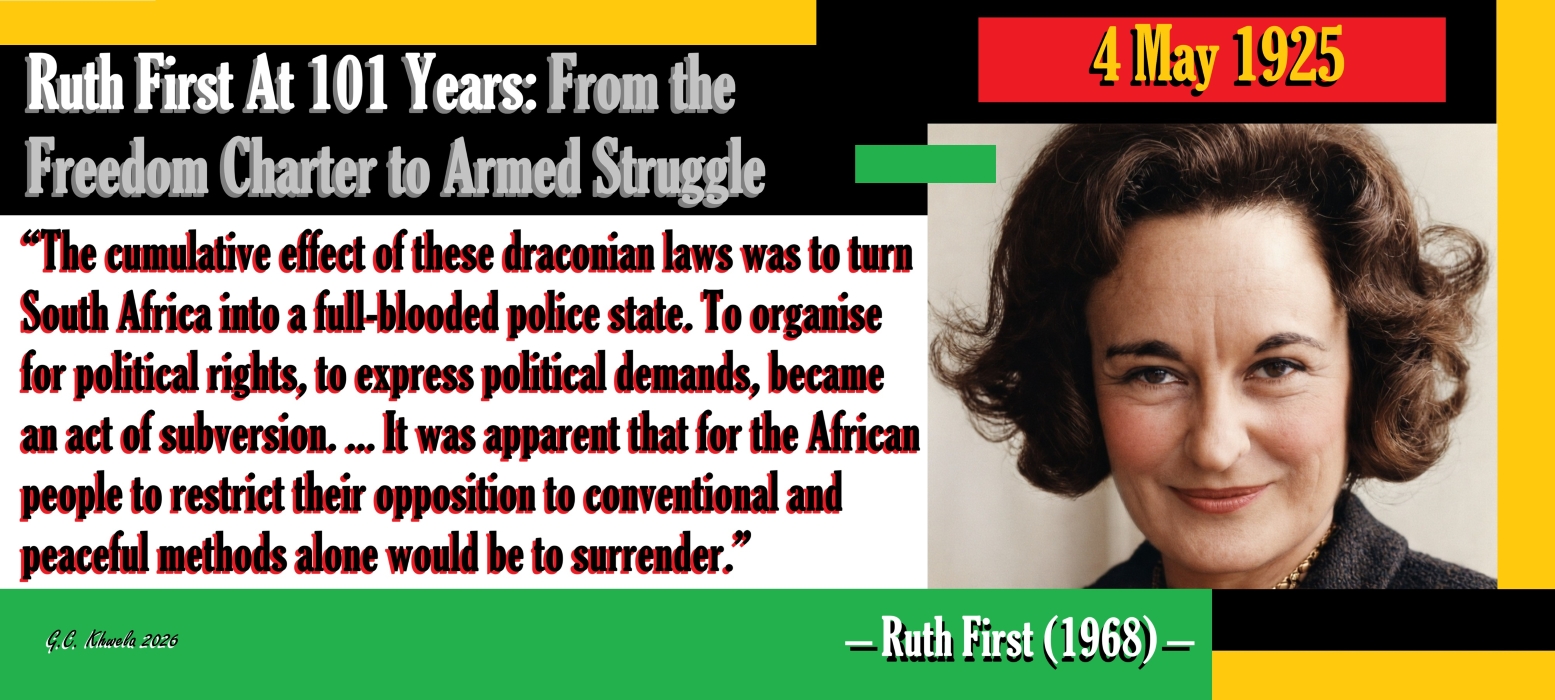
Ruth First At 101 Years: From the Freedom Charter to Armed Struggle
(Heloise Ruth First would have turned 101 years today, as she was born on 4 May 1925 in Johannesburg. In recognition of her birthday, we are posting one of Ruth First’s seminal writings, titled “From the Freedom Charter to Armed Struggle”, which was penned in 1968 in in her Selected Works published in September 2022).
The launching of armed struggle against the South African regime must be seen against the total background: the history of South Africa is one of organised violence applied against the majority of the people. First, the violence of military conquest over three centuries (the last act of armed resistance was the Bambatha Rebellion at the beginning of this century in Natal), and then the institutionalised violence of a political system which entrenches a minority in power against the will and the interests of a majority that outnumbers them four to one.
The history of South Africa is also one not of a steady or even gradual devolution towards greater fights for the majority, but of a progressive loss of rights, the abolition of what limited franchise existed as a hangover from Cape liberalism of the nineteenth century, and a consistent undermining and finally abolition of the right of the individual to advance his civil liberties and living standards through the courts and the use of the rule of law, or by political or trade union organisation.
Non-violent protest was a tenet of the Congress movement for the greater part of its history, from the foundation of the African National Congress (ANC) in 1912. The late Chief Luthuli put the seal on this early period. “Who will deny,” he asked in October 1952, “that 30 years of my life have been spent knocking in vain, patiently, moderately and modestly on a closed and barred door? What have been the fruits of moderation? The past 30 years have seen the greatest number of laws restricting our rights and progress until today, we have reached the stage where we have almost no rights at all.”
The immediate post-World War II period was a time of great economic hardship for the African people, and also of a great spurt of organisation, in trade unions and mass political movements. But the policy of the Government was to “bleed the unions to death” (the words of a South African Minister of Labour), and to repress the political upsurge. The first years of the Nationalist Government in power were a taste of things to come: there was a great spurt of repressive legislation from the all-White Parliament and one after another the few remaining rights of the Non-White people came under attack. The legislative record of the Nationalist Government has been well documented elsewhere. So, too, has the growth in strength and influence of the resistance movement, that mustered great national protest strikes and an impressively disciplined Defiance Campaign against Unjust Laws during which 8,500 volunteers courted imprisonment in order to draw attention to the seething bitterness of the Non-White people and the urgency of their claim.
The campaigns of the fifties were the years of mass mobilisation of the Africans, the Indian people and the Coloureds, with the support of a small sprinkling of anti-racial Whites, and also of the hammering out of a programme of aims and demands for the liberation movement of South Africa. This latter objective culminated in the Congress of the People, held at Kliptown, outside Johannesburg, on 26 June 1955. The Congress was the climax of months of organising in villages, factories, mines and townships to get ordinary people to speak out their demands for freedom. They wrote their grievances and their demands in resolutions taken at unknown hundreds of meetings, then elected delegates to come in person to the mass conference that adopted the Freedom Charter. Its demands are well-known, in general:
“South Africa belongs to all who live in it, black and white.
No government can justly claim authority until it is based on the will of the people.
The people shall govern.
All national groups shall have equal rights.
The land shall be shared among those who work it.
All shall be equal before the law.
There shall be work and security.
The doors of learning shall be opened, and so on.”
The Freedom Charter was the first policy document of the mass movement of oppressed people to set out objectives for a non-racial democratic South Africa.
The Government retaliated with the mass arrest of political leaders of all races. Twenty days before Christmas 1956, the Treason Trial opened. One hundred fifty-six political leaders of all races were in the dock. The State charged them with a treasonable conspiracy to overthrow the South African government by violence. The focus of the case was ANC policy from 1952 to 1956, and every document written by or in possession of every one of the 156 was studied minutely and presented as part of the case for prosecution. The trial went on for over four years and eventually collapsed. All 156 were found not guilty and discharged. The State evidence alleging violence had been manufactured. This was the most ignominious defeat of the government in the courts and before the eyes of the world. From then on, the South African government began steadily to circumscribe the powers of the judiciary, to break what independence it had left, and acted beyond the law by edict and ministerial decree.
While the Treason Trial was still in progress, the country was shaken by the events of Sharpeville in 1960. In March of that year, the police opened fire on mass anti-pass protests in two centres, at Sharpeville in the Transvaal, where 69 were killed and 180 wounded, and at Langa in the Cape, where two died, and 49 were wounded. The ANC called for a national strike as a day of mourning. The government wavered for a moment with its announcement that the pass laws would be suspended, and Chief Luthuli burnt his pass, followed by thousands of others. The government declared a national emergency, and the ANC and the Pan-Africanist Congress were banned. Eighteen hundred political leaders were imprisoned for the duration of the state of emergency.
The following year, 1961, was when White South Africa was preparing to hold a referendum to declare itself a (White) Nationalist Republic. An ad hoc committee of African leaders (that took the initiative because the organisations of the African people were banned) summoned an all-in conference in Pietermaritzburg for March 1961 to draft a non-racial constitution for South Africa and to reinforce its demand that the vote be extended to all without discrimination. The demand was backed by the calling of a national protest strike. The government answered the strike with the country’s biggest mobilisation since World War II, as the army and police staged an unprecedented display of armed force to strangle the strike at birth. But for all that, the stay-at-home received solid and massive support throughout the country. It was at this point that Nelson Mandela, who had led the strike from underground, posed the question:
“Is it politically correct to continue preaching peace and nonviolence when dealing with a Government whose barbaric practices have brought so much suffering and misery to Africans? … Have we not closed a chapter on this question?”
The smashing of the strike – with Saracens [armoured personnel carriers] made in Britain – was the turning point in the political struggle. Africans had decided that the violence of the State made peaceful protest futile.
For the fifties had seen, along with the sharpening of African claims and the maturing of their political organisation, a steady attack on their rights to organise. This started with the Suppression of Communism Act in 1950, which gave the Minister of Justice autocratic power to ban any organisation, newspaper, individual or policy. Bans on trade unionists and political leaders, which were initially for two years, were extended to five. Men and women were restricted to certain magisterial districts, townships and, ultimately, under the ‘Sabotage Act of 1962’, to their own homes. They were forbidden to enter factories or harbour areas, to attend meetings, to write for publication, to enter newspaper offices, to belong to any organisation which discussed the affairs of the state, to communicate with other banned individuals or be seen in the company of more than one other person, for this was construed as an illegal gathering. Opposition members who had outspokenly expressed their views were sentenced to a state of civil death, and the political movement was drained of its activists for one transgression or another of a myriad of legal restrictions.
From 1953 onwards, the government had empowered itself to suspend all law and rule by decree in a state of emergency. These emergency powers were used not only to crack down after Sharpeville, but also against the peasant revolt in Pondoland, and to this day, Proclamation 400 in the so-called independent Transkei enables the government to detain anybody for any length of time.
The cumulative effect of these draconian laws was to turn South Africa into a full-blooded police state. To organise for political rights, to express political demands, became an act of subversion. Political expression was driven underground, and political organisation was pursued at the peril of victimisation, arrest and imprisonment. It was apparent that for the African people to restrict their opposition to conventional and peaceful methods alone would be to surrender. The more the political organisations proved their ability to rally the African people behind them, the more savage the repression unleashed against them. A dead-end of continuing oppression and discrimination seemed to stretch before the country.
On 16 December 1961, uMkhonto we Sizwe (The Spear of the Nation) emerged with a series of attacks with explosives against government buildings, particularly those connected with the implementation of apartheid, and a manifesto that overnight was pasted on the walls of city buildings:
“The people prefer peaceful methods of change to achieve their aspirations without the bitterness and suffering of civil war. But the peoples’ patience is not endless … The Government has interpreted the peacefulness of the movement as weakness; the peoples’ non-violent policy has been taken as the green light for government violence … without any fear of reprisals. uMkhonto we Sizwe marks a break with the past. We are striking out along a new road for the liberation of the people. The government policy of force, repression and violence will no longer be met with non-violent resistance only! … uMkhonto we Sizwe will be at the front line of the peoples’ defence. It will be the fighting arm of the people against the government.”
uMkhonto we Sizwe was to complement the actions of the established national liberation movement. The new movement, despite its military character, announced that it did not abandon the hope and prospect of change without violence in South Africa:
“We of uMkhonto we Sizwe have always sought, as the liberation movement has sought, to achieve liberation without bloodshed and civil clash. We hope – even at this late hour – that our first actions will awaken everyone to a realisation of the disastrous political situation to which Nationalist policy is leading. We hope that we will bring the government and its supporters to their senses before it is too late, so that both the government and its policies can be changed before matters reach the desperate stage of civil war. We believe our actions to be a blow against the Nationalist preparations for civil war and military rule.”
So long as there remained the slightest possibility of forcing a reconsideration of intransigent official policies, uMkhonto we Sizwe stressed, the armed struggle would remain the supplementary, not the main form of struggle, and the people would, side by side with uMkhonto actions, strive as before to find every means at their disposal to win democratic change by the methods of mass action.
The government answered the formation of uMkhonto we Sizwe with the ‘Sabotage Act’, the General Laws Amendment Act of 1962. It created retrospective offences for which people could receive the death penalty, it provided for the indefinite detention of political prisoners – the 90-day Law, which was suspended in January 1965 but replaced some months later by the 180-day detention powers – and defined sabotage as almost any illegal action taken to further economic or political changes. Since practically every sort of political activity was by now unlawful, a trade unionist trespassing on factory premises or an African taking part in a strike could find himself accused of sabotage.
The International Commission of Jurists condemned the law as reducing the liberty of the citizen to a degree not surpassed by the most extreme dictatorship.
Ninety-day detention inaugurated the official use of torture by the state. Where solitary confinement did not have the desired effect of manufacturing confessions out of prisoners or forcing them into becoming state witnesses, the Security Police resorted to torture – the statue torture, use of electric shock treatment, and other forms.
The effect of this and other laws was to cram the jails with political prisoners. The wave of repression was nowhere more cruelly administered than in the Eastern Cape, a stronghold of ANC militancy, where, in the space of two years, the Security Police arrested over 1,000 people. Mass arrests, mass trials and the mass dispensation of ‘justice’ became the order of the day. The State relied for its evidence increasingly on police traps, informers, and the brute extraction of confessions. According to the figures of the Minister of Justice, 3,335 South Africans were detained under various security laws in 1963. According to calculations by a South African newspaper, between March 1963 and August 1964, there were 111 mass political trials in which 1,353 persons were charged. Of these, 44 were sentenced to death and 12 to life imprisonment and 894 to a total of 5,713 years of imprisonment. Among the first casualties of the death penalty for sabotage were Vuyisile Mini, the dockers’ leader, and Khayinga and Mkaba, who were hanged in 1964.
On 11 June 1963, the police raided the underground headquarters in Rivonia, a suburb in Johannesburg, and arrested Walter Sisulu, Govan Mbeki, Ahmed Kathrada, and others. The prolonged Rivonia Trial of the nine leaders of the ANC ended in the conviction of life imprisonment of these men, all now on Robben Island. From the dock, Nelson Mandela said:
“I admit I was one of the persons who helped to form uMkhonto we Sizwe. I do not deny that I planned sabotage. I did not plan it in a spirit of recklessness or because I have any love of violence. I planned it as a result of a calm and sober assessment of the political situation that had arisen after many years of tyranny, exploitation and oppression of my people by the Whites.”
The events of the early sixties had convinced the African political movement that no possible prospect remained of effecting change in South Africa by peaceful means. Constitutional, parliamentary action has never been open to the African majority. Demonstrations, petitions, massive organisation to prove the representativeness and popular support of the organisations, passive resistance campaigns influenced by Gandhism, uniquely South African-evolved nonviolent campaigns, and even the warning shots fired by uMkhonto we Sizwe in its selected sabotage action had left the granite wall policy of apartheid and White supremacy rule unyielding and impregnable.
On 13 August 1967, advance units of uMkhonto we Sizwe, together with fighters of the Zimbabwe African Peoples Union (ZAPU), opened a new chapter of resistance in Southern Africa. Advance units engaged the Rhodesian security forces in fierce fighting at Wankie and other areas. Three pitched battles that month were followed by sporadic engagements, a steady penetration of guerrilla forces into Rhodesia and towards South Africa, and the opening of a second major assault phase from 15 March this year (1968). The South African Sunday Times has admitted that “the guerrilla campaign is now a full-scale war of attrition”.
The Lusaka communique that announced the start of the fighting officially broadcasted the existence of a military alliance between the ANC and ZAPU. This sets a precedent in African resistance, for there is no other instance of freedom fighters drawn from different territories uniting in a common force. Oliver Tambo, ANC Acting President-General, has said that the joint ANC-ZAPU action was to meet the unified strategy of the Unholy Alliance of Vorster-Smith-Salazar:
“We are fighting the same enemy ultimately. Our military cooperation flowed from the political cooperation with which we answered the common repression of white minority governments in the South.”
Source:
Ruth First, “‘From the Freedom Charter to Armed Struggle’ in Selected Writings”, International Union of Left Publishers, September 2022, pp. 35 – 45.
Castro Khwela
Good morning fellow Compatriots!🙏🏾✊🏾👊🏾
Discover more from CASTRO KHWELA
Subscribe to get the latest posts sent to your email.