Pietermaritzburg Ten on Trial for Revolutionary Activism
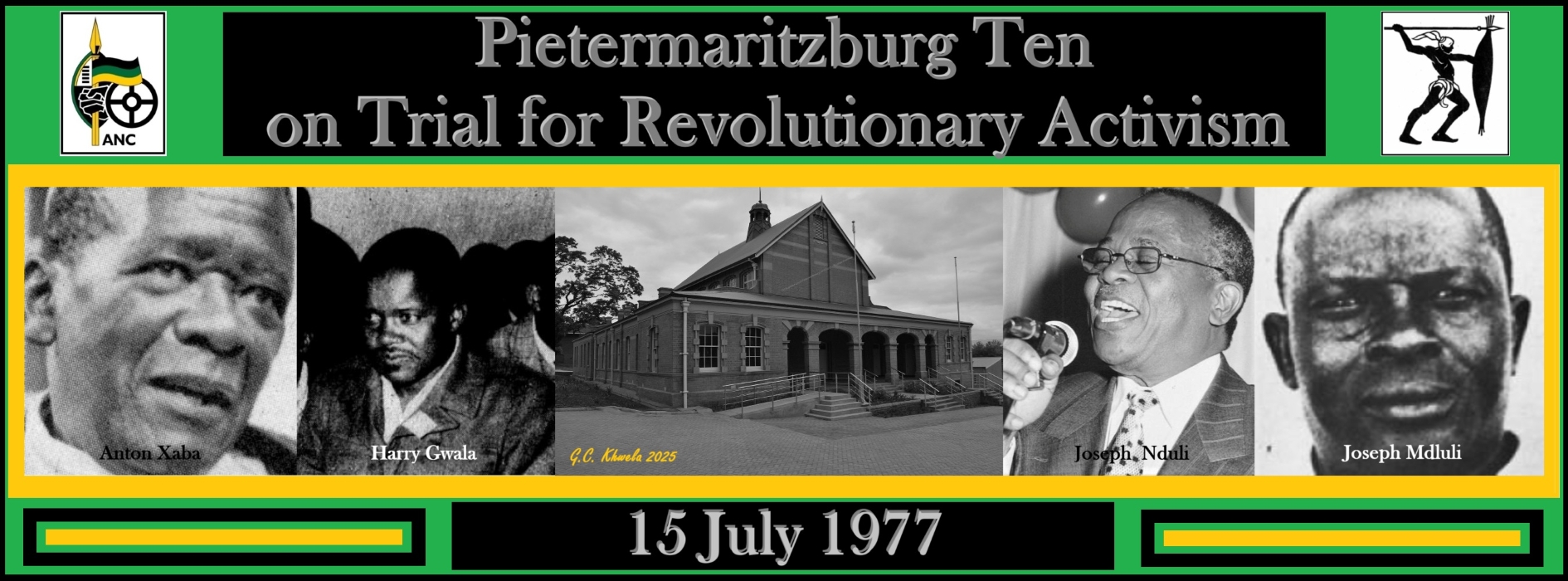
On 15 July 1977, a 532-page judgment was eventually concluded regarding the trial of ten revolutionary cadres of the African National Congress (ANC) and the People’s Army, Umkhonto we Sizwe (MK), in the Natal Provincial Division of the Supreme Court in Pietermaritzburg. The trial, which became colloquially referred to as the “Pietermaritzburg Ten Trial” or the “Harry Gwala Treason Trial”, the latter being based on the trial being registered as the “State v Harry Gwala and 9 others”, began on 14 May 1976, when all ten accused were held incommunicado for the duration of their detention until they were brought before the court.
Despite the defence’s argument that Gwala and other accused had not participated in the recruitment of people to undergo military training outside the country, the judge found that “it had been proven beyond reasonable doubt that Gwala and other accused received subversive literature and letters which referred to the recruitment of youth for training in Mozambique”. Furthermore, the judge found that Gwala had “committed a conspiracy when he procured Mandla Sikhosana, Edgar Zondi, Mtu Khumalo, R. M. Hadebe, Vicky Khumalo, Caiphas Nene and George Mkhize to undergo military training abroad”. With the exception of William Fano Khanyile, who was acquitted of all the charges, all the other accused were found guilty.
All the accused appeared briefly on the morning of 25 July 1977 to plead in mitigation of sentence, and the judge handed down the sentences on the same afternoon. Themba Harry Gwala was sentenced to life imprisonment; Anton Ndoda Xaba, life imprisonment; Matthews Makholeka Meyiwa, life imprisonment; John Vusimuzi Nene, life imprisonment; Zakhele Elphas Mdlalose, life imprisonment; Vusimuzi Truman Magubane, 15 years’ imprisonment; Joseph Ntuliswe Nduli, 15 years’ imprisonment; Cleopas Melayibone Ndhlovu, ten years’ imprisonment; and Azaria Ndebele, seven years’ imprisonment.
It all began on the morning of 30 November 1975, when members of the Security Branch arrested Gwala at his house together with his wife, Elda, for “participating in terrorist activities in contravention of the Terrorism Act of 1967 as amended”. They were taken to the Security Branch section on the second floor of Loop Street Police Station, where they were separated, severely tortured, and kept in solitary confinement. Gwala was subsequently moved to the Town Hill Police Station, which was mainly for “cooperative” detainees. However, after it became clear that he was “not willing to cooperate” with his interrogators, he was sent back to Loop Street. By the end of January 1976, Gwala had been tortured to the extent that he applied to have his “will drawn up as he feared” for his own health and his life as well as those of his family.
Anton Ndoda “Mfenendala” Xaba was also arrested on 30 November 1975, and he told the Truth and Reconciliation Commission (TRC) that police surrounded his house, rounded up all six members of his family and took them to Loop Street Police Station. Xaba said he was taken upstairs where he was systematically assaulted, tortured and interrogated for two days. He bled heavily and lost consciousness a number of times. His torture included being dangled out of the window by his feet while the policemen swung him backwards and forwards and banged his head against the wall. His arm was broken in the process. At one point during the torture, he said he could hear the screams of his wife in the adjoining room. On his second day of torture, Xaba’s hands were cuffed behind his back and he was suspended from the ceiling like “meat in the butchery”.
From 30 November to 19 December 1975, over 20 people were arrested and placed in solitary confinement in connection with their involvement in the Gwala and Jacob Zuma network. Besides those who later became the accused, Herold Bekisisa Nxasana, Abion Alfred Duma, Sylvia Ntombikayise Gamedze, Peter Bhekimpi Gamedze, Moses Bhengu and Sipho Kubheka were also arrested, tortured and were later turned into state witnesses.
Meanwhile, as the Security Branch assembled a team of senior officers from Natal and Johannesburg to detain all those suspected of being involved in the Gwala and Jacob Zuma network, Zuma managed to escape the country to Swaziland in December 1975. As the raids continued, the Security Branch detained Joseph Mdluli on 18 March 1976 and proceeded to torture him to death within 24 hours.
Over 50 people who were suspected of involvement in the Gwala and Zuma network had been detained by the Security Branch towards the end of February 1976. Despite the fact that Jacob Zuma had left the country, the Security Branch was still determined to detain Joseph Nduli and Cleopas Ndhlovu, even though they had been provided political asylum in Swaziland. On 18 March 1976, Zuma gave R10 000 to Samson Lukhele, which he was supposed to give to Joseph Mdluli. Zuma was not aware that Lukhele had become a turncoat.
Once Mdluli had been murdered, on 25 March 1976, Lukhele made a scam arrangement with the Security Branch to give back the money to Joseph Nduli and Cleopas Ndhlovu and hand over another group of recruits from Natal. Nduli and Ndhlovu went to the spot at the border fence where they had agreed to meet. However, to their astonishment, people started to emerge from the vehicle, climbed through onto the Swaziland side of the fence, and apprehended them.
After the arrest of Joseph Nduli and Cleopas Ndhlovu, the state consolidated its charged sheet and issued an indictment with Gwala as accused number one. All ten accused were held without any communication with each other or the outside world for the duration of their detention until they were brought before the court in May 1976.
The accused were all kept in different police stations: Harry Gwala was kept at Townhill Police Station, John Nene, Anton Xaba and Azaria Ndebele at Loop Street, Truman Magubane at the Howick Police Station, Joseph Nduli and Cleopas Ndhlovu at the Alexandra Street Police Station, William Khanyile at Umbilo, while Mathews Meyiwa was at Wartburg and Zakhele Mdlalose at the Greytown Police Station. By detaining the accused in various police cells and different police stations far removed from their families, the state was trying to mitigate the risk of the accused presenting a unified, well considered legal defence.
As the trial proceeded, the prosecutor argued that during the period 1 November 1973 to 25 March 1976, Harry Gwala and other accused had been members or active supporters of the ANC. Through their involvement they had “sent or received messages to or from representatives of the ANC in Swaziland”. Furthermore, the state argued that they had received “subversive literature from members of the ANC in Swaziland” and they distributed and studied its content.
The state’s narrative was centred on the allegation that Gwala and other accused conspired to overthrow the government by “procuring people to undergo training outside the borders of the Republic”. The coercive and punitive capacity of the state became evident as its list of state witnesses comprised collaborators, “askaris” and persons who had been detained in solitary confinement for over three months, and who had been severely tortured, and turned into state witnesses.
The state’s “outstanding” witnesses were Leonard Nkosi and Bruno Mtolo, who were known turncoats, with Mtolo being their “star” witness, whom the judge referred to as “a skilled and reliable witness”. Bruno Mtolo had testified during the Rivonia trial (1963 – 64), the state trial of Billy Nair, the trial of Curnick Ndlovu and 17 others in 1964, and the state trial of Gwala, again in 1964. Leonard Nkosi, on the other hand, left South Africa in 1963 to undergo military and political training with MK. He was one of the commanders, a leader, in the Luthuli Detachment and allegedly a renowned sniper in the Wankie Campaign. Nkosi had surrendered to the Security Branch in 1967, and it was believed that he worked as an “askari” and later joined the Security Branch. On 9 September 1977, shortly after testifying against Gwala and nine others, Nkosi was assassinated.
As the accused appeared on the morning of 25 July 1977 to plead in mitigation of sentence, and for sentencing on the same afternoon, the judge maintained that “in view of the nature of their crimes, they must be sentenced to long terms of imprisonment, but in their cases the punishment must be designed to reform as well as to prevent and deter”.
After hearing the grounds for appeal on 28 July 1977, the judge maintained that he was convinced that the accused showed no remorse for their actions and was not persuaded that there had been misdirection in the case. He therefore did not accept the defence submission that the sentences were “disturbingly inappropriate or severe as to induce a sense of shock”. While he agreed that the sentences indeed were severe, he was convinced that the severity was justifiable and dismissed the application for leave to appeal.
The ANC responded to these developments by stating that “the trial also revealed once more that the African National Congress fights on, and will not be put down even after 15 years of special branch informers, torture and murder”. In a message of the National Executive Committee (NEC) issued during the same period, the ANC declared that “A revolutionary organisation like the African National Congress has the necessary experience of many decades of revolutionary struggle. Our organisation enjoys the support of the masses of our people and that of the whole progressive democratic mankind. It therefore has the most reliable compass to steer our struggle to the shores of victory.”
Sources:
Wikipedia.
South African History Online (SAHO).
South African History Archive (SAHA).
Lucas Dladla, “Heroes of our Revolution: Joseph Mdluli (1925 – 1976)”, Dawn: Official Journal of Umkhonto we Sizwe (MK), Vol. 7 No. 4, 1983.
Sechaba Correspondent, “Pietermaritzburg Ten on Trial for ANC Activism”, Sechaba, Vol. 11, First Quarter, 1977.
Jabulani Sithole and Sifiso Ndlovu, “The Revival of the Labour Movement, 1970 – 1980”, In Sadet, “The Road to Democracy in South Africa”, Volume 2, Zebra, 2004.
Hugh Macmillan, “The Lusaka Years: The ANC in Exile in Zambia 1963 to 1994”, Jacana, 2013.
Thula Simpson, “Umkhonto we Sizwe: The ANC’s Armed Struggle”, Penguin, 2016.
Gregory Houston, “The Post-Rivonia ANC and the SACP Underground”, Human Sciences Research Council, January 2004.
Mxolisi Dlamuka, “Harry Gwala, Political Militancy and State Trials, 1960 – 1977”, University of the Western Cape History Department, 1990.
Truth and Reconciliation Commission (TRC), “State and Allied Groupings: Torture in Custody”, TRC Final Report, Vol. 3, Chapter 3, 29 October 1998.
Castro Khwela
Good day fellow Compatriots!
Discover more from CASTRO KHWELA
Subscribe to get the latest posts sent to your email.