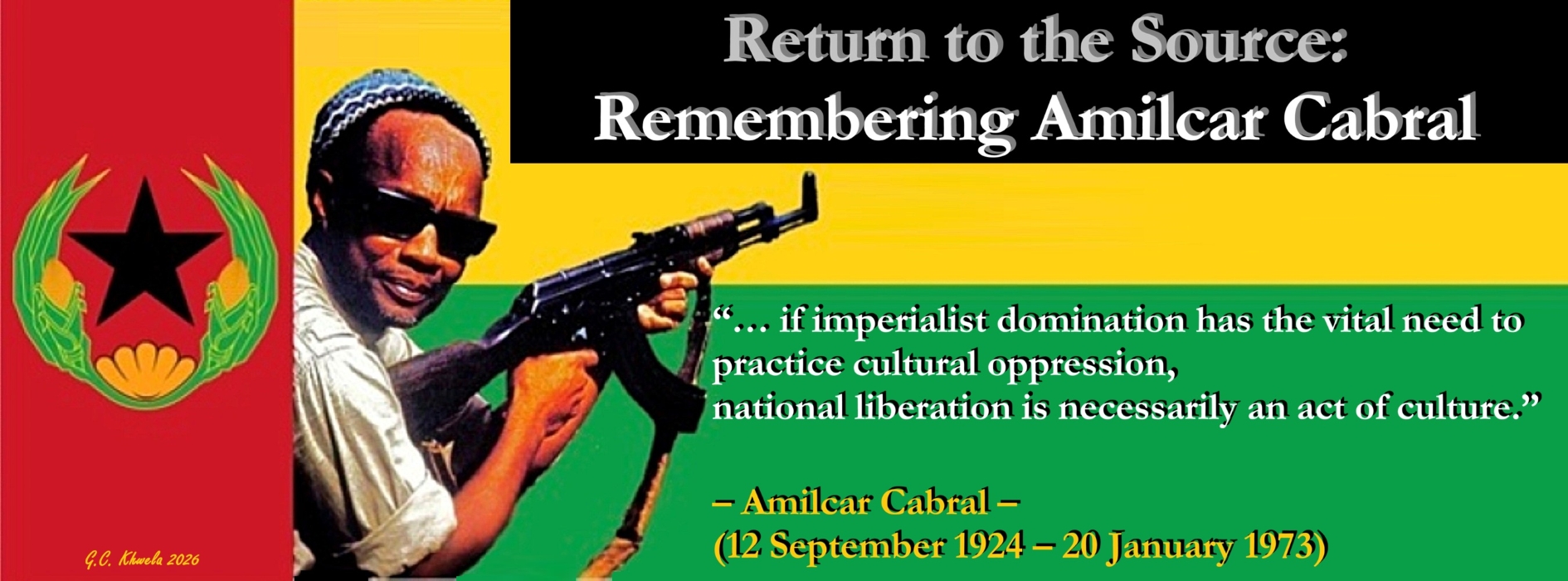
Return to the Source: Remembering Amilcar Cabral
“A people who free themselves from foreign domination will be free culturally only if, without complexes and without underestimating the importance of positive accretions from oppressor and other cultures, they return to the upward paths of their own culture, which negates both harmful influences and any kind of subjection to foreign culture. Thus, it may be seen that if imperialist domination has the vital need to practice cultural oppression, national liberation is necessarily an act of culture.”
“PENSAR PARA AGIR E AGIR PARA MELHOR PENSAR!”
“THINK IN ORDER TO ACT, OR ACT IN ORDER TO THINK BETTER!”
– Amilcar Cabral –
(12 September 1924 – 20 January 1973)
Amílcar Lopes Cabral, born on 12 September 1924, was a Bissau-Guinean and Cape Verdean agricultural engineer, and was widely known as one of Africa’s foremost revolutionary political organisers, an anti-colonialist, anti-imperialist pan-Africanist and intellectual nationalist revolutionary theoretician and poet.
He was also known by the nom de guerre “Abel Djassi”, who led the PAIGC (African Party for the Independence of Guinea and Cape Verde), a revolutionary nationalist movement for the liberation of Guinea-Bissau and the Cape Verde Islands from Portuguese colonialism, and Commander-in-Chief of its armed wing, the Revolutionary Armed Forces of the People (FARP).
Cabral was shot dead on 20 January 1973 by a Portuguese (PIDE) colonial agent in Conakry, Guinea, about eight months before Guinea-Bissau’s unilateral declaration of independence. He was deeply influenced by Marxism, becoming an inspiration to revolutionary liberation movements worldwide.
Sources:
Wikipedia.
Amilcar Cabral, “Return to the Source: Selected Speeches by Amilcar Cabral”, Africa Information Service, 1973.
Castro Khwela
Good morning fellow Compatriots!🙏🏾✊🏾👊🏾
Discover more from CASTRO KHWELA
Subscribe to get the latest posts sent to your email.