40 Years After the MK Bombing of the Magoo’s Bar in Durban
On 14 June 1986, exactly a year after the Gaborone Raid, at approximately 19:00, Robert McBride showed up at the house of Matthew le Cordier, and together they went to Durban’s Marine Parade. Just before reaching Magoo’s Bar on Marine Parade, McBride flashed the lights of the blue Ford Cortina he was driving. Following this, Greta Apelgren moved out of a parking space in a greenish-brown Mazda, which McBride occupied with the Ford Cortina.
There were fifty kilograms of explosives in the boot of the Cortina, a limpet mine was placed in the centre to set them off, and a cord that was concealed under a blanket led from the armrest into the boot. McBride pulled the cord, and after ensuring that the pin had been pulled out, he and Cordier than left the car, walking slowly to join Apelgren in the Mazda, and they drove off.
They left the Cortina which was parked just outside one of the Durban’s most popular nightspots, where there was Magoo’s Bar in the adjacent block, the Why Not Bar, Garfunkel’s Restaurant, the Parade Hotel and the Easy Beat Bar at the Empress Hotel. All of them were packed Saturday-night revellers. Just after fifteen minutes later, the revellers saw a white light which turned yellow and then orange, followed by a huge explosion.
A lady, who was walking her dog along the street, saw a blinding flash and the ground shook under her. As she looked to the entrance of Garfunkel’s, two people, a white man with blood all over his shirt and an Indian woman with numerous cuts on her face, staggered out of the door, with glass splattered everywhere. Three women, Angelique Pattinden, Michelle Gerrard and Julie van der Linde, were killed by the blast.
Robert McBride and Greta Apelgren had returned to Wentworth from Botswana the previous day, 13 June 1986, and went to the Apelgren family home, while the country was in the midst of a State of Emergency. On 7 June, while they were still in Botswana, they met Umkhonto we Sizwe (MK) Special Operations Commander, Aboobaker “Rashid” Ismail at the Oasis Motel in Gaborone. Before talking, “Rashid” swept the room for bugging devices and turned on the air-conditioner.
McBride outlined the reconnaissance previously conducted by Gordon Webster for a possible attack on the apartheid South African Defence Force (SADF) Natal Command’s military base on Durban’s Marine Parade. Even after he conducted reconnaissance of the area himself, McBride maintained that under all scenarios civilians would be hurt. The movement had endorsed a change of policy at the Kabwe Conference that the main consideration was to hunt security personnel whether they were on or off duty.
In its first submission to the Truth and Reconciliation Commission (TRC), the African National Congress (ANC) maintained that, “The much publicised case of the car bomb explosion at the Magoo’s and Why Not bars in Durban on June 14 1986 provides another case in which civilian casualties occurred in the context of the intensification of the armed struggle.”
According to the ANC Submission, “The operation was carried out during a time of extreme political upheaval in the country, which had culminated in the declaration of a nationwide State of Emergency on June 12; this granted virtually unlimited powers to the Security Forces, and granted them indemnity from prosecution for any actions carried out during this period. The attack was also carried out to commemorate the June 16, 1976 uprising, in which hundreds of schoolchildren were killed by the police.”
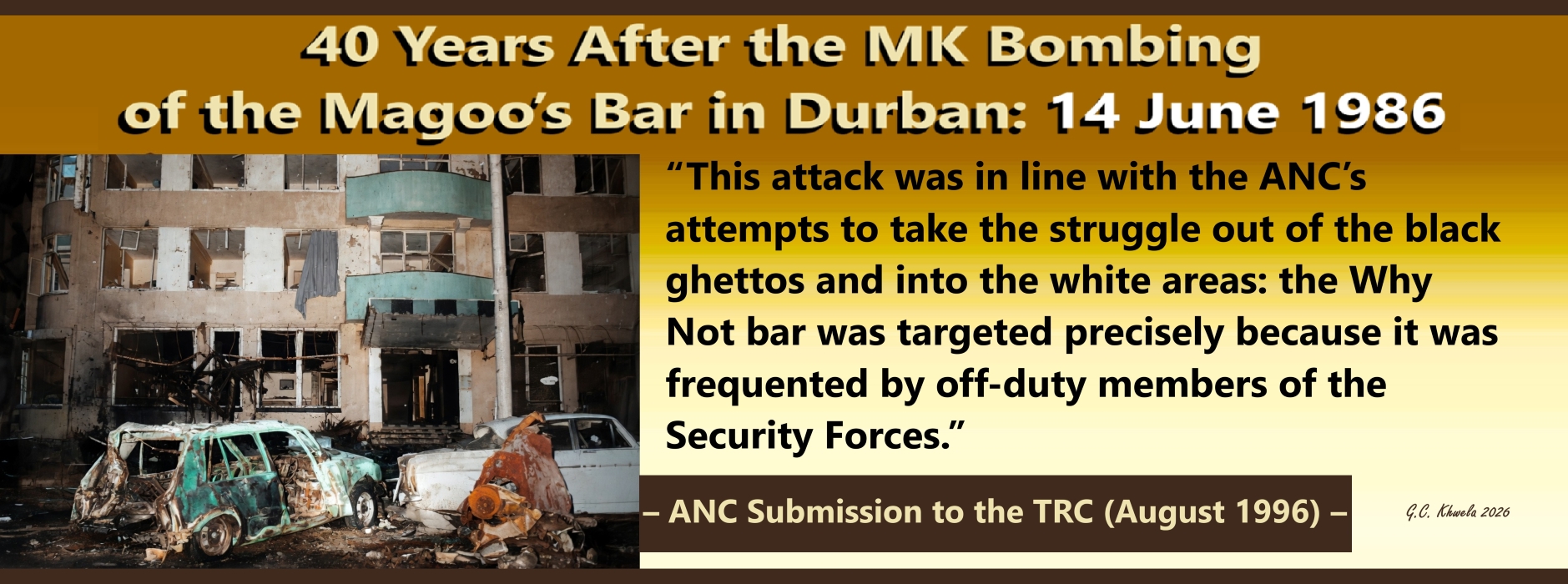
“It commemorated the anniversary of the June 14 1985 raid on Gaborone”, the Submission added, “on the eve of the Kabwe Conference, in which 12 people were killed, including two young women who were citizens of Botswana, a six-year old child from Lesotho, a Somalian citizen, and eight South Africans of whom only five were members of the ANC and none were MK combatants. This attack was in line with the ANC’s attempts to take the struggle out of the black ghettos and into the white areas: the Why Not bar was targeted precisely because it was frequented by off-duty members of the Security Forces.”
The operation was planned using a strict, decentralised, “need-to-know” compartmentalisation command structure managed out of Botswana by Aboobaker Ismail (aka “Rashid”), the overall commander of Umkhonto we Sizwe (MK) Special Operations Unit. The planning, supply chain, and tactical execution unfolded through several highly calculated steps. Ismail acted under a broad mandate from high-ranking ANC leadership, including President Oliver Tambo and MK Chief of Staff, Joe Slovo, to strike the apartheid war machine’s “soft underbelly”. Ismail explicitly ordered field commander Robert McBride to seek out a high-visibility target in white, urban areas, hence the apartheid SADF Natal Command base was identified. If operating at night, McBride was instructed to target a beachfront night spot heavily frequented by off-duty apartheid police or military personnel.
Logistics and ordnance personnel operated in isolation from the frontline actors. MK logistics officer, Ernest Lekoto Pule, supplied McBride with the required mass of military explosives while McBride was visiting Botswana. However, obeying the unit’s strict “need-to-know” security protocols, the logistics team was never told what specific target the explosives would be used against. Support networks, including operatives like Lester Dumakude, arranged safe houses across borders, such as in Botswana and Swaziland, and channelled funding to ensure the field cell remained mobile and undetected.
McBride returned to South Africa to scout locations along the Durban beachfront. Relying on intelligence passed to him by his Commander and fellow operative Gordon Webster, who claimed the Marine Parade beachfront establishments were “infested” with policemen, McBride selected the Why Not Bar, which was adjacent to Magoo’s Bar, and McBride briefed Ismail on the proposed target, assuring him that it held a heavy concentration of security personnel. Based entirely on this verbal brief from his field commander, Ismail formally authorised the bombing.
During testimonies at the Truth and Reconciliation Commission (TRC), it was revealed that the decentralised structure contributed heavily to the tragic outcome. Ismail admitted to the TRC Amnesty Committee that he sanctioned the operation without independently validating McBride’s local reconnaissance. The TRC concluded that the field cell’s surveillance was not that highly professional, as they failed to verify if any security personnel were actually inside the bar on that specific evening, resulting in an indiscriminate attack that killed three civilians instead of the intended military targets.
The Magoo’s Bar bombing fundamentally altered the landscape of the anti-apartheid struggle by polarising public opinion, triggering unprecedented state repression, and forcing the ANC to re-evaluate its armed operational strategies. The bombing served as a direct justification for the apartheid state to have declared a nationwide State of Emergency a few days earlier. This gave the police and military sweeping powers to detain activists, enforce strict curfews, and heavily censor the media.
However, for the oppressed black majority, the operation shattered the myth of white invulnerability. It proved that the armed wing, Umkhonto we Sizwe (MK), could successfully bypass state intelligence networks to strike deep within affluent, heavily guarded white urban strongholds. The African National Congress (ANC) justified the 1986 Magoo’s Bar (and “Why Not” Bar) car bombing by framing it as a legitimate attack on apartheid security forces that resulted in tragic civilian casualties due to faulty intelligence.
When facing condemnation from the international community over the three civilian deaths and 73 injuries, the ANC used several specific arguments to defend the operation. The ANC maintained that the primary target was the “Why Not” Bar, which was situated next to Magoo’s Bar. They argued that their intelligence indicated the venue was a known hangout for off-duty apartheid SADF and police personnel. In official submissions to the TRC, the ANC stated that the bomb was timed to target security personnel but went off prematurely. They classified the civilian deaths as a tragic mistake of war, resulting from “faulty intelligence” rather than an intentional attack on non-combatants.
The ANC’s armed wing, Umkhonto we Sizwe (MK), launched the operation to commemorate the 10th anniversary of the June 16, 1976 Soweto Uprising. It was also retaliation for a cross-border raid by apartheid South African forces into Gaborone, Botswana, the previous year, which had killed 12 people. The ANC argued that the operation was part of a necessary strategic shift to take the anti-apartheid struggle out of black townships and bring the reality of the conflict into white, middle-class areas. It explicitly rejected accusations of terrorism from international critics.
The ANC claimed they strictly avoided “soft” public targets like schools, churches or commercial aircraft and argued the justness of targeting a facility used by military personnel aligned with international definitions of a liberation movement fighting a “just war” against an oppressive state. The operative who executed the bombing, Robert McBride, and his Commander, Aboobaker Ismail, later apologized to the victims’ families for the unintended civilian loss of life. However, they stood firmly by the political justification of the operation as a targeted strike against the apartheid machinery.
“ATTACK, ADVANCE, GIVE THE ENEMY NO QUARTER!” – O. R. Tambo.
Sources:
Wikipedia.
O. R. Tambo, “‘Attack, Advance, Give the Enemy No Quarter!’, Message of the National Executive Committee of the African National Congress on the 74th Anniversary of the ANC, 8 January 1986”, Sechaba, March 1986.
African National Congress, “Statement to the Truth and Reconciliation Commission”, August 1996.
African National Congress, “Further Submissions and Responses by the African National Congress to Questions Raised by the Commission for Truth and Reconciliation”, 12 May 1997.
Truth and Reconciliation Commission, “Truth and Reconciliation Commission of South Africa Report Vol. 2”, Truth and Reconciliation Commission (TRC), 29 October 1998.
Truth and Reconciliation Commission, “Truth and Reconciliation Commission of South Africa Report Vol. 3”, Truth and Reconciliation Commission (TRC), 29 October 1998.
Truth and Reconciliation Commission, “Truth and Reconciliation Commission of South Africa Report Vol. 5”, Truth and Reconciliation Commission (TRC), 29 October 1998.
SAPA, “Magoos Bomb Meant for Security Personnel: TRC”, South African Press Association, 27 September 1999.
SAPA, “McBride Apologises to Family of Those Slain in Armed Struggle”, South African Press Association, 5 October 1999.
SAPA, “McBride Meets Blast Victims”, South African Press Association, 6 October 1999.
SAPA, “TRC told McBride Doesn’t Deserve Amnesty”, South African Press Association – Independent Online (IOL), 13 October 1999.
Truth and Reconciliation Commission, “Truth and Reconciliation Commission of South Africa Report Vol. 6”, Truth and Reconciliation Commission (TRC), 21 March 2003.
Jessica Bundage, “Magoo’s Bar Bombing”, South African History Online (SAHO), 17 December 2013.
Robyn Leslie and Debora Matthews, “McBride & the TRC: Secrets, Lies and Legacy of Deadly Bombing”, Daily Maverick, 25 June 2015.
Thula Simpson, “Umkhonto we Sizwe: The ANC’s Armed Struggle”, Penguin, 2016.
Bryan Rostron, “The Night McBride and Friends Blew Up Magoo’s Bar”, Mail & Guardian, 5 November 2019.
Yunus Carrim, “Attacking the Heart of Apartheid: The ANC’s MK Special Operations Unit”, Jacana, 2025.
Michael Schmidt, “The Magoo’s Bar Bombing in Durban 40 Years On”, Business Day, 9 June 2026.
Castro Khwela
Good evening fellow Compatriots!🙏🏾✊🏾👊🏾
Discover more from CASTRO KHWELA
Subscribe to get the latest posts sent to your email.