
What is the Meaning of a National Democratic Revolution – Part 3
The District Development Model as an Agent for Transformation
Having employed the District Development Model as a unit of analysis, a foundation would have been laid for the model to be used to address the issues of transformation that a post-apartheid state failed to deal with over the past 30 years. The five main areas of transformation which are economic empowerment, reindustrialisation and employment; land redistribution for mining, agriculture and housing; education, health and general welfare; technological advancement, sports, arts and culture; as well as safety and security, are currently national and provincial competencies, whereas they would be effectively executed at a district level given the vivid results that would emerge from their evaluation as units of analysis.
In its 1962 Programme for the South African Revolution, titled “The Road to South African Freedom”, the South African Communist Party (SACP) declared “that the revolutionary people of South Africa cannot merely take over existing State and government institutions designed to maintain colonialism, but must destroy them and create new people’s institutions in their place. … New territorial administrative regions should be established enjoying full powers of local government (District Municipalities) corresponding to the progressive traditions and the wishes of the people of each area, but conforming to the overall character and laws of the people’s democratic state” (Own emphasis in Brackets).
For example, it would be easier for district municipalities to determine the economic potential of its own area, its current and previous production output, and the number of the unemployed (including their skills and qualifications) in the various wards, would be effortlessly identified. Furthermore, the demarcation of land that is earmarked for mining and agriculture, as well as land that is lying fallow, could be readily accomplished. This will then assist in determining how it can be redistributed for development and housing, particularly for those who need housing – who could be unmistakably acknowledged – including the number of units that could be built at regular periods.
A district health system would be the best to manage, especially in terms of determining the effects of the various epidemics and health risks and the means to mitigate them, as well as the practitioners to population ratio; and ultimately the skills that society is lacking would be lucidly elucidated from a district rather than from a national or provincial level, thus also providing an appropriate platform for intervention in terms of the quantity and quality of institutions, including goods and services required to meet the demands of the market. A similar approach could be followed with regard to education, as well as safety and security. There is actually no justifiable reason to keep these competencies at a national or provincial level, except for the former to dictate or prescribe the standards for national regulation.
Within the current dispensation, the spheres of safety and security are largely national and provincial competencies, although the metropolitan councils have a limited mandate accorded to their metropolitan police services. However, district councils do not have such a capacity, which could make a huge impact on combating crime, traffic offences, illegal immigration and illicit businesses. Furthermore, such a capacity could be a force multiplier to security services, particularly in enhancing the capacity of the national and metropolitan police services.
The SACP maintained that “In order to preserve and extend the gains of the revolution, particularly in the conditions of South Africa, the utmost vigilance must be exercised against those who would seek to organise counter-revolutionary plots, intrigues and sabotage, against all attempts to restore White colonialism and destroy democracy. While extending the greatest measure of democracy to the people, and ensuring their fullest participation in the public life of the country, a vigorous and vigilant dictatorship must be maintained by the people against the former dominating and exploiting classes.” This is difficult to undertake at a national or provincial level. However, it could be easily managed under the conditions of a district municipality, where every citizen and their activities will be known.
Making the people determine their own future is at the core of the concept of a national democratic society, as envisaged in the Freedom Charter. It conforms to the clause that “The People Shall Govern”, that “all people shall be entitled to take part in the administration of the country; the rights of the people shall be the same, regardless of race, colour or sex; all bodies of minority rule, advisory boards, councils and authorities shall be replaced by democratic organs of self-government.” Instead of political parties and other entities determining how the state is managed and administered, within the auspices of the District Development Model, the people would have a greater say in the administration of the country at their own place of residence or work.
For its success, the Model should be guided by tenets of greater participation, empowerment, transformation, empathy, consultation and accountability (PETECA), which are in line with the “ubuntu-botho” as well as “batho pele” principles. These are African principles that imply “humanity to others”, which are core values in South African culture that emphasise the importance of community and compassion, as well initiatives aiming at improving public service delivery. At the core of all these values is an emphasis on “the centrality of the people”, which will entail a neutralisation of a centralised state and governance, but most importantly negating the redundant concept of provincial federalism, which was one of the unnecessary products of a negotiated settlement.
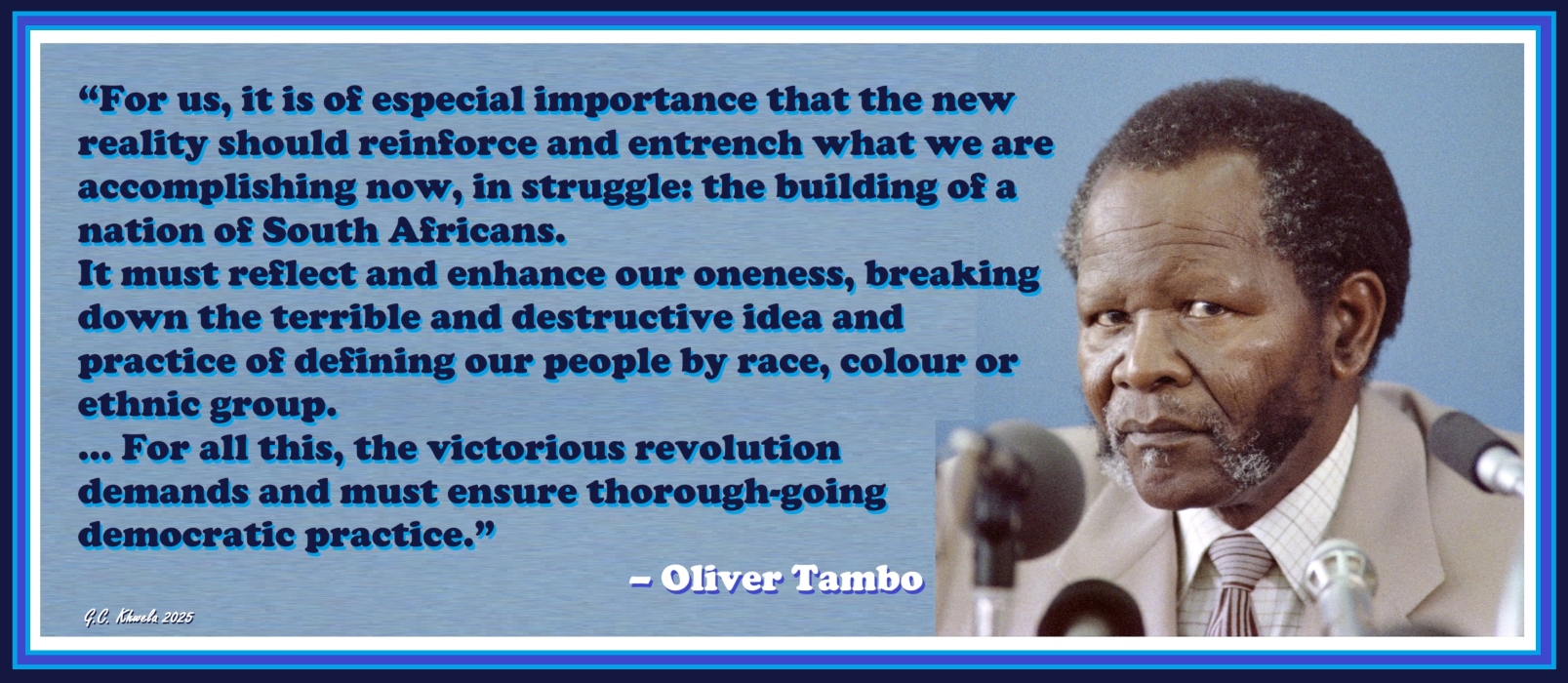
The hybrid model of the state as we have now, with a highly centralised national level and a superfluous provincial federal government has for the past thirty years not yielded the desired results for the advancement of the South African people. Rather it has created avenues for corruption and maladministration to fester, establishing fiefdoms for political parties to pursue parochial agendas, and thus safeguarding uneven socio-economic development, instead of ensuring a holistic nation-building project. It has made the current dispensation to fail to address the acute contradictions that made South Africa to be characterised as a “colonialism of a special type”. This takes us back to 1987, to what the then President of the African National Congress (ANC), Oliver Tambo, emphasised, when he asserted that:
“For us, it is of especial importance that the new reality should reinforce and entrench what we are accomplishing now, in struggle: the building of a nation of South Africans. It must reflect and enhance our oneness, breaking down the terrible and destructive idea and practice of defining our people by race, colour or ethnic group. … For all this, the victorious revolution demands and must ensure thorough-going democratic practice.” (To be continued)
Sources:
SACP, “The Road to South African Freedom: Programme of the South African Communist Party”, The African Communist, Vol. 2 No. 2, January–March 1963.
Oliver Tambo, “Advance to People’s Power: January 8th, 1987 Message from the National Executive Committee of the African National Congress”, Sechaba, February 1987.
Castro Khwela
Good day fellow Compatriots!
Discover more from CASTRO KHWELA
Subscribe to get the latest posts sent to your email.


I cannot agree more this is a well thought input i wish we can escalate the debate to the yet to unfold platform of national dialogue as well as white paper for local government.