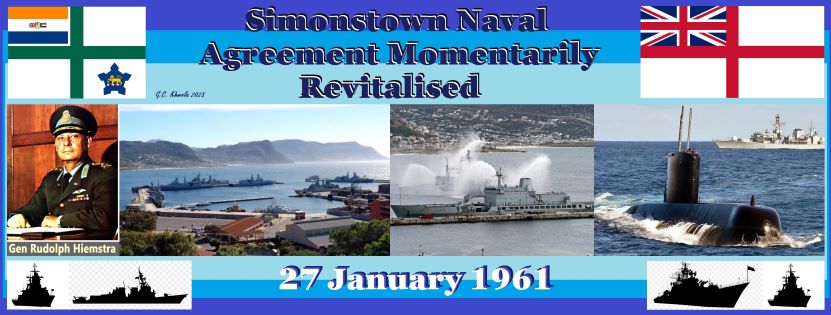
On 27 January 1961, the Chief of the apartheid South African Defence Force (SADF), Commandant General Rudolph Hiemstra, announced the successful conclusion of Anglo-South African talks on aspects of the Simonstown Naval Agreement for the defence of sea routes around Southern Africa. The Simonstown Agreement dated back to 1955 when it was signed by apartheid South Africa and Great Britain. In terms of this agreement, the South African Navy was expanded and the Simonstown base and Naval Dockyard were handed over to South Africa on 1 April 1957.
The agreement also permitted the SA Navy to buy six new Type 12 (modified Rothesay Class) anti-submarine frigates, ten Ton Class coastal minesweepers and five Ford Class seaward defence boats from the United Kingdom (UK) valued at £18 million over the following eight years. Accordingly, the Simonstown Agreement initiated an era of unprecedented expansion and modernisation of the South African Navy between 1955 and 1963, resulting in the development of a small but highly professional, efficient and well-equipped navy.
Under the agreement, the UK Royal Navy (RN) gave up its naval base at Simonstown and transferred command of the South African Navy (SAN) to the apartheid government. In return, South Africa promised the use of the Simonstown base to Royal Navy ships. In effect, the agreement was a mutual defence arrangement aimed at protecting sea routes between the UK and the Middle East.
From a financial perspective, while Britain retained full access to Simonstown, the agreement imposed considerable obligations on the South Africans and absolved Britain from the costly upkeep and modernisation of the base and other maritime facilities at the Cape, including access to strategic naval communications and fuel stocks.
Finally, from an economic perspective, the Agreement greatly benefited the British industry with significant South African orders for warships, helicopters and maritime patrol and strike aircraft. However, the agreement became controversial because of South Africa’s policy of apartheid.
In the early 1960s, as the Nationalist Party’s racial policies began to create increasing ill-will abroad, apartheid South Africa was subjected to a process of increasing isolation from the international community. Despite South Africa’s departure from the Commonwealth in 1961 and increasing international pressure, the British government maintained defence links with the apartheid government.
Britain continued to supply arms to South Africa in terms of the Simonstown Agreement and the 1955 exchanges were re-affirmed in a further informal exchange of letters between the British and South African Defence Ministers in 1961 – 1962. Ultimately, following the election of a Labour government, led by Harold Wilson, in the United Kingdom in October 1964, Britain refused to supply further arms to South Africa.
Whilst this ban included any new orders for maritime aircraft and naval vessels and equipment, the British government was still prepared to honour existing contracts and to provide spares and ammunition within the terms of the Agreement. This concession was later extended to include licences for the sale of additional Wasp helicopters in 1966 to replace aircraft written off during normal operations. At that stage, all South African naval vessels were of British design and construction.
For reasons of compatibility and logistics, and because of the close traditional links with the Royal Navy, South Africa wished to place orders for submarines and replacements for the Loch class and Type 15 frigates in the United Kingdom. However, the Labour government was not prepared to approve the construction of any additional vessels for the South African Navy.
As a result, apartheid South Africa, which would have preferred to acquire Oberon class submarines from the United Kingdom, turned to France for the provision of three Daphne class submarines. France continued to sell some weapons to the racist regime, but pressure was mounting for most countries to comply with the voluntary United Nations 1963 Arms Embargo, which became mandatory in 1977. This led to desperation within the apartheid defence establishment, which turned to Israel, as the only country that was willing to help in selling anything and everything to Pretoria.
Castro Khwela
Good day fellow Compatriots!
Discover more from CASTRO KHWELA
Subscribe to get the latest posts sent to your email.