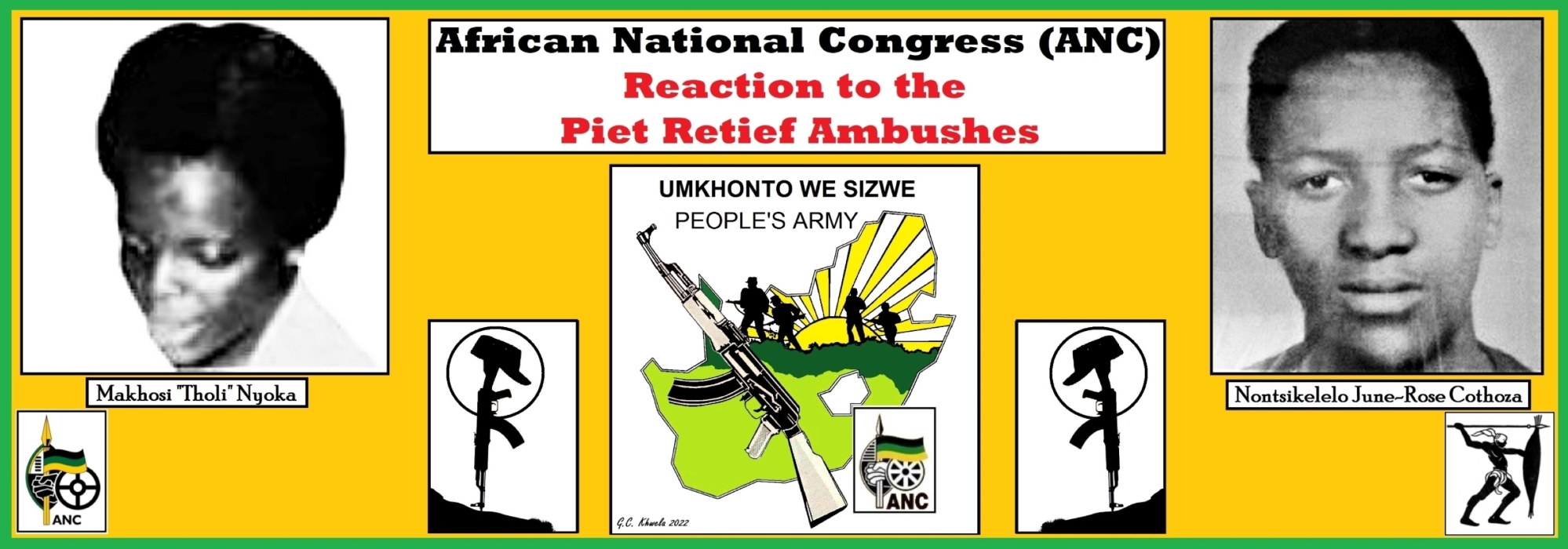
African National Congress Reaction to the 1988 Piet Retief Ambushes
On 15 June 1988, following the June 8 and 12 Piet Retief ambushes, the African National Congress (ANC) launched an investigation into those in the Umkhonto we Sizwe (MK) Natal Machinery responsible for armed infiltrations, as apartheid Colonel Eugene de Kock had suspected. This affected the greater part of the Natal Machinery, and in the process the entire Command was withdrawn to Lusaka.
Towards the end of June, Umkhonto we Sizwe Military Intelligence Operatives, and also the Natal Machinery Team responsible for the infiltration of cadres, were summoned to ANC President Oliver Tambo’s office in Lusaka, with Tambo expressing unhappiness with the timing of the missions. Tambo was saying that from 15 May onwards, it would have been too risky to have cadres entering the country because the South African security forces would be on high alert with the June 16 anniversary on the way.
The source that provided Flip Theron with the information that led to the two ambushes was arrested by the ANC in Swaziland approximately two weeks after 12 June and was sent back to Lusaka for questioning. Actually, the MK member who was detained on 23 June 1988 in Manzini, Swaziland, by ANC security after the killing of a number of MK operatives was identified as Lita Nombango Mazibuko (aka “Mumsy Khuzwayo”). She was initially held in Mozambique and then in Zambia for over a year. During her incarceration, she was subjected to repeated severe ill-treatment and torture, including a staged execution. She was later transferred to a prison in Tanzania where she was held until December 1992 when she returned to South Africa.
In their Amnesty Applications to the Truth and Reconciliation Commission, the Piet Retief Security Branch, in particular her handler, Flip Coenraad Theron, testified that Ms Lita Mazibuko was responsible for the transport arrangements of the two groups of MK personnel in June 1988. The Piet Retief Security Branch provided transport and drivers when both groups were ambushed and killed on 8 and 12 June 1988, after which Mazibuko was paid for her services. Her handler, Flip Theron, further testified that, on her return to South Africa in 1992, she reported to him and was paid a further sum for her involvement.
On 26 July 1988, Edward Lawrence (aka “Raymond Mgcina”, “Leonard” or “Comrade Fear”) appeared before the ANC panel of inquest and was asked to talk about his “wife”, Jessica. According to Lawrence, she was the first enemy agent and he was sure of that fact. He was asked how many times she went to South Africa and for what purposes. Lawrence responded by saying he was never in a position to monitor her movements, as she went to South Africa frequently, about four to five times, as far as he knew and she never wanted to reveal the purposes behind her visits. Jessica also refused to submit her Lesotho passport when she was asked to do so, because it reflected her trips to South Africa and could have led to her being questioned and discovered to be an enemy agent.
Unfortunately, Lawrence did not give much on the subject, as he complained of stomach pains when he was awoken the following morning, saying he wanted to vomit. When a doctor was called to examine him, he certified Lawrence dead as a result of poisoning. Under interrogation, Lawrence admitted to having been recruited by the security police and his wife, Jessica, was also detained for espionage, despite the fact that she was a member of the South African Communist Party (SACP). She had been the only black woman to attend the 1984 SACP Conference, shortly after graduating from the Lenin school, in Moscow. Jessica was detained in Angola and was later transferred to Uganda until 1992.
In August 1988, Thami Zulu (real name Muziwakhe Ngwenya), who was the Commander of the Natal Machinery, was brought in for questioning by the ANC Security Department, as part of what had become a general inquiry into the Natal Command as a whole, not just those directly involved with infiltrations. Believing that there was confirmation that Edward Lawrence and his wife were spies, the interrogators focused their questions on whether Thami Zulu was a third person working for the apartheid South African security forces. Under Thami Zulu, the Natal Machinery continued to suffer one disaster after another, losing dozens of operatives.
One MK cadre working in Natal, Sithabiso Mahlobo, travelled to Swaziland to report to his superior officers. On returning to his post in Natal, he was arrested by the apartheid security police. They casually showed him a copy of the report he had just submitted in Swaziland, demonstrating just how well connected they were. Mahlobo was subsequently sentenced to 20 years in Robben Island.
Nevertheless, it was not proven that Thami Zulu worked for the apartheid security forces. Based on the apartheid security services reports, the placing of agents at high levels remained one of the prime objectives of the enemy and this program was conducted from the highest levels, for example, Edward Lawrence was handled by apartheid Security Branch Major Stadler of HQ GROUP: BJ42. Two months after Zulu had been confined, the commission of inquiry that was appointed to investigate the Piet Retief ambushes reported that although it had found no conclusive proof that he had been collaborating with the enemy.
According to the special commission, there were “some matters in relation to which he had been unable to give convincing answers” but these could only be cleared up by obtaining information from the Swaziland Special Branch – which they regarded as an impossible task at the time. It was then recommended that Zulu be disciplined for criminal neglect in the case of the June 1988 deaths of nine cadres under his command, who had been ambushed and shot dead by police soon after crossing the Swaziland border near Piet Retief.
The commission’s report noted that despite many improvements, some of the critically important measures introduced after the Kabwe Conference were not functioning as well as it had been hoped: “while considerable progress has been made, the Code has not been fully implemented and the situation of legality inside the ANC falls short of what the Conference called for”. Furthermore, the report noted that there were no regulations to govern periods of investigation. In terms of the report, “witnesses from Security themselves asked for a clear set of norms governing detention, since they feel torn between the conflicting objectives of not giving up their investigations until irrefutable proofs or disproofs existed and not prolonging their inquires in an undue manner”.
Responding to these atrocities by the apartheid regime, ANC President Oliver Tambo maintained that “To our demands for one person one vote in a unitary state and the sharing of the wealth in our country, the oppressor replies with military rule, vigilantes and state terrorism. To all this… we have no alternative but to unite in action and to mount an all-sided concerted offensive against the apartheid system” (Luli Callinicos).
Sources:
South African History Archives (SAHA).
African National Congress, “Further Submissions and Responses by the African National Congress to Questions Raised by the Commission for Truth and Reconciliation”, 12 May 1997.
Truth and Reconciliation Commission, “Lita Nombango Mazibuko”, Truth and Reconciliation Commission: Women’s Hearings, 29 July 1997.
Truth and Reconciliation Commission, “Truth and Reconciliation Commission of South Africa Report”, Vol. 2, 29 October 1998.
Truth and Reconciliation Commission, “Truth and Reconciliation Commission of South Africa Report”, Vol. 6, 21 March 2003.
Truth and Reconciliation Commission, “Truth and Reconciliation Commission of South Africa Report: Victim Findings”, Vol. 7, August 2002.
Thula Simpson, “Umkhonto we Sizwe: The ANC’s Armed Struggle”, Penguin, 2016.
Stephen Ellis, “External Mission: The ANC in Exile”, Jonathan Ball, 2012.
Luli Callinicos, “Oliver Tambo: Beyond the Engeli Mountains”, David Philip, 2017.
Castro Khwela
Good day fellow Compatriots!
Discover more from CASTRO KHWELA
Subscribe to get the latest posts sent to your email.