ANC Leaders and SA Business Meet in Kaunda’s Game Lodge
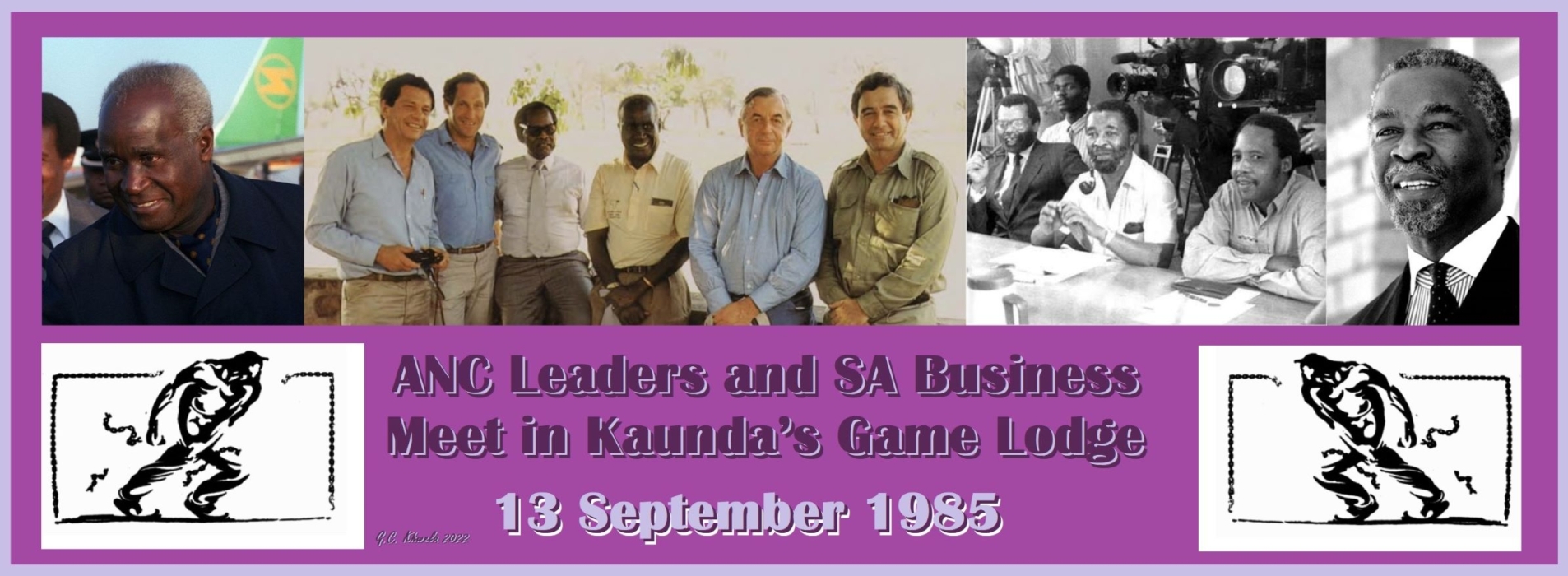
On 13 September 1985, African National Congress (ANC) President Oliver Tambo and his entourage consisting of Pallo Jordan, Mac Maharaj, Chris Hani, Thabo Mbeki and James Stuart met moguls of South African business and media at Zambian President Kenneth Kaunda’s private game lodge in the Luangwa National Park, Mfuwe, Zambia.
South African business and media was represented by Gavin Relly and Zach de Beer of Anglo American, Tony Bloom of Premier Group Holdings, Tertius Myburgh (Editor of the “Sunday Times” newspaper), Harold Pakendorf (Editor of “Die Vaderland” newspaper), J. de L. Peter Sordor (Director of the South African Foundation) and Hugh Murray (Editor of “Leadership South Africa” bulletin).
The primary aim of the discussions was around negotiations, however in the ANC summary of the meeting was that the ANC’s stance then on the matter, as expressed at the Mfuwe meeting, was that “we have not reached the stage where we can even talk about talks. The Botha regime has to take concrete steps in order to create the atmosphere where even talk about talks can be entertained.”
According to the ANC, the concrete steps included the release of Nelson Mandela and all political prisoners, lifting the state of emergency, releasing all detainees, halting political trials, removing police and troops from black townships and ‘ghettoes’, lifting the ban on the ANC, and removing laws that would prevent the movement from organising the masses freely. Nevertheless, the ANC did not view these engagements as futile, as they were a clear indication that most South Africans were looking for a negotiated solution to the crisis facing the apartheid state.
Before this meeting with South African business, there were already some discreet engagements on a one-on-one basis, such as the one held by Thabo Mbeki with Professor HV “Harvey” van der Merwe, a conflict resolution expert based at the University of Cape Town. The engagement was held in October 1984, which confirmed to Mbeki that many senior leaders in the apartheid government wanted a negotiated settlement but were unable to say that in public.
The other engagement Mbeki had was with Piet Müller, the Deputy Editor of the “Beeld” newspaper, which was a mouthpiece of the National Party. Mbeki managed to manipulate the possibilities for such an engagement on the basis that as Head of the ANC Department of Information and Publicity, he could be interviewed by any media house. However, this provided him with access to a direct channel into the core of the Afrikaner fortifications.
The interview, which occurred in December 1984, made it clear to the apartheid government that the ANC was not opposed to negotiations, even if these were to be conducted covertly, they would ensure that those leaders who were prepared to negotiate were not subdued by militants within the Movement due to avoidable postponements. Nevertheless, there was unequivocal hostility within the ranks of the ANC leadership when Mbeki reported back on these engagements, as the apartheid regime was viewed as being intransigent and unable to be transformed.
The breakthrough only came in April 1985, when Thabo Mbeki met Hugh Murray, the publisher of an exclusive journal, “Leadership”, at the Pamodzi Hotel in Lusaka. It was Murray’s plan to bring the delegation of South African businessmen led by Gavin Relly to Lusaka to meet with the ANC, which Mbeki enthusiastically conveyed to a sceptical Tambo, particularly when one of their conditions was that Joe Slovo, the then Chairperson of the South African Communist Party (SACP), should not be part of the meeting. Tambo’s scepticism was mainly driven by the fact that he was pushing for the strengthening of international economic pressure on the apartheid regime to accelerate transformation, and so avoid further bloodshed.
Nevertheless, with the drive for the ANC to be seen to be willing to compromise, ultimately, with the support of President Kenneth Kaunda, who was excited to host the meeting, he managed to persuade Tambo with the proviso that Chris Hani was to replace Slovo and also represent Umkhonto we Sizwe’s (MK’s) perspective in the meeting. Actually, Kaunda had proposed an informal meeting between corporate businessmen and the ANC because since Zambia’s independence, he had become friendly with investors in the Zambian copper mines. One of these businessmen was a director of Anglo American, Gavin Relly, who had been stationed in Zambia in the early years of independence.
By 1985, financial sanctions were beginning to bite and the South African Foundation, which was led by Relly and other businessmen, began to call for tangible reforms. Apartheid President P.W. Botha had assured them that reforms were on the way, but his strategy of co-opting so-called Coloured and Indian communities in a ‘tricameral’ parliamentary system served only to anger the excluded majority and the limited minorities even further. For instance, the bombing of the Anglo American and Anglo Vaal buildings after the dismissal of a substantial number of workers in May 1985, clearly demonstrated the armed struggle’s active support for opposition organisations and for the labour movement.
Following Kaunda’s cue, Relly solicited support for talking to the ANC to a number of businessmen, including Afrikaner entrepreneurs such as Anton Rupert of Rembrandt and Fred du Plessis of Sanlam, as well as directors Tony Bloom of Premier Milling, Chris Ball of Barclays Bank and Mike Rosholt of Barlow Rand, who showed interest. However, the plan was leaked, and Botha made it clear that he was opposed to the initiative, prompting Anton Rupert and Fred Du Plessis to withdraw. Botha attacked Relly ferociously for disloyalty and to forbid planned follow-up trips by student and church groups. Nevertheless, newspaper editors and publishers, such as Harold Pakendorf, Tertius Myburgh and Hugh Murray, defied the odds, with the support of former Progressive Federal Party (PFP) leader Zach de Beer, who joined the team to meet with the ANC.
The meeting finally took place on 13 September 1985, as the two parties sat down around a table at Kaunda’s game lodge, to a formal reception by their host. President Kaunda presented the purpose of the meeting as an intention to ascertain just how much the two groups had in common, as opposed to focusing on the issues that divided them. During the discussions, Tambo pointed out the under-utilised power of business to intervene in the South African political scenario. According to Tambo, “The government will not defy the views of business if business is insistent”. However, they had to accept the unfortunate fact that “the ANC will have to escalate the struggle, and hundreds will probably have to die before the international community takes notice”.
Nevertheless, the engagement went very well, as everyone thoroughly enjoyed the exchange. For Gavin Relly, “It was one of the nicest days I’ve ever spent, a picnic among South Africans talking about their future together.” The impression that the ANC’s brand of Marxism was no more radical than a Swedish form of social democracy, had a lasting impression on Tony Bloom came away with. Ultimately, the business delegation, and Relly in particular, concluded that the meeting had the effect of “demystifying and de-demonising the ANC”. In fact, business leaders discovered that the ANC leaders were not the “wild-eyed terrorists” as described by the apartheid media.
Sources:
Wikipedia.
South African History Online (SAHO).
Sheila Rule, “Business Leaders in Pretoria Urge End to Apartheid”, The New York Times, 30 September 1985.
Blaine Harden, “S. African Businessmen Meet with Exiled Guerrilla Leaders”, The Washington Post, 13 September 1985.
Times Wire Services, “South African Businessmen, Guerrillas Meet”, The Los Angeles Times, 14 September 1985.
We The People of South Africa, “The Story Behind The ‘Safaris’ to Meet the ANC-In-Exile, 1985 – 1989”, The Constitution Hill Trust, 1989.
Michael Savage, “Trekking Outward: A Chronology of Meetings Between South Africans and the ANC in Exile 1983–2000”, Book Review, University of Cape Town, May 2014
Barry Shapiro, “Building Trust and Playing Hardball: Contrasting Negotiating Styles in South Africa’s Transition to Democracy”, African Journal on Conflict Resolution – ACCORD, 29 October 2012.
Itumeleng Makgetla and Ian Shapiro, “Business and the South African Transition”, Yale University (Unpublished Script), 20 February 2016.
Luli Callinicos, “Oliver Tambo: Beyond the Engeli Mountains”, David Philip, 2004.
Mark Gevisser, “Thabo Mbeki: A Dream Deferred”, Jonathan Ball, 2007.
Janet Smith and Beauregard Tromp, “Hani: A Life Too Short”, Jonathan Ball, 2009.
Stephen Ellis, “External Mission: The ANC in Exile, 1960 to 1990”, Jacana, 2012.
Hugh McMillan, “The Lusaka Years: The ANC in Exile in Zambia, 1963 to 1994”, Jacana, 2013.
Niël Barnard, “Secret Revolution: Memoirs of a Spy Boss”, Tafelberg, 2015.
Thula Simpson, “Umkhonto we Sizwe: The ANC’s Armed Struggle”, Penguin, 2016.
Castro Khwela
Good day fellow Compatriots!
Discover more from CASTRO KHWELA
Subscribe to get the latest posts sent to your email.