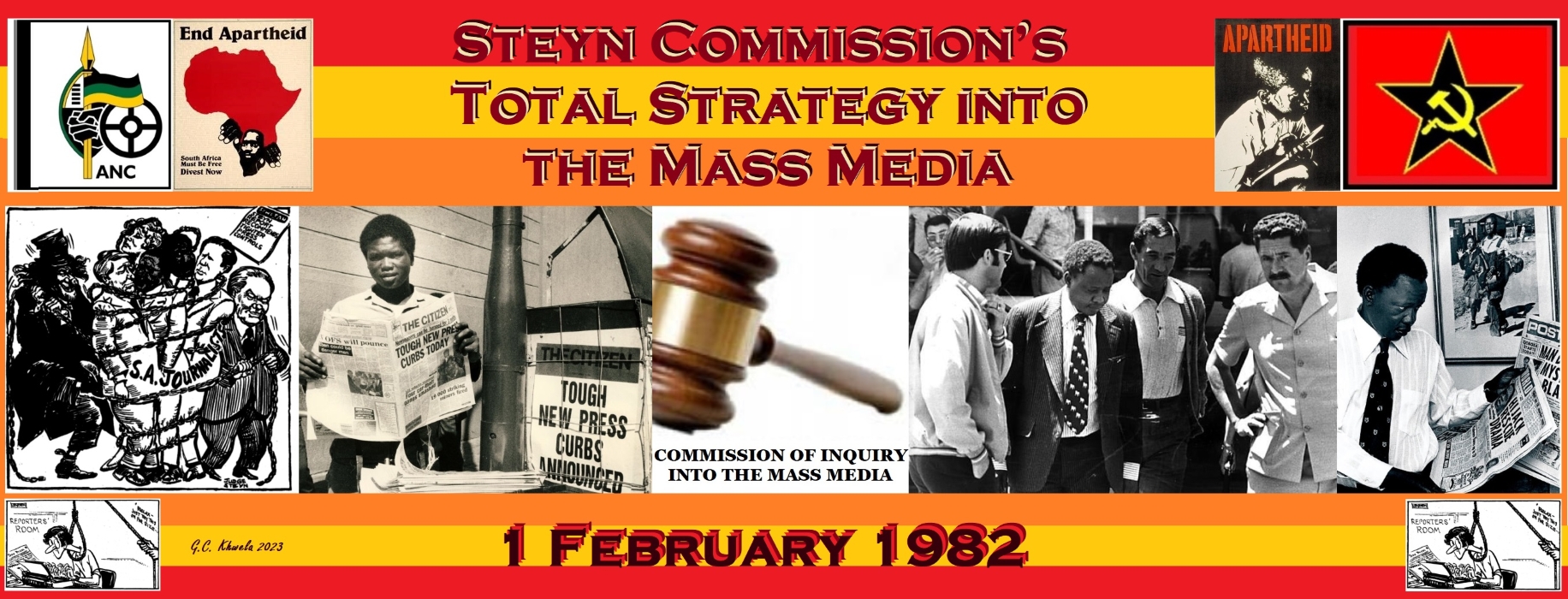
On 1 February 1982, the official Commission of Inquiry into the mass media, appointed in June 1980, under the chairmanship of Justice M. Steyn, tabled its report. The “Steyn Commission” recommended that a general Press Council of journalists should be established by law to regulate entry into the profession and sit in judgement on journalists accused of violating a constitutional code of conduct. The report’s findings and recommendations were widely criticised.
Underlying the continuing controversy over the Press Council was one persistent policy of the National Party: to bend the English press to its will, to find a way to make it conform to the concerns and the world view of the ruling Afrikaners and their apartheid policy. Nationalist Prime Ministers from Malan to Vorster had sought to control the annoying opposition newspapers into being “responsible”.
In his report on the media, Judge MT Steyn found that apartheid South Africa was the subject of a “total onslaught” led by an alliance between the African National Congress (ANC) and the South African Communist Party (SACP) and the media had played an important role, whether directly or indirectly, in the promotion of this campaign against the “legitimate” institutions of the apartheid state. In his conclusions Steyn recommended major legislation to curb the media and thus defend the “legitimate” interests of the apartheid state.
In the early 1980s, already the media was subjected to a number of restrictive barriers through enacted legislative restrictions, which made the task of the editors to be tedious, and these were described at the time as “walking blindfold through a legislative minefield”. This was stressed by then Prime Minister, P.W. Botha, who emphatically said, “I appeal to newspaper editors to draw up a policy for their newspapers which will prevent radical and revolutionary elements getting the headlines … If the editors do not do this, then the government will see that it is done” (The African Communist, No. 89, 2nd Quarter, 1982). By 1985 the effect of the Steyn report was finally felt as the government reinforced its legal stranglehold with a range of Emergency regulations that emaciated the freedom of the press.
In its response, the ANC described the Steyn Commission Report as being far more than the press, as the first-ever comprehensive exposition of the “total onslaught” philosophy that had become the all-encompassing justification for any action that the racist regime cared to take. The ANC quoted the then Chief of the apartheid Defence Force, General Magnus Malan, when he defined total strategy as a “national reorientation aimed at survival”. According the to the ANC’s analysis, the report was aimed at legitimising the racist apartheid government’s attempt at forcing journalists to reflect the ever diminishing picture of South African reality. By omission, the intention was not only to falsify reality, but to “reassure” the public, rather pressuring them to face the challenges of the time, the conflicts and demands that were confronting the apartheid regime (Sechaba, July 1982).
In the Report a Press Council was recommended to “discipline newspapers”, as well as a register of journalists which was to ensure that only registered journalists were to be allowed to work for newspapers or to send reports overseas. The commission complained about reports sent overseas about South Africa’s racial and political situation, which were said to be “very bad”, “bad” or “faulty” in favour of Blacks and biased against the Afrikaners. The South African Press Association, which was the main source of news for Reuters international news agency was blamed for this slanted reporting.
Two Steyn commissions were established, the first in February 1980 to investigate the reporting of defence and police matters in the press, the purpose being to find a means of moulding newspapers to the needs of the security forces. Accordingly, it was constituted by Generals and Colonels from the apartheid South African Defence Force (SADF). The second Commission, headed by the same Justice M. Steyn, was established in June 1980, with the mandate to decide how much South Africans were to know about what was happening in the country. “The Steyn Commission was actually awarding the racist government some form of permanent state of emergency powers” (Sechaba, July 1982).
As a response to these measures, The African Communist (No. 89, 2nd Quarter, 1982) concluded that “the censorship of the legal press places a great responsibility on the liberation movement. The ANC and SACP must expand their underground propaganda work, providing news and views which are vital for the mobilisation of the people in the struggle against the racist regime. In time our underground publications will provide the basis for a truly free people’s press when South Africa is finally liberated.”
Castro Khwela
Good evening fellow Compatriots!
Discover more from CASTRO KHWELA
Subscribe to get the latest posts sent to your email.